From the outside, investment real estate can feel overwhelming. While you may not be dissuaded by the substantial amounts of money floating around at all times, the daunting list of acronyms, initialisms, and abbreviations might keep you up at night.
When investing in multifamily real estate, you will undoubtedly consume esoteric jargon, whether you are a skilled practitioner, new to underwriting, an accredited investor, or an aspiring agent. The following is a partial list of valuable key terms waiting to fill the gap in your investment education and be added to your real estate glossary.
ACQUISITION
Acquisition is a term used to describe how one comes to own or control a real estate asset or an interest in it. Simply put, purchasing property is an acquisition.
BRIDGE LOAN
A bridge loan describes money lent temporarily while the borrower secures more stable financing. It fundamentally acts as a bridge between short-term and permanent financing. Bridge loans can also remove existing obligations, such as settling a high-interest-rate loan in exchange for newer debt with updated terms. However, it is essential to know that bridge loans typically carry higher interest rates due to the brevity of the loan term. In other words, since the duration of the loan can be brief, lenders profit from interest rate payments to mitigate borrowers who pay the loan off quickly. [1]
COLLECTIONS
In multifamily investment real estate, collections represent a percentage-based measurement of rent owed versus what is collected. So, if a multifamily owner/operator (sponsor) is owed $2000 from its residents but only receives $400, that is a collection percentage of 20%. The goal is to achieve 100% collections. [2]
DEBT SERVICE COVERAGE RATIO
The Debt Service Coverage Ratio (DSCR) compares the income and cost of debt. For example, if your property produces $1250 in net operating income (NOI), and your debt service is $1000, your DSCR is 1.25. Lenders (typically banks) want to ensure the asset (property) has the cash flow to support its debt service. A ratio of 1.25 is an industry-wide minimum. [2]
EVERGREEN
Evergreen is a label for investment vehicles (funds and products) that generate returns in perpetuity. An evergreen fund has no end date or hold period, meaning firms can continue accumulating capital while investors receive periodical distributions.
FAIR MARKET VALUE (FMV)
Fair market value (FMV) is a legal term referring to the price a property would sell for on the open market. It can be calculated by reviewing comps (neighborhood comparisons or market comparables) within the property’s community. Appraisers are typically hired to determine the FMV using location, age, renovations/maintenance, and size.
GROSS POTENTIAL RENT/REVENUE (GPR)
Gross potential rent (GPR) is a metric to determine the maximum rental income a property can generate. A property’s gross potential revenue (also GPR) is calculated by totaling the market rent for each unit in that property. Remember that gross potential revenue determinations do not account for market volatility, weather, or other disruptors. The gross potential rent must be calculated and applied during a specific time. In other words, the gross potential rent of a multifamily investment property in Iowa in 2024 will not reflect the gross potential rent of that same property in 2026.
HOLD(ING) PERIOD
A real estate transaction’s hold period is the period during which an owner/operator (sponsor) owns or “holds” a property before selling it.
INTERNAL RATE OF RETURN (IRR)
The internal rate of return (IRR) is the discount rate that makes a project’s net present value (NPV) zero. It includes cash flow during the holding period and is calculated to determine the potential rate of return. Said another way, it is your return of equity and return on equity with a time value of money (TVM) component. So, a dollar today is worth more than five years from now. [2]
JUNIOR DEBT
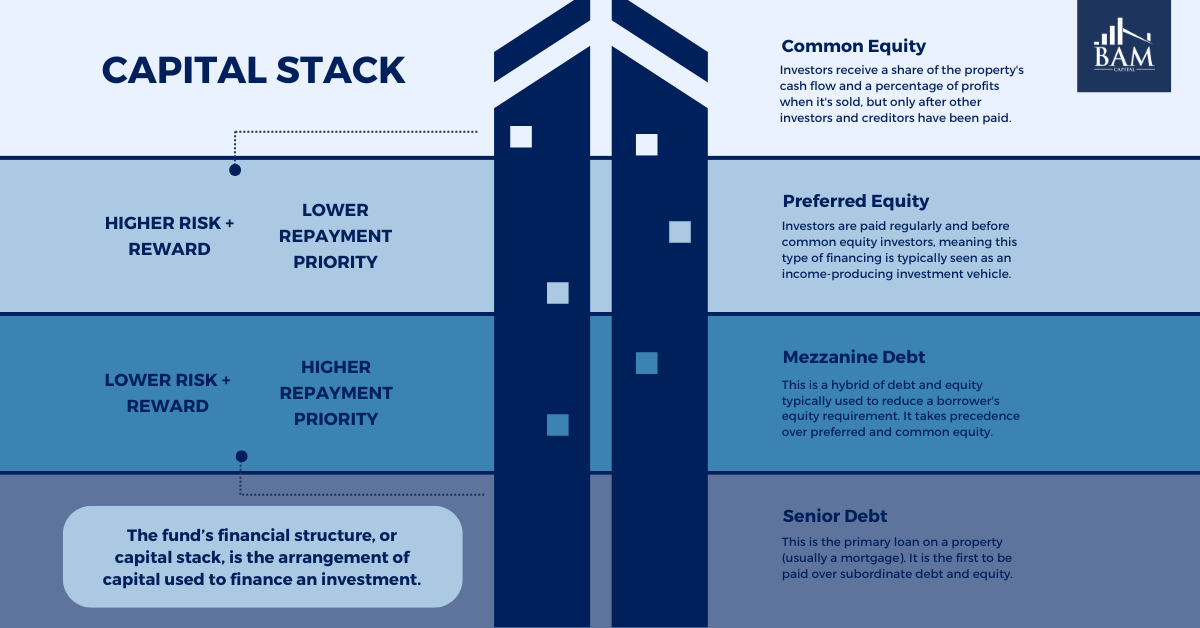
Junior debt represents a subordinate debt in the capital stack with a lower repayment priority. If senior debt is the primary loan on a property (usually in the form of a mortgage) and is the first to be paid over subordinate debt and equity, junior debt is next to be paid before equity and is typically not backed by any collateral.
KEY PERFORMANCE INDICATOR
Key performance indicators (KPIs) gauge the performance of a real estate fund or product. Some of the terms you learned above, such as debt service coverage ratio (DSCR) and internal rate of return (IRR), factor into KPIs to determine profitability. Among DSCR and IRR, several other indicators are considered: cap rate, occupancy rate, cash-on-cash return, etc.
LEASE TRADE-OUT
A lease trade-out measures the financial performance of rental units per lease. It is quantified on a percentage base or a dollar change amount. For example, if a resident vacates the property, an owner/operator will look at their old lease rent to inform the new lease rent on that same unit. The expectation is that there will be positive growth from lease to lease. Similarly, if there is a lease renewal with an existing resident, their current lease rent will inform the growth trajectory for their new lease. [2]
MARKET RENT
Much like a property’s FMV—calculated by reviewing neighborhood comps—market rent establishes the going rate for multifamily units at a specific time within a particular area. Because of this specificity, the market plays a substantial role in determining FMV, but the market does not wholly determine market rent.
*BONUS M! – MULTIFAMILY REAL ESTATE
Multifamily investment real estate includes residential and commercial properties. Residential multifamily properties must have four or fewer housing units but more than one (e.g., duplex). Five or more housing units must be categorized as a commercial multifamily property.
NET OPERATING INCOME (NOI)
A property’s net operating income (NOI) is the measurement of income based on the sum of revenues minus operating expenses. Unlike your paystub from work, which lists your gross (before taxes) earnings and net (after taxes) earnings, NOI is a pre-tax calculation. So, revenue – operating expenses = NOI. [2]
OCCUPANCY
Occupancy measures the number of units occupied versus those that are available. A 100-unit apartment community where 95 units are occupied represents a 95% occupancy rate. [2]
PORTFOLIO RESERVES
Portfolio reserves are a supply of cash ready for use in the event of unforeseen expenses. They help mitigate sudden expenditures and should only be used in assured circumstances.
QUALIFIED PURCHASERS
A qualified purchaser’s status (also known as a qualified investor) depends on the value of their investments rather than their net worth, income, or credentials, which is how an accredited investor is identified. Individuals or entities must invest either $5 million for themselves or $25 million for a group of investors (who must also qualify individually) to be considered qualified purchasers. [3]
REGISTERED INVESTMENT ADVISOR (RIA)
Registered investment advisors (RIAs) are persons or entities that manage investment portfolios and expertly advise their clients on financial matters. You will often hear of someone having a financial advisor; however, the role of a financial advisor differs from that of an RIA.
STABILIZED YIELD ON COST
Stabilized yield on cost (YoC) uses the net operating income (NOI) once the asset has stabilized and all the asset management initiatives have been achieved to calculate one’s return on their real estate investment. So, NOI ÷ total cost of a project = stabilized YoC. For example, if you have a portfolio for $100 million, and its NOI is $5 million, that’s a 5% cap rate. But suppose you take that $5 million and make it $7 million (assuming there are decreased operating expenses, increased ancillary income, and rent income is low). In that case, it is now a 7% stabilized yield on cost.
TRACK RECORD
A real estate track record is a collection of past achievements, successes, or failures that can be used to judge what someone or something is likely to do in the future. In multifamily real estate, a track record can refer to an account of the owner/operator’s due diligence and investment history.
UNDERWRITING
Underwriting in multifamily real estate is a risk assessment process to determine potential returns on an investment. Specifically, underwriting among real estate private equity firms encompasses rigorous explorations of the quality and quantity of a product. Almost all of the terms above are used in underwriting to identify risk-adjusted returns on a property. From property valuation to legal probes and financial analyses, investment real estate underwriters conduct due diligence before entering a deal. [4]
VERTICALLY INTEGRATED REAL ESTATE PLATFORM
Vertical integration is a business strategy that entails a single real estate company (platform) handling everything from asset selection and investor relations to property management and renovation/repairs. Controlling more than one stage of the product can ensure efficient operations, as resources are shared and third-party liability is reduced.
WHITE PAPER
Historically, white-colored government files represented public access or educational reports. Today, a white paper is a research-based document that describes a problem and a proposed solution and is often used to inform readers or motivate them to take a particular action. In multifamily real estate, industry experts may want to discuss current trends, market behavior, investment strategies, or other related topics. White papers are the marketing instrument allowing them to do so.
X – EQUITY MULTIPLE
Equity multiple (EMx) in commercial real estate is a financial metric that compares the total cash an investor receives from a property over a period of time to the total amount of capital they invested. It is calculated by dividing the cash flow distributed during the holding period by the total equity invested. So, if you invest $400,000 in a property and receive $100,000 in cash flow each year for five years, then turn around and sell the property for $1 million, the equity multiple is 3.75x. In other words, you earned $3.75 for every dollar you invested.
YEAR-OVER-YEAR (YOY) RENT GROWTH
Year-over-year (YOY) rent growth is another key performance indicator (KPI) that represents a percentage-based measurement of rental rates on an annual basis. This can be broken down by looking at rental rates within a specific period and comparing them to rental rates from 12 months prior within that same period. For example, if monthly rent revenues from your property in April 2024 were $1,080 and rent revenues for April 2023 were $1,000, then the YoY rent growth rate would be 8%.
ZONING
In multifamily real estate, zoning enforces municipal laws and regulations governing whether constructing properties is prohibited or authorized in specific geographic regions.
CONNECT WITH AN INSTITUTIONAL REAL ESTATE OWNER/OPERATOR
BAM Capital prioritizes accredited investors who want to enjoy passive income and all the other benefits of multifamily private placement. As the private equity arm of The BAM Companies, BAM Capital has been focusing on buying the most profitable assets and staying disciplined in its investment thesis. BAM Capital’s investment strategy aims to create forced appreciation while mitigating investor risk. To date, the brand has successfully managed over $1.7 billion in assets across ~9,000 apartment units.
Remember that no investment is without risk. Before making financial decisions, consult your investment advisor and schedule a call with a BAM Capital investment team member.
Disclaimer: All investments carry risk, including potential loss of capital. This content is for informational purposes only and is not financial, legal, or investment advice, nor an offer or solicitation to buy or sell any security. Consult an independent advisor for personalized guidance and contact BAM Capital for details on current offerings. BAM Capital and its representatives are not fiduciaries or investment advisors. The information provided is general and may not reflect individual financial goals. Any financial terms, projections, or forward-looking statements contained herein are hypothetical in nature and should not be interpreted as guarantees of future performance or safety. Such statements reflect Bam Capital’s opinion and are subject to market fluctuations, economic conditions, and investment risks. Past performance does not predict future results. BAM Capital and its affiliates do not guarantee the accuracy or completeness of this information. Bam Capital offers investment opportunities under Rule 506(c) of Regulation D exclusively for accredited investors as defined by the SEC. Verification of accredited investor status is required prior to participating in any investment.
© 2025 Bam Capital. All rights reserved.
SOURCES:
[1]: Investopedia. (2024). “What is a Bridge Loan and How Does It Work, With Example.” https://www.investopedia.com/terms/b/bridgeloan.asp
[2]: BAM Capital. (2024). “Multifamily Vocab.” YouTube Playlist. https://www.youtube.com/playlist?list=PLmBQi1cTgtJHgAJnmJZgCeE2AtZl3g2dI
[3]: AngelList. (n.d.). “Accredited Investors vs. Qualified Purchasers: What You Need to Know.” https://www.angellist.com/learn/accredited-investors-vs-qualified-purchasers
[4]: EquityMultiple. (2024). “What is Underwriting in Real Estate?” https://equitymultiple.com/blog/what-is-underwriting-in-real-estate#:~:text=Real%20estate%20underwriting%20is%20the,real%20estate%20private%20equity%20investments.
For additional multifamily real estate insights, visit Pathways to Passive Wealth, BAM Capital’s new platform designed to make real estate investing more accessible, transparent, and achievable for aspiring and experienced investors.