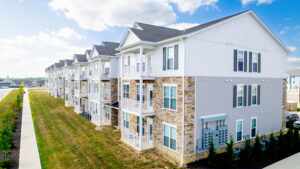

Multifamily real estate’s appeal stems from increased home prices, demand for affordable housing, lower single-family home supply, liquidity (how efficiently a property can be sold at or close to market value), and changes in overall lifestyle preferences.
Multifamily real estate comprises several subgroups, including apartment communities, age-restricted housing, independent senior living communities, and more. These subgroups are classified as either residential or commercial multifamily properties. Here, we will discuss the defining characteristics of multifamily real estate, including multifamily property types, primary features, and classes.
Residential vs. Commercial Multifamily Properties
Multifamily real estate consists of residential properties with two to four housing units and commercial properties with five or more housing units. A smaller building with fewer units, like a duplex, would be categorized as residential. However, a more sizable operation, like an apartment community, would fall under commercial multifamily real estate. [1] Multifamily real estate is distinguished by its ability to generate income by renting individual units within a property to residents rather than single-unit or single-family properties.
Multifamily Property Types
A multifamily property is a tangible asset with an essential use and the ability to deliver cash flow and hedge against inflation. Depending on your investment strategy, there are different risk/return profiles and considerations to apply. Smaller multifamily properties, like duplexes, may have lower operational costs but have a different potential for scale and total return. [1] Value-add real estate investments, however, are high-risk and, therefore, have higher total return potential. [2][3]
Soren Godbersen, Chief Growth Officer at EquityMultiple, offers a clear list of defining characteristics for a few of the property subtypes often grouped into the multifamily asset class:
Apartment Communities
- can be mid-rise, high-rise, or garden-style
- most common type of multifamily property on the market
- 20+ million units nationwide as of 2024
- require involved property management teams and routine maintenance
- high resident turnover
- rent fluctuates to reflect current market values [2]
Duplexes, Triplexes, and Quadruplexes
- a wall is shared between multiple units
- all units are housed within one building
- fewer units can mean fewer operational responsibilities
- unique portfolio add for experienced investors [2]
Townhomes
- offers affordable privacy
- most share a wall with other units
- can be spacious or come with garages/private yards
- product utility to hold and sell for a profit [2]
Specialized Housing
- age-restricted: usually limited to the 55+ age group, but is built with accessibility in mind and has an active community management team to engage residents
- student living: resembles standard apartment communities but is designed for college students, located near the campus, and affordable
- build-to-rent (BTR): operates under property management similar to apartment communities but includes carefully curated construction with a long-term investment plan
Multifamily Property Classes
An asset class, also known as a property class, is a group of similar investments. [1] Investors can balance risk and reward by including different asset classes in their portfolios. This is because each asset class behaves differently depending on market conditions. You might consider similar characteristics when traveling. For example, if you vacation during hibernal seasons, you may select a homestay experience with wintertime amenities such as a fire pit and heated spa/pool. Amenities are items or services that provide comfort, convenience, or enjoyment. Multifamily properties can be graded as A, B, C, or D based on age, quality, amenities, rent levels, and location. [2]
Class A is a top-tier property with resort-style amenities like pools, recreation areas, and fitness centers. The closer a property is to Class A, the higher its rent will be in its respective market.
Class B offers less than Class A regarding building quality, location desirability, and amenities. These properties cater to median-income earners through relatively affordable rents. You might hear this asset class referred to as workforce housing.
Class C is the second-lowest tier, generally consisting of older buildings with outdated designs or systems requiring maintenance or renovations. [2]
Class D is the lowest tier and comprises poor construction in a declining market (neighborhood) and extensive maintenance repairs or renovations. Due to resident issues and potentially high vacancy rates, these properties are considered risky.
WORK WITH BAM CAPITAL FOR MULTIFAMILY REAL ESTATE INVESTING
BAM Capital partners with accredited investors who want to enjoy passive income and all the other benefits of multifamily private placement. As the private equity arm of The BAM Companies, BAM Capital has been focusing on buying the most profitable assets and staying disciplined in its investment thesis. BAM Capital’s investment strategy aims to create forced appreciation while mitigating investor risk. To date, the brand has successfully managed over $1.85 billion in assets across 10,000+ apartment units. [4]
Remember that no investment is risk-free. Before making financial decisions, consult your investment advisor and schedule a call with a BAM Capital investment team member.
Disclaimer: All investments carry risk, including potential loss of capital. This content is for informational purposes only and is not financial, legal, or investment advice, nor an offer or solicitation to buy or sell any security. Consult an independent advisor for personalized guidance and contact BAM Capital for details on current offerings. BAM Capital and its representatives are not fiduciaries or investment advisors. The information provided is general and may not reflect individual financial goals. Any financial terms, projections, or forward-looking statements contained herein are hypothetical in nature and should not be interpreted as guarantees of future performance or safety. Such statements reflect Bam Capital’s opinion and are subject to market fluctuations, economic conditions, and investment risks. Past performance does not predict future results. BAM Capital and its affiliates do not guarantee the accuracy or completeness of this information. Bam Capital offers investment opportunities under Rule 506(c) of Regulation D exclusively for accredited investors as defined by the SEC. Verification of accredited investor status is required prior to participating in any investment.
© 2025 Bam Capital. All rights reserved.
SOURCES:
[1]: BAM Capital. (n.d.). “What is an asset class?” https://bamcapital.com/asset-class/
[2]: EquityMultiple. (2024). “Multifamily Investing: A Comprehensive Guide.” https://equitymultiple.com/blog/multifamily-investing#:~:text=1.%20They%20Offer%20Simple%20Financing%20Options%20Multifamily,of%20tenants%20that%20can%20generate%20impressive%20returns
[3]: CrowdStreet. (n.d.). “Glossary Terms.” https://www.crowdstreet.com/glossary
[4]: BAM Capital. (n.d.). “Current Portfolio.” https://bamcapital.com