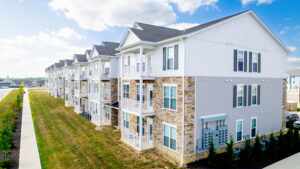

Key metrics act as measurable benchmarks for investors, allowing them to compare different properties, analyze trends over time, and identify areas for improvement.
Metrics such as loan-to-value ratio (LTV) and debt-service coverage ratio (DSCR) enable operational efficiency, helping to secure financing, optimize returns, manage risks, enhance resident satisfaction, and improve the overall management of multifamily properties. [1]
If you haven’t already read part 1 of this article, click here. If you have, let’s continue by addressing five other metrics investors use when evaluating multifamily real estate deals.
DEBT-SERVICE COVERAGE RATIO (DSCR)
Debt service is the total cash required to cover interest and principal payments on a loan. The debt-service coverage ratio (DSCR) compares the income and cost of debt. DSCR measures how well a property’s operating cash flow can cover its mortgage payments, indicating whether it generates enough to service its debt obligations. Divide the property’s net operating income by its annual debt service, including principal and interest payments, for the DSCR. For example, if your property produces $200,000 in annual net operating income (NOI), and your debt service (annual debt obligation) is $160,000, your DSCR is 1.25. This means the property produces 25% more income than is needed to pay its mortgage. Lenders (typically banks) want to ensure the asset (property) has the cash flow to support its debt service and still have cash flow after the debt is paid.
LOAN-TO-VALUE RATIO (LTV)
The loan-to-value ratio (LTV) compares the mortgage amount to appraised property or market value. It’s calculated by dividing the loan amount by the property value and expressed as a percentage. For example, an LTV of 80% means the mortgage equals 80% of the property’s value. A first mortgage of $6,500,000 on a market value of $10,000,000 represents a 65% LTV ratio. Lenders generally see Lower LTVs as less risky since the borrower has more equity in the deal.
CASH FLOW
Cash flow is a catch-all term typically used to describe the income a property produces after all operating expenses and debt service has been paid. Positive cash flow is when a property’s income exceeds its costs, while negative cash flow is when its expenses exceed its income. [2] To calculate cash flow, you must know the property’s gross income, debt service, and total expenses. [2] Then, subtract total expenses and debt service from gross income to determine the net cash flow (remaining income after deducting all costs—e.g., mortgage, taxes, insurance, etc.). Gross income is slightly more straightforward because you only need to determine the property’s total income before deducting any expenses.
Multifamily cash flow is often more predictable than other asset types, as rental income is collected monthly and from multiple sources (many residents/units vs. single-family occupants). If a few residents are delinquent, there is considerable latitude in paying the bills. With single-family, there is zero rent if the resident does not pay.
VACANCY & OCCUPANCY RATES
The vacancy rate refers to the percentage of rental units that are unoccupied or vacant. In contrast, the occupancy rate is the percentage of occupied units in a property relative to the total number of units available. You might hear “stabilized occupancy rate” utilized in multifamily real estate, representing the point at which occupancy is consistent and reflects the market. This metric falls under the category of management efficiency because daily operations on a property directly impact resident retention, vacancy, and occupancy rates. Streamlined processes for resident screening, lease agreements, staff training, and proactive maintenance minimize the risk of legal disruptions and resident turnover, ultimately optimizing asset performance. [3]
RENT GROWTH
Rent growth is the expected incremental increase in rental rates over time. Resident retention balances the need for higher rent and occupancy. Market research shows that resident satisfaction, quality maintenance, community safety, and moderate rent increases can help minimize resident churn. [4] Rent growth is essential because it directly impacts investor returns, driving income growth and property value appreciation. Multifamily real estate has been historically resilient against economic downturns and recessions. According to CONTI Capital’s analysis of CoStar data, “multifamily was the only major property type to experience positive rent growth” during what’s commonly referred to as the Gulf War Recession (1990-91). [5] Tracking how rent growth in multifamily outperforms amid market uncertainty is key to generating consistent income and producing outsized returns for investors.
WORK WITH BAM CAPITAL FOR MULTIFAMILY REAL ESTATE INVESTING
BAM Capital is a vertically integrated owner/operator that partners with accredited investors who want to enjoy passive income and all the other benefits of multifamily private placement. As the private equity arm of The BAM Companies, BAM Capital has been focusing on buying the most profitable assets and staying disciplined in its investment thesis. BAM Capital’s investment strategy aims to create forced appreciation while mitigating investor risk. To date, the brand has successfully managed over $1.7 billion in assets across ~9,000 apartment units.
Remember that no investment is risk-free. Before making financial decisions, consult your investment advisor and schedule a call with a BAM Capital investment team member.
Disclaimer: All investments carry risk, including potential loss of capital. This content is for informational purposes only and is not financial, legal, or investment advice, nor an offer or solicitation to buy or sell any security. Consult an independent advisor for personalized guidance and contact BAM Capital for details on current offerings. BAM Capital and its representatives are not fiduciaries or investment advisors. The information provided is general and may not reflect individual financial goals. Any financial terms, projections, or forward-looking statements contained herein are hypothetical in nature and should not be interpreted as guarantees of future performance or safety. Such statements reflect Bam Capital’s opinion and are subject to market fluctuations, economic conditions, and investment risks. Past performance does not predict future results. BAM Capital and its affiliates do not guarantee the accuracy or completeness of this information. Bam Capital offers investment opportunities under Rule 506(c) of Regulation D exclusively for accredited investors as defined by the SEC. Verification of accredited investor status is required prior to participating in any investment.
© 2025 Bam Capital. All rights reserved.
SOURCES:
[1]: Google Generative AI. (2025). “Why are key metrics essential in multifamily real estate?” https://www.google.com/search?q=why+are+key+metrics+essential+in+multifamily+real+estate
[2]: SmartAsset. (2022). “How to Calculate Cash Flow in Real Estate.” https://smartasset.com/investing/cash-flow-real-estate
[3]: Google Generative AI. (2025). “The importance of operational efficiency in multifamily real estate.” https://www.google.com/search?q=the+importance+of+operational+efficiency+in+multifamily+real+estate
[4]: Google Generative AI. (2025). “Resident turnover balancing act between higher rent and occupancy.” https://www.google.com/search?q=resident+turnover+balancing+act+between+higher+rent+and+occupancy
[5]: CONTI Capital. (2024). “Multifamily Weathers Recessions Better Than Other CRE Types.” https://conticapital.com/news/multifamily-weathers-recessions-better-than-other-cre-types/#:~:text=The%20most%20recent%20pandemic%2Dinduced%20recession%20had%20a,actually%20positive%20for%20industrial%2C%20multifamily%20and%20retail.