

Financial metrics are necessary for understanding the performance and profitability of multifamily real estate investments. They provide valuable insights into a property’s economic health, enabling investors to make informed decisions, manage risks effectively, and optimize returns. By analyzing these key metrics, investors can assess profitability, evaluate financial stability, and develop effective investment strategies.
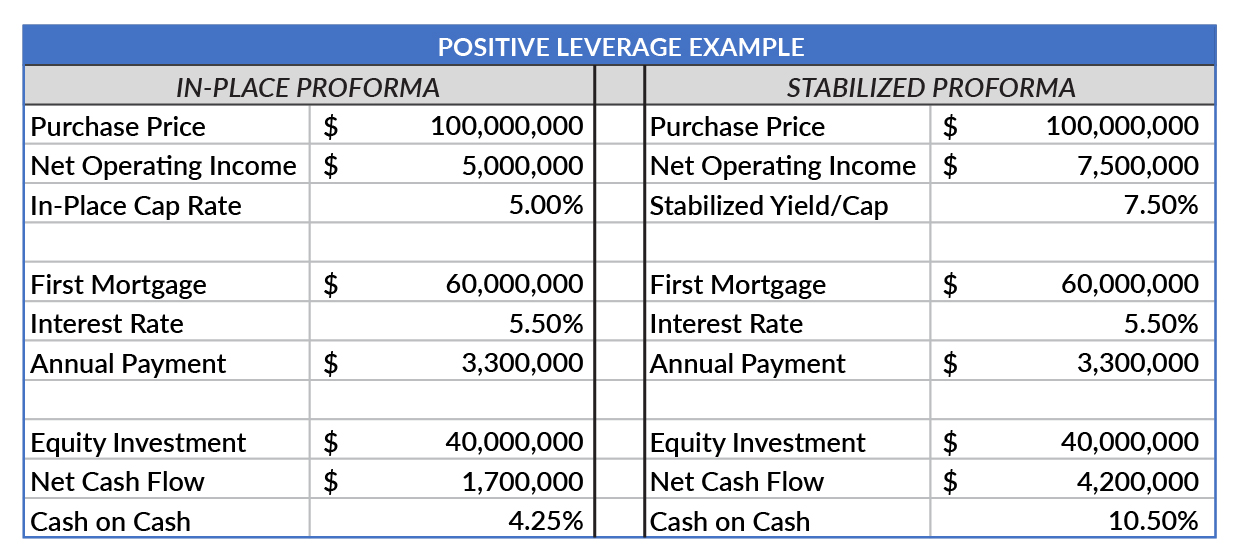
Capitalization Rate (Cap Rate): It’s the owner’s last dollar and the first loss position of the real estate capital stack. It’s calculated by dividing the property’s net operating income (NOI) by its current market value. A $100 million acquisition with an NOI of $5 million results in a 5.0% capitalization rate. Cap rates help investors compare different investment opportunities and assess the potential risks and rewards.
Stabilized Yield on Cost: Stabilized yield on cost (YOC) in multifamily real estate is a key metric that represents the expected return on investment after a property is fully leased and operating at its optimal level, relative to the total project cost. It’s arguably the most critical metric in real estate finance as it is the primary driver of all other investment yields and can shift the scale from negative leverage at the outset to positive leverage in the future with an experienced sponsor or operator.
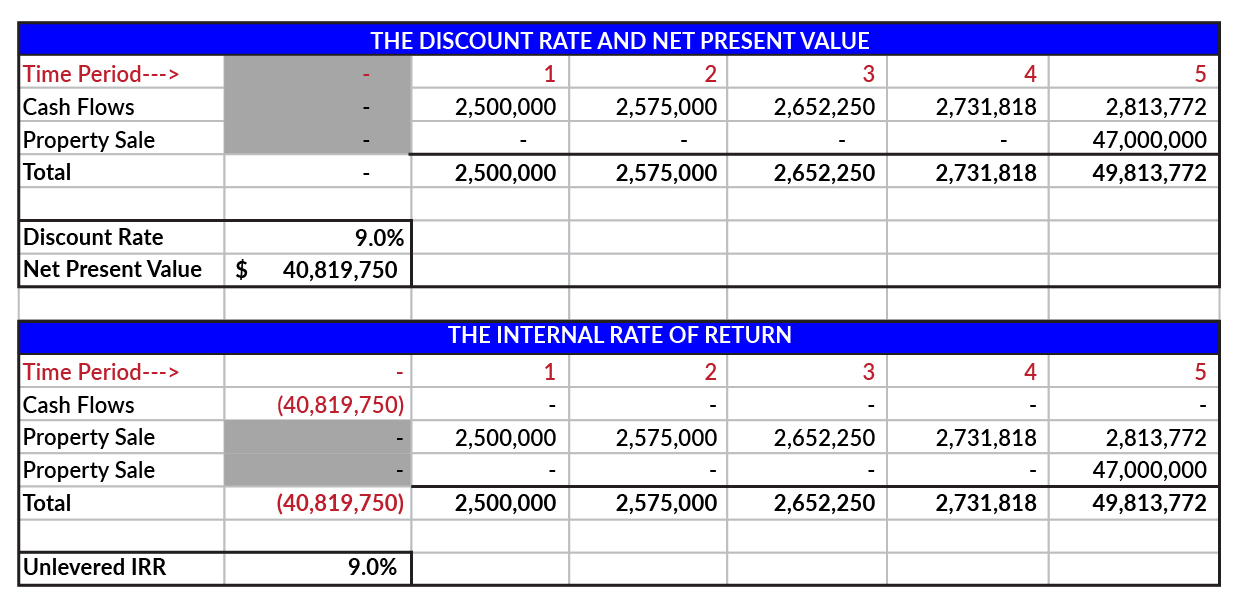
Discount Rate: The discount rate is a crucial factor in determining the present value of future cash flows and assessing the investment’s overall worth. It reflects the perceived risk and expected return associated with an investment. This rate is used to discount those future cash flows to their present value, allowing for comparison with other investment options. It’s also the investor’s unlevered internal rate of return (IRR) and how you solve the purchase price on a potential transaction with no pricing guidance.
Net Present Value (NPV): The NPV is an essential tool for assessing the financial viability of multifamily real estate investments. It helps investors determine if the potential returns outweigh the initial investment costs by calculating the present value of all future cash flows associated with the property, including rental income, expenses, and appreciation, and then discounting them back to their present value using a specified discount rate.
Internal Rate of Return (IRR): Here is the textbook definition: IRR is the discount rate that makes the net cash flow of all cash flows from a particular investment equal to zero. In simpler terms, it’s the rate of return at which the present value of expected future cash inflows equals the initial investment.
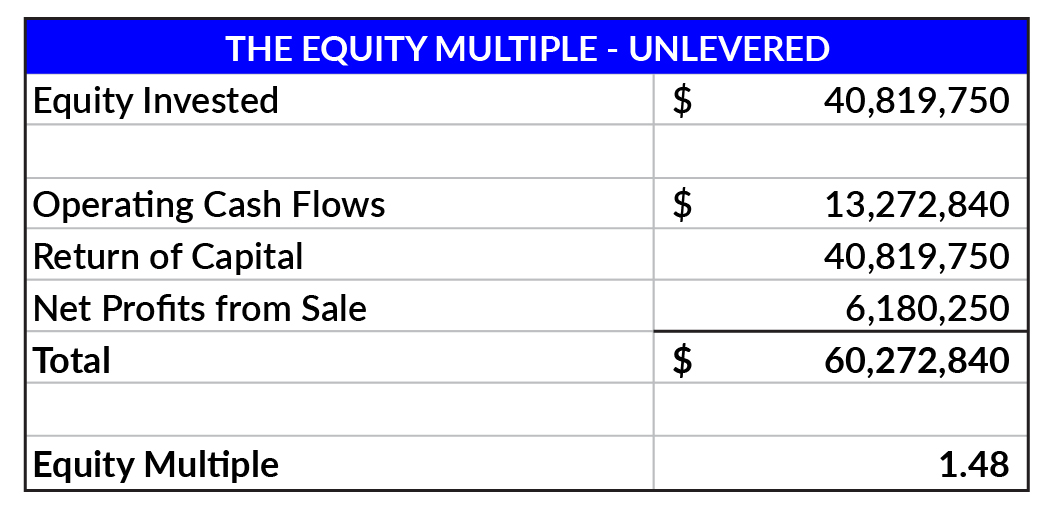
Equity Multiple (EMx): The equity multiple is a key metric that measures the total return on an investment relative to the initial equity invested. It includes cash flows during the holding period, a return of equity, and a return on equity.
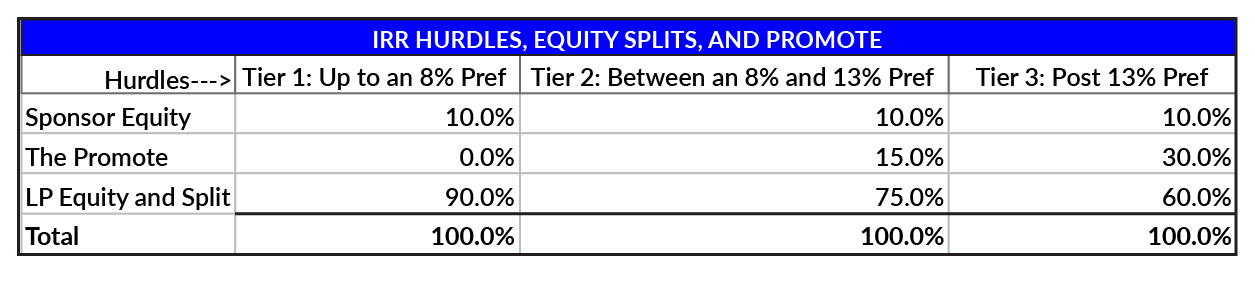
IRR and Preferred Return Hurdles: In multifamily real estate investment, “cash hurdles” or “return hurdles” refer to specific profit targets that must be achieved before distributing profits to different investors (like limited partners or sponsors) in a waterfall structure. Generally speaking, an IRR or preferred return (Pref) defines these hurdles. These metrics incentivize sponsors to maximize profits to reach the next distribution tier.
Equity or Residual Splits: Profit distribution to investors (Limited Partners or LPs) and the deal sponsor/manager (General Partner or GP) is structured through equity splits or waterfall structures. For example, this split can also be tiered, meaning the percentages change as the investment achieves higher returns.
Promote or Carried Interest: It represents a disproportionate share of profits that a real estate sponsor (the individual or entity managing the investment) receives above their initial investment, typically after investors have achieved an agreed-upon return. Similar to the equity split, the promote will vary and is deal-specific, depending on the risk profile of the investment.
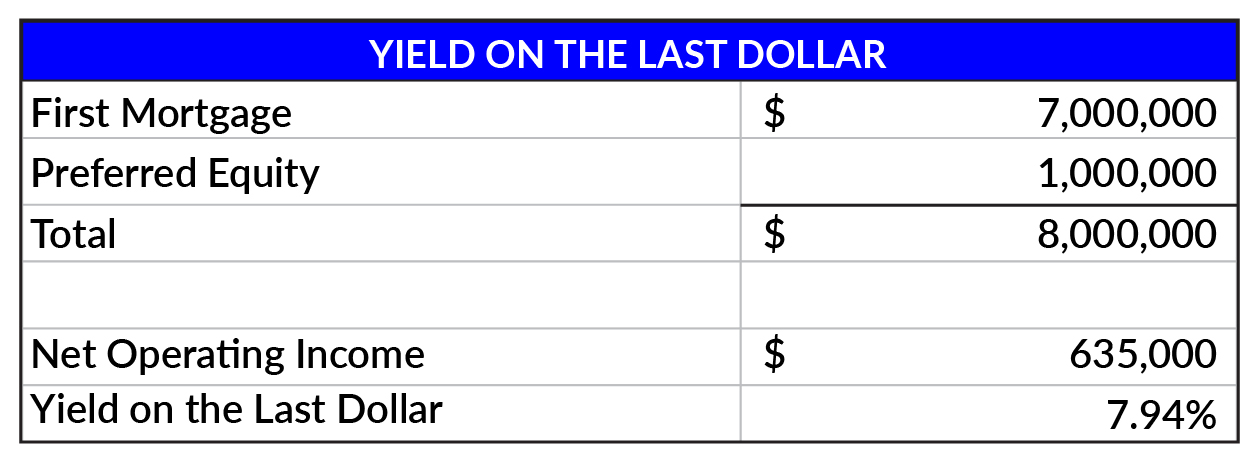
Last Dollar Basis: The “last dollar yield” is often discussed in the context of underwriting preferred equity investments. Therefore, the “last dollar” refers to the preferred equity’s highest loan-to-value or the total capitalization achieved when including the preferred equity alongside the senior debt.
Mastering these financial metrics is essential for success in multifamily investment, whether actively managing properties or passively investing. These metrics help investors make informed decisions from initial deal assessment to operations and exit strategy development. By having a comprehensive understanding of these concepts, investors can make informed decisions, manage risk effectively, optimize returns, and build a successful multifamily real estate portfolio.
Hypothetical/pro forma performance: tables in this Whitepaper show hypothetical results based on modeling criteria and assumptions and are not actual results or a guarantee of future performance.
Disclaimer: This document is for informational purposes only and is not financial, legal, or investment advice, nor an offer or solicitation to buy or sell securities. Investment opportunities offered by Bam Capital are made pursuant to Rule 506(c) of Regulation D and are available exclusively to accredited investors, as defined by the Securities and Exchange Commission (SEC). Verification of accredited investor status is required before participation in any investment. The information contained herein reflects the opinions of the author and does not necessarily represent the views of Bam Capital. Any financial terms, projections, or forward-looking statements contained herein are hypothetical in nature and should not be interpreted as guarantees of future performance or safety. Such statements reflect opinions and are subject to market fluctuations, economic conditions, and investment risks. Investing in private real estate securities involves significant risks, including but not limited to illiquidity, economic downturns, and potential loss of invested funds. Past performance does not guarantee future results. Prospective investors are strongly encouraged to conduct independent due diligence and consult with legal, tax, and financial advisors before making any investment decisions. Bam Capital makes no representation or warranty regarding the accuracy or completeness of the information contained herein.
© 2025 Bam Capital. All rights reserved.
Author: Tony Landa, Senior Economic Advisor, The BAM Companies, November 2025