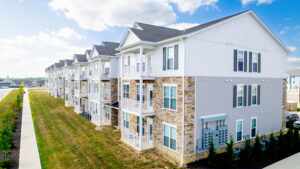

from the Q1 2026 Quarterly Reports
Dear Partners,
I’m going to write this quarterly letter a little differently.
After 9 years in real estate working for my first mentor, I started BAM as a property management company in 2010 in my spare bedroom, with the lessons of 2008 still ringing in my ears. I had lost a lot, but I had learned more in those few years than I had in the whole career that came before. Almost every decision I make in this business today — how we underwrite, how we borrow, who we partner with, how much liquidity we keep on our balance sheet, is a reflection of what that cycle taught me.
I bring that up because the conditions in multifamily right now are the most interesting they’ve been in nearly twenty five years of doing this, and the lessons of the last cycle are about to matter again.
So this letter is going to do two things. First, I want to be frank with you about what the multifamily industry has been weathering, and the fact that BAM’s portfolio has felt every bit of it. Second, I want to make a case I believe in deeply: the same forces that have made the past three years uncomfortable for owners are now producing what I think is the best buying opportunity in institutional-quality multifamily in over a decade. It is a hard time to sell most assets, yet it is a wonderful time to buy them.
That distinction is the lens I’d ask you to read everything that follows through.
What the Industry Has Weathered
You hear plenty about how multifamily is “recession proof” or “always goes up.” Anyone who actually owns and operates large apartment communities knows it is one of the hardest asset classes on the planet to run well. The last three years have reminded all of us why.
A short, honest accounting.
First, interest rates. The cost of capital moved from effectively free to historically normal in roughly eighteen months. For an industry whose returns are leveraged on top of debt, that was not just inconvenient, it was structural. Underwriting that worked at 4% debt cost did not work at 7%. Refinances that penciled at 65% LTV at 2021 prices and 2021 rates did not pencil at today’s rates and reset valuations. This is not a small detail. It is the central fact of the cycle.
Second, debt maturities. A meaningful share of multifamily acquired or developed in 2021 and 2022 was financed with floating-rate bridge debt and aggressive rate caps. Those caps were intended as a placeholder until permanent financing arrived in a calmer market. The market did not calm on schedule. As that debt has matured, owners have been forced to renew rate caps at multiples of the original cost, refinance at materially lower proceeds, contribute fresh equity, sell into a soft market, or hand the keys back. None of those outcomes is comfortable.
Third, supply. New deliveries crested at multi-decade highs in 2023, 2024, and into 2025, fueled by a building boom that was financed under the prior rate regime. Markets that were already absorbing strong demand received an extraordinary amount of new product all at once. Concessions widened. Rent growth went flat or negative. Even strong assets in strong submarkets have had to compete with brand-new lease-up product offering two months free.
Fourth, operating costs. Insurance premiums, in many of our markets, increased significantly. Property taxes have continued to climb in jurisdictions that were quick to reassess at peak valuations. Payroll, repairs, and maintenance have all run hotter than long-term averages. NOI has been compressed by the cost side, even where revenue held up.
Fifth, the deals done at the top of the market. The hardest part of this cycle is not theoretical. Real capital, owned by real people, was deployed into transactions underwritten on assumptions that did not survive contact with the new regime — exit cap rates of 4.5%, refinancing at par, rent growth of 6% a year forever. In a lot of cases the underlying real estate is fine. The capital structures wrapped around it were not.
That is the storm. I do not minimize any of it.
How BAM Has Weathered It
We are not immune. Like every operator out there, our portfolio has felt all five of the pressures above to varying degrees. Some of our assets have absorbed concessions while new supply leased up around them. Some have refinanced at lower proceeds than we would have liked. Some have had to renew rate caps at meaningfully higher cost. We have managed insurance shocks, tax reassessments, and the same cost pressures every owner is dealing with. The cycle did not skip our zip code, however the Midwest has felt the impacts to a far lesser extent than many other markets where investors’ equity has been vaporized in the boom and subsequent bust cycle.
What I do believe is unique and what matters most for our partners; is that we built BAM, deliberately, to hold through a cycle like this rather than to be sold out by it.
That comes from a few choices we made before we needed them. We have run conservative leverage. We have favored long-duration capital relationships over short-duration capital. We have maintained liquidity, both at the asset level, fund level and at the BAM balance-sheet level, that has cost us return in the good years and is paying for itself today. We have stayed focused on a single asset class (large multifamily), in a single region we know well, where our team’s operating depth is real and our information advantage is something we earned over years of being on the ground. We have stayed vertically integrated, which means when something needs to be fixed at the asset level, our own people fix it.
The result is staying power. BAM is in a position to hold its existing portfolio through the bottom of this cycle, not as a hope but as a fact tied directly to capital structure. Hold periods across funds will increase undoubtedly and will be based on sales market conditions. We do not need to be a forced seller of any of our portfolio. When the right offer comes, we can take it. When an offer does not make sense, we can decline it. In an environment like this one, the difference between an outcome you control and an outcome that is dictated to you is enormous.
That brings me to the other half of the letter. The same conditions that make this a difficult time to sell most multifamily are precisely what make it an exceptional time to buy.
Why This Is the Best Buying Window in Nearly Twenty Years
Several conditions are converging at once that I have not seen lined up like this since the years following 2008.
The seller side. Forced and semi-forced sellers are coming to market in real numbers, driven by the maturity wall of debt and stabilized new construction assets that are merely a victim of timing. Lenders are growing tired of “extend and pretend” with underwater borrowers. These are owners who, in many cases, would prefer to hold but cannot. Their motivation is structural, not strategic, and in any market, structural motivation shows up in pricing.
The financing side. Banks have stepped back from commercial real estate. Private credit has stepped in, but at higher spreads, lower leverage, and tighter covenants than were available three years ago. Debt capital remains available only to disciplined operators; it is largely unavailable to the undisciplined.
The buyer side. This is the change I think is most underappreciated. The back half of the last cycle saw an extraordinary wave of new entrants into multifamily, particularly a class of newer syndicators with very limited operating history. Many of them raised retail capital through podcasts, bootcamps/masterminds, and social media on the promise of doubling investors’ money in three to five years. They came to the auction table with underwriting that, in hindsight, had less to do with analysis than with enthusiasm. Six percent rent growth a year, indefinitely. Exit cap rates with no historical anchor. Refinances in two or three years on the assumption of conditions that had never existed before. They paid up reliably, and in doing so they pulled cap rates to levels that simply did not pencil for any disciplined buyer.
It was a textbook case of irrational exuberance. The herd convinced itself that multifamily was a one-way trade, that rents would compound forever, that rates would not normalize, that capital would always be there to refinance into higher valuations. The herd bid prices well above what fundamentals could support. And for a while, the herd was rewarded for it.
The herd is now gone. The same buyers who set the prices on the way up cannot raise their next fund, cannot renew their rate caps without fresh equity that no one will write, and cannot win deals against operators with real balance sheets and real operating depth. Many of them are working through capital calls their LPs are not meeting, refinances that do not pencil, and sales into a market that does not reward what they paid. They are not the buyers they were two years ago. In a lot of cases, they are now the sellers. The single most important fact about today’s competitive landscape is the disappearance of the marginal bidder who set the prices in 2021 and 2022. That, more than anything, is why the competitive set for institutional-quality multifamily is the smallest it has been in over a decade.
The supply side. Construction starts have collapsed from the 2022 peak. Construction financing, where it is available at all, is materially more expensive. Deliveries in 2026 and 2027 are still working through the prior cycle’s commitments. Deliveries in 2028 and beyond fall off a cliff. That kind of supply runway is something investors normally pay a premium for. Right now, we are getting it without paying the premium.
The demand side. The affordability gap between owning and renting in most U.S. markets has widened, not narrowed. The lock-in effect from existing low mortgage rates has suppressed for-sale turnover, which pushes incremental household formation into rental housing. Migration and demographic trends continue to favor the Midwest, where reshoring and economic development have been quietly accelerating in a way I think will surprise people over the next five years.
The pricing side, and I want to be specific here. Two distinct opportunities have emerged that deserve attention.
First, brand-new institutional-quality construction: Class-A product delivered or stabilizing over the past two to three years, is increasingly being marketed through forced or semi-forced sales at or below replacement cost. Pause on that. We are being offered the chance to buy property that effectively cannot be profitably built today, at a price below what it cost to build, from sponsors whose capital structures no longer work. Brand-new physical product. Very little new supply behind it. A discount to construction cost as the entry point. In nearly twenty years of buying multifamily in the Midwest, that is not how new product trades. Until it is.
Second, older-vintage assets with credible value-add potential are pricing at levels that, on the math, generate return profiles I have not seen in nearly ten years. The reset in entry pricing, combined with a supply pipeline that thins meaningfully behind us, has restored a kind of operational alpha that the cap-rate-compression years of 2014 through 2021 quietly took away. When the basis is right, the supply backdrop is right, and the macro tailwind for rental demand is intact, competent operations can again move the needle. That is precisely the kind of environment where the team and the systems we have built are designed to do their best work.
Put it all together, forced sellers, restricted financing for marginal buyers, the absence of the herd that set the prices, slowing future supply, durable demand, brand-new product at or below replacement cost, and value-add product at returns we have not seen in a decade. What we have is, in my judgment, the best buying environment for institutional-quality multifamily in fifteen years.
How We Are Approaching It
The job now is to convert that observation into action without losing the discipline that got us here.
Warren Buffett’s framing has guided me my whole career. Rule one: do not lose money. Rule two: remember rule one. Periods like this can look like a green light to deploy aggressively. They are actually the moments where the bar for what you will buy needs to go up, not down, because the consequences of getting basis wrong in a regime this unforgiving are large. We are looking for assets where the seller’s motivation is clear, the basis is below replacement cost or pencils at value-add returns we can actually execute, the financing terms are something we are comfortable holding through any future bumps, and the long-term thesis on the market and the asset is intact.
We will pass on far more than we pursue. We did that on the way up. We will do it on the way through.
The next few years will reward patience, discipline, and operational excellence. That is exactly where BAM is positioned. We expect to be a meaningful net buyer over the balance of 2026 and into 2027, across both newly built product trading at or below replacement cost and older-vintage value-add candidates. We expect to selectively realize value on a small subset of mature assets where doing so is the right answer for partners on the holds they signed up for. And we expect to continue to hold the rest of our existing portfolio through the bottom of this cycle, because we built the capital structure to do exactly that.
Looking Ahead
I do not expect this period to resolve cleanly or quickly. Cycles like this rarely do. They unfold deal by deal, asset by asset, in modifications, restructurings, change-of-control sales, until the data accumulates into something that, in hindsight, looks like an obvious turning point.
What I am confident of is this. Periods of acute stress in real estate are the periods that produce the vintages we look back on most fondly. The capital deployed in 2010 through 2018 did not feel courageous at the time. It felt patient. The capital that gets deployed over the next eighteen to twenty-four months will feel similar in retrospect.
For our part, the work is to be ready. Ready with capital. Ready with conviction. Ready with the operating capability, top to bottom, from our team picking up the trash on site to the folks running our funds. I have not seen a setup for buying institutional-quality multifamily this attractive since the Great Financial Crisis. These windows do not last forever. I intend for BAM, and the partners standing alongside us, to make the most of this one.
Thank you, as always, for the trust you place in me and in our team. We are honored to steward your hard-earned capital through the toughest part of this cycle and into what I believe is, in many ways, the most exciting part of it.
Most Sincerely,

Ivan Barratt
Founder & CEO
The BAM Companies
PS: This writing is not financial advice and should be used for educational purposes only. Please consult your trusted advisors. The views expressed herein are subject to change at any time and without notice.
Disclaimer: This content is for informational purposes only and is not financial, tax, legal, or investment advice, nor an offer or solicitation to buy or sell securities. Investment opportunities offered by BAM Capital and its affiliates are made pursuant to Rule 506(c) of Regulation D, available exclusively to accredited investors, as defined by the Securities and Exchange Commission (SEC) and, if applicable, qualified purchasers, as defined by Section 2(a)(51) of the Investment Company Act of 1940. Verification of accredited investor status is required before participation in any investment.
Contact BAM Capital for details on current offerings. BAM Capital and its representatives are not fiduciaries or investment advisors. The information provided is general and may not reflect individual financial goals. Financial terms, projections, or forward-looking statements contained herein are hypothetical and should not be interpreted as guarantees of future performance or safety. Such statements reflect BAM Capital’s opinion and are subject to market fluctuations, economic conditions, and investment risks. Investing in private real estate securities involves significant risks, including, without limitation, illiquidity, economic downturns, and potential loss of invested funds or capital. Past performance does not predict or guarantee future results. Historical transaction figures represent past performance across multiple deals as of the date this information was published, not a single investment transaction. BAM Capital and its affiliates do not guarantee the accuracy or completeness of this information. Prospective investors are strongly encouraged to conduct independent due diligence and consult with legal, tax, and financial advisors before making any investment decisions.
© 2026 BAM Capital. All rights reserved.