Since the fall of 2022, the S&P 500 has more than doubled. Over the same four years, the value of a Class A apartment building fell by about 20%.
Most investors only feel the first fact. While their equity portfolios make new highs, the apartment community down the road, 95% occupied and earning more than it did in 2022, is worth a fifth less.
Equities are priced for everything to go right. Luxury apartments are priced as if all the important conditions will trend down further. I started at The BAM Companies in 2010, at the bottom of the last cycle. Back then I made an absolute killing on those early deals as a percentage return. However, I was just getting up and running on my own deals and they were quite small in dollar terms. Today it’s the same play and I’m eternally grateful to be in a capitalized position to acquire thousands of Class A units.
What you pay
Howard Marks says, “It’s not what you buy, it’s what you pay for it.”
The Shiller CAPE ratio, which compares stock prices to ten years of inflation-adjusted earnings, sits around 41. It has been higher exactly once, in late 1999. You are paying about $41 for every dollar of the market’s long-run earnings, and ten companies make up almost 40% of the index.
A Class A apartment community trades at a cap rate near 5.8%. That is roughly $17.25 for every dollar of earnings, and those earnings are rent checks from households who need a place to live.
Apartments didn’t get cheap because income fell. NCREIF’s index of institutionally owned apartments shows net operating income up about 9% since late 2022 while values dropped about 14%. Green Street has values 22% below the 2022 peak. Income up, price down. That only happens when the problem is somewhere other than the building.
The problem is the debt. Too many apartments were bought or built in 2021 and 2022 with floating-rate loans that only worked with 4% money. The 10-year Treasury today (mid-Nov 2026) is hovering around 5.1% and may go higher in the short to mid term run. About $330 billion of multifamily loans mature this year and next. Delinquencies on apartment loans in CMBS reached 8.09% in October, up from 1.8% in mid-2024. Appraisals lag, so I don’t think the repricing is finished. More and more “pretend and extend” lenders are starting to force “capitulation.”
Spring is certainly coming (as described and illustrated below) but it’s still tough to say exactly when. However many owners don’t have the staying power to make it through the final innings of winter.
Nobody is building the competition
The fear and subsequent carnage in multifamily came from rapidly rising interest rates and a massive supply wave storm hitting at the same time. Developers delivered about 695,000 apartments in 2024, a 40-year record, and rents went negative in many cases for two years.
That wave is ending. Apartments take two to three years to build, so tomorrow’s deliveries are yesterday’s starts. CoStar counted about 55,000 starts in the first quarter, the lowest quarter since 2011 and 73% below the early-2022 peak. Deliveries are on pace for about 420,000 this year, and CoStar has them near 350,000 in 2027. That is half the peak.
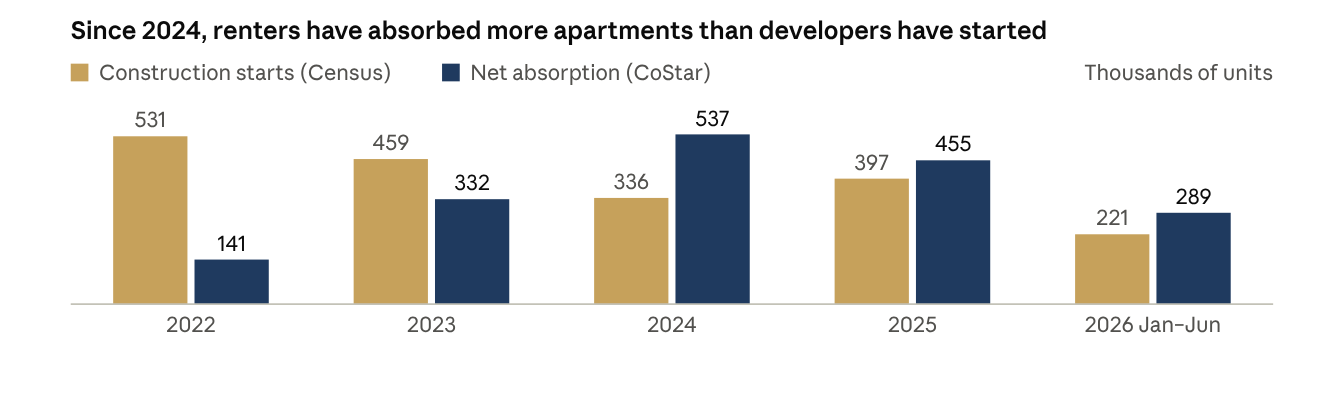
Sources: U.S. Census Bureau (starts, buildings with five or more units); CoStar (net absorption). 2026 covers January through June.
The Census Bureau’s broader count of starts runs higher than CoStar’s. Even on that measure, renters have absorbed more apartments than developers have started every year since 2024.
It isn’t coming back quickly. Building costs are up about 18% since late 2022 and still rising more than 5% a year. At today’s borrowing costs, most new deals don’t pencil until rents rise a good deal. That protects the buildings already standing.
The renter isn’t going anywhere
For most of the last decade, owning the median home cost about $300 a month more than renting. Today the premium is about $1,300 a month, and we ran that number before mortgage rates went back above 7%.
So people rent, and they rent longer. The median first-time buyer is now 40 years old. Existing-home sales last year were about 4.1 million, a three-decade low. In 1960, 52% of Americans were married and owned a home by age 30. Today it is 12%.
All of that lands in apartments. Renters added nearly 900,000 households in 2025, roughly four of every five formed in the country.
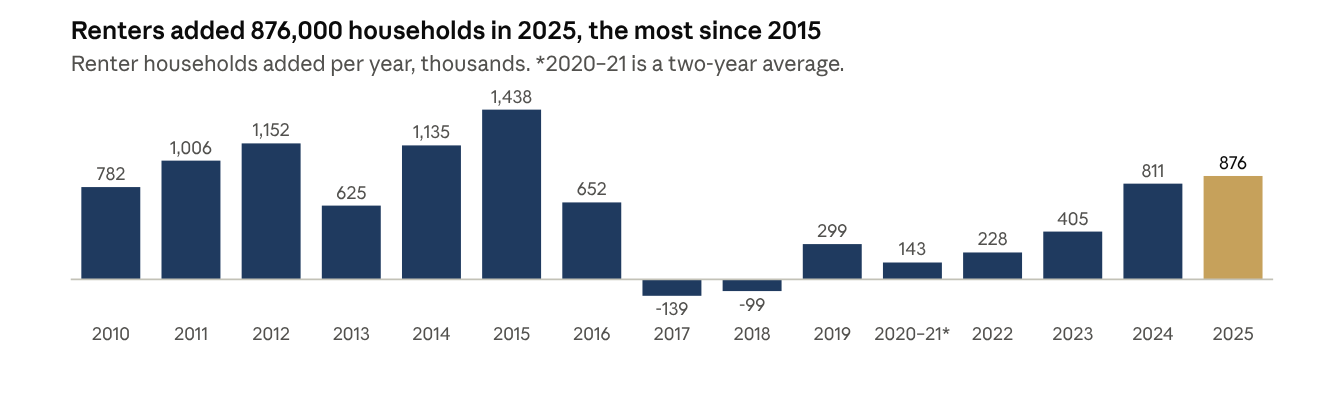
Source: U.S. Census Bureau, Housing Vacancy Survey, annual averages.
Full buildings
Over the 12 months ending in September, renters absorbed about 305,000 apartments while developers finished about 318,000. That gap is the smallest since 2015. The summer quarter was soft, and I’d expect a few more choppy quarters.
National occupancy is 95.4%. Rents turned positive again in the third quarter, and the major forecasters have them growing about 2.5% next year. The Midwest, where supply never got out of hand, led the country at 2.3%.
The renter can likely pay more too. Wages have grown faster than rents for more than three years.
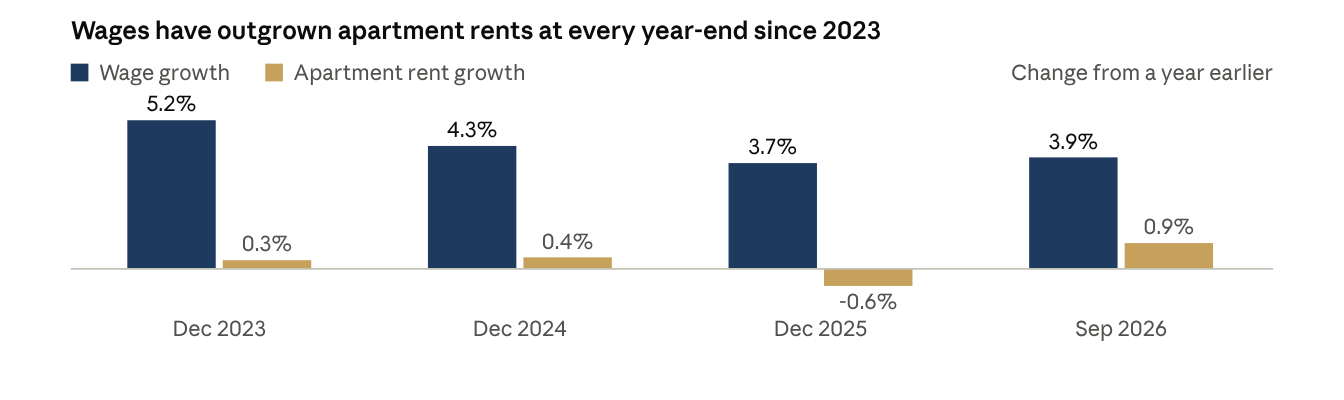
Sources: Federal Reserve Bank of Atlanta Wage Growth Tracker; RealPage effective asking rents.
Below what it costs to build
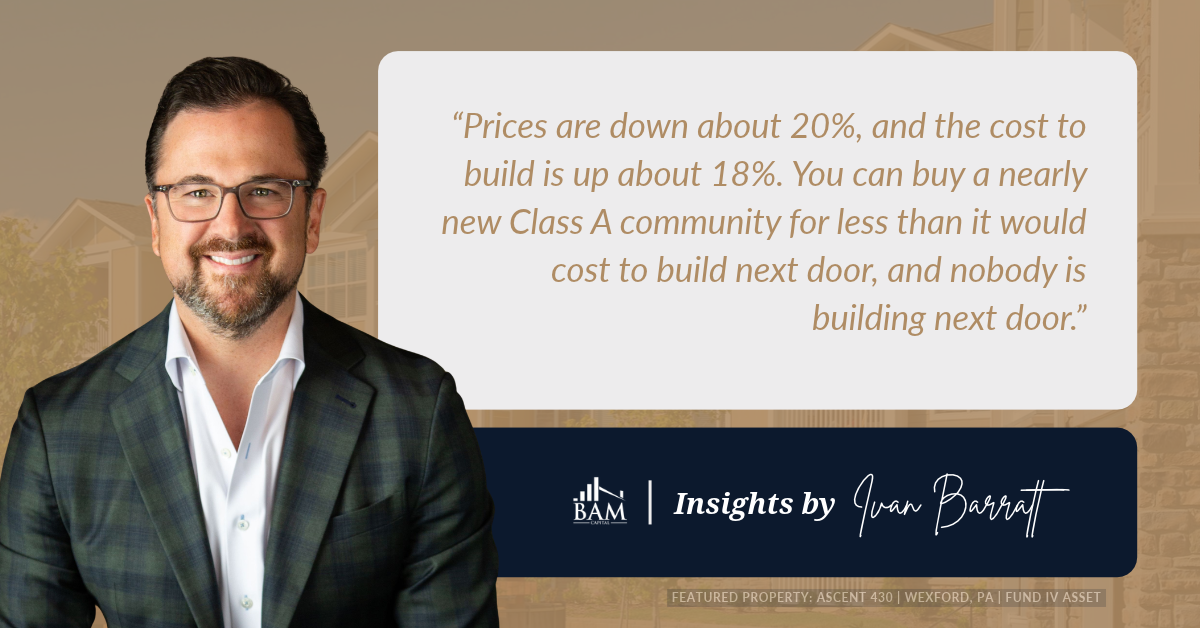
Put those pieces together. Prices are down about 20% and the cost to build is up about 18%. You can buy a nearly new Class A community for less than it would cost to build next door, and nobody is building next door.
That isn’t theory for us. In the Midwest we’ve bought new communities 9 to 12% below replacement cost. This fall we closed on a 2024-built community in a coastal Southeast market at a little over $206,000 a unit. It would cost about $250,000 a unit to build today, with zero market-rate apartments coming within five miles through 2030. The seller had a loan coming due, and we had capital and patience.
That discount is the margin of safety. If I’m wrong about the timing, I own a full building at a basis no new competitor can match, and I collect rent while I wait.
What I’d tell an investor
None of this means buy anything with a roof. Tough to manage/operate, Class C assets have fallen by as much as 50% and they are still likely not cheap enough to acquire. For us the strategy is new, Class A, in Midwest and Southeast markets we know, at a basis we can defend against replacement cost, with moderate, hedged debt and enough term that we’re never the forced seller. Add in population and job growth and it’s a strong recipe.
It doesn’t mean sell your stocks either. It means look at how much of your net worth rides on one market at one of the highest valuations in 150 years, and ask whether some of it belongs in an asset that got cheaper while its income went up. Many of the wealthiest families have already altered their allocations and investment strategies.
As I alluded to previously no one can predict when this winter will end or how cold it will get but rest assured, spring always comes. I’ll leave you with a final question. If you could go back in time to the savings and loan crisis, 2008, or even the first early days of COVID-19, how much real estate would you have bought then?

Ivan Barratt
Founder & CEO
The BAM Companies
Disclaimer: This content is for informational purposes only and is not financial, tax, legal, or investment advice, nor an offer or solicitation to buy or sell securities. Investment opportunities offered by BAM Capital and its affiliates are made pursuant to Rule 506(c) of Regulation D, available exclusively to accredited investors, as defined by the Securities and Exchange Commission (SEC) and, if applicable, qualified purchasers, as defined by Section 2(a)(51) of the Investment Company Act of 1940. Verification of accredited investor status is required before participation in any investment.
Contact BAM Capital for details on current offerings. BAM Capital and its representatives are not fiduciaries or investment advisors. The information provided is general and may not reflect individual financial goals. Financial terms, projections, or forward-looking statements contained herein are hypothetical and should not be interpreted as guarantees of future performance or safety. Such statements reflect BAM Capital’s opinion and are subject to market fluctuations, economic conditions, and investment risks. Investing in private real estate securities involves significant risks, including, without limitation, illiquidity, economic downturns, and potential loss of invested funds or capital. Past performance does not predict or guarantee future results. Historical transaction figures represent past performance across multiple deals as of the date this information was published, not a single investment transaction. BAM Capital and its affiliates do not guarantee the accuracy or completeness of this information. Prospective investors are strongly encouraged to conduct independent due diligence and consult with legal, tax, and financial advisors before making any investment decisions.
© 2026 BAM Capital. All rights reserved.