

Multifamily Market Headwinds, Tailwinds, and Long-Term Opportunity
Higher interest rates have made today’s multifamily market one of the most challenging in recent years. But for well-capitalized buyers, this environment also creates opportunity. In our 2026 Founders’ Town Hall, Ivan Barratt and Adam Ehret unpacked these capital market shifts and shared how experienced multifamily investors can successfully navigate the current cycle.
The Market Is Still Facing Real Pressure
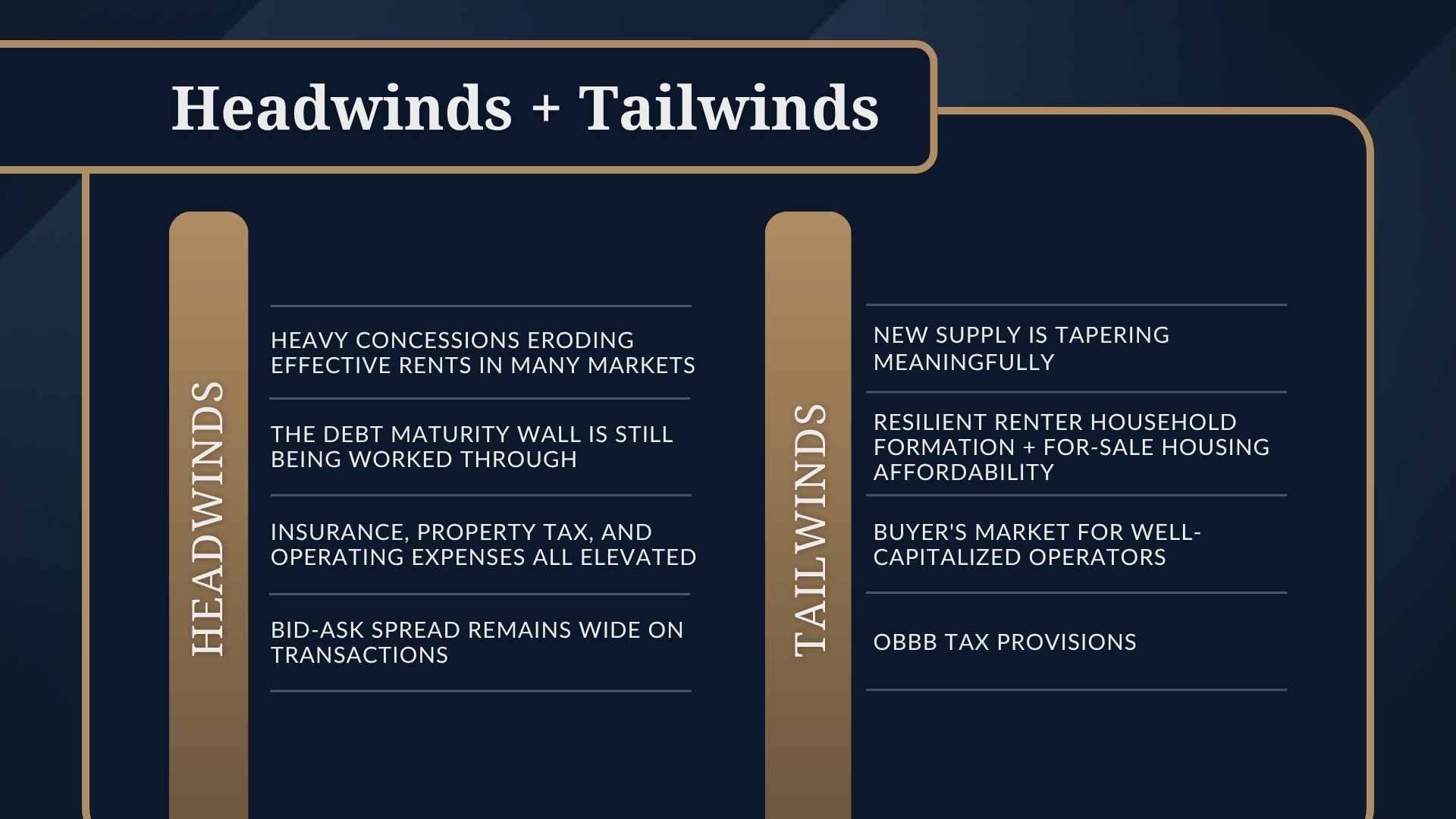
One of the biggest hurdles today is an oversupply of new apartments in certain markets, leading many operators to offer concessions and incentives to attract renters.
Nationally, rent growth has remained relatively flat year over year, reflecting just how competitive leasing conditions have become across much of the country.
The Midwest, where BAM Capital’s portfolio is concentrated, continues to stand out. Data shared during the presentation showed Midwest multifamily markets posting 2.5% year-over-year rent growth, along with stronger occupancy rates and less new supply coming online.
Key Market Comparisons Shared During the Presentation
Year-over-year rent growth
- National: 0.9%
- Midwest: 2.5%
Occupancy
- National: 90.6%
- Midwest: 91.8%
Percentage of inventory under construction
- National: 3.55%
- Midwest: 3.27%
Another major challenge across the industry is the “debt maturity wall,” Ivan explained.
Many apartment owners who purchased properties when interest rates were low are now facing loan maturities in today’s higher-rate environment. For some, refinancing has become difficult, especially without bringing in additional capital.
As a result, we’re seeing a trickle of assets come to market, where owners are being forced to sell for one reason or another. “Essentially, anyone that can be patient and wait to sell is waiting,” Ivan told the group.
Because of this, transaction activity remains relatively slow, with buyers and sellers still far apart on pricing in many markets.
Meanwhile, insurance costs, property taxes, and day-to-day operating expenses remain elevated, continuing to pressure property performance.
“We’re still in this buyer’s market,” Ivan said. “It is a fairly good time to buy assets, and we may even see more of a buyer’s market before conditions shift back toward sellers.”
Positive Trends Are Beginning to Build
Even with those headwinds, several important trends are beginning to shift in favor of long-term multifamily investors. One of the most notable is the slowdown in new apartment construction.
Ivan explained that development pipelines in some areas are shrinking as higher borrowing costs and lower projected returns make it more difficult to move new projects forward.
“New supply has definitely tapered off meaningfully and has literally fallen off a cliff in some markets,” he said. “Even though there are still lots of units that need to be rented, we’re not seeing additional projects entering the pipeline.”
Demand for rental housing, however, remains strong. The gap between renting and the cost of homeownership continues to widen across many parts of the country. Higher mortgage rates and home prices have pushed homeownership further out of reach for many households, keeping more people in the rental market for longer.
That combination of limited new supply and steady renter demand is creating more favorable long-term conditions for multifamily investors.
It was also noted that pricing on some acquisitions is beginning to approach replacement cost, with select assets trading near what it would cost to build new today.
Portfolio Performance and the Long-Term View
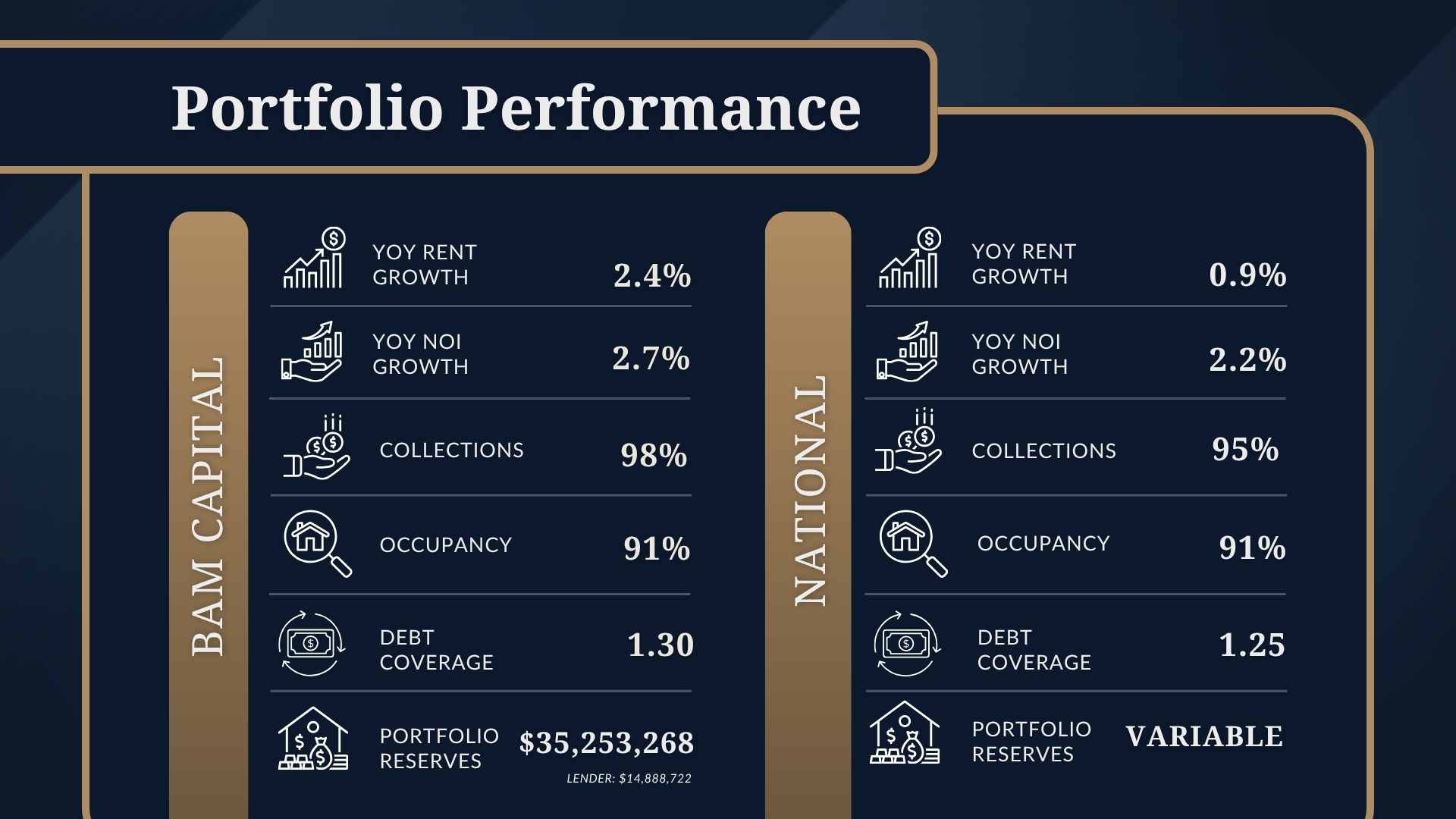
The team shared that occupancy and NOI growth are not currently where they would like them to be given today’s market conditions. Even so, BAM Capital’s portfolio continues to outperform many national benchmarks across several key metrics.
Over the firm’s track record, BAM Capital has generated a 32.19% net IRR and a 2.36x equity multiple, reflecting a long-term focus on disciplined acquisitions and operational execution across different market cycles.
BAM Capital prioritized keeping strong cash reserves, which helps us meet lender requirements and protects the portfolio from market volatility. Early signs suggest that some capital may gradually begin flowing back into the market as investors position for the next phase of the cycle.
The market is still adjusting, but the team believes patient, well-capitalized buyers may be positioned to benefit as conditions continue to evolve.