On conviction, discipline, and why the best time to buy multifamily is precisely when it feels worst
There is an old piece of Wall Street wisdom that nearly everyone repeats and almost no one questions: don’t try to catch a falling knife. Wait for the blade to hit the floor. Wait for the dust to settle. Wait until the uncertainty has been resolved. It sounds like prudence. It feels like discipline. And in my experience, it is one of the most expensive ideas in all of investing.
I want to spend a few pages on that idea, because I think it explains exactly where we are in multifamily today—and why I believe this is one of the most attractive moments to be a buyer that we will see in this cycle.
The Investor Who Made a Career Catching Knives
Few people have thought more carefully about this than Howard Marks, the co-founder of Oaktree Capital and the author of the memos that Warren Buffett says are the first thing he reads when they arrive. Marks has built one of the great investment records of the last forty years by doing the thing everyone else is too frightened to do. In The Most Important Thing, he describes the moment a market breaks:
Whenever the debt market collapses, for example, most people say, “We’re not going to try to catch a falling knife; it’s too dangerous.” They usually add, “We’re going to wait until the dust settles and the uncertainty is resolved.” What they mean, of course, is that they’re frightened and unsure of what to do. The one thing I’m sure of is that by the time the knife has stopped falling, the dust has settled and the uncertainty has been resolved, there’ll be no great bargains left.
Read that last sentence again, because it is the whole game. The discount and the discomfort are the same thing. The reason an asset is cheap is that owning it feels terrible. The moment it stops feeling terrible—the moment the headlines turn, the financing reopens, and the crowd feels safe—the price has already moved. You cannot have the bargain without the fear. They are sold together or not at all.
Marks does not pretend this is comfortable, and he does not pretend it is easy. His conclusion is simply that someone has to do it: “It’s our job as contrarians to catch falling knives, hopefully with care and skill.”
Why “Wait Until It’s Obvious” Is the Losing Move
Marks’s deeper point is about psychology, not bravado. He draws a distinction I think about constantly: skepticism and pessimism are not the same thing. As he wrote in his October 2008 memo The Limits to Negativism, in the depths of the financial crisis:
Skepticism calls for pessimism when optimism is excessive. But it also calls for optimism when pessimism is excessive.
When everyone is euphoric, the skeptic gets cautious. But when everyone is despondent—when no story is too negative to be believed—the skeptic’s job is to get interested. In that same memo, written when the world genuinely felt like it might end, Marks reached a conclusion that turned out to be one of the great calls of his career: “the negatives are on the table, optimism is thoroughly lacking, and the greater long-term risk probably lies in not investing.”
That phrase—the greater risk lies in not investing—is the inversion most people never make. We are wired to see action as risky and waiting as safe. At the bottom of a cycle, it is the reverse. The real risk is sitting in cash, congratulating yourself on your patience, while the bargains are quietly bought by someone with more nerve. As Marks put it, the necessary condition for a bargain to exist at all is that “perception has to be considerably worse than reality.” Bargains are not created by good assets. They are created by good assets attached to bad feelings.
The Part Everyone Forgets: Care and Skill
Here is where I want to be careful, because “catch falling knives” can sound like a license to be reckless. It is the opposite. Marks never says catch every knife. He says catch them with care and skill. The whole philosophy rests on a discipline he laid out plainly in 2008—a formula for buying into a collapsing market: have a firm, well-reasoned estimate of an asset’s intrinsic value; buy when price falls below that value; be willing to average down if it falls further; and—above all—be right about the value.
Contrarianism without analysis is just stubbornness. The edge isn’t doing the opposite of the crowd for its own sake; it’s knowing why the crowd is wrong, and having the balance sheet and the temperament to act on it while everyone else is paralyzed. Marks’s own summary of what it takes—“patient opportunism, buttressed by a contrarian attitude and strong balance sheet”—is as good a description of disciplined real estate investing as I have ever read.
So the question for us is not whether catching knives is brave. The question is whether there is, right now, a real bargain attached to real fear—and whether we have the care and skill to tell the difference between a genuine opportunity and a value trap. I believe the answer to both is yes. Let me show you why.
The Knife That Has Been Falling: Multifamily, 2022–2025
For the better part of three years, multifamily has been the falling knife. After a decade as the most beloved asset class in commercial real estate, apartments got hit by three things at once.
First, the cost of money roughly tripled. As interest rates climbed, capitalization rates expanded by approximately 125 basis points—from a low near 4.5% in early 2022 to the high-5% range—and that repricing alone took something like 20% off the value of stabilized apartment assets. Deals underwritten on cheap, short-term, floating-rate debt in 2021 and 2022 suddenly didn’t work. Transaction volume froze. Sentiment, which had been giddy, turned uniformly grim.
Second, the industry got hit by the largest wave of new apartment supply since the 1980s. Hundreds of thousands of units delivered into softening demand, rents went flat to negative, and every bearish headline wrote itself: oversupplied, overleveraged, over.
Third, the operating side of the business got squeezed by a wave of cost increases that ownership cannot control. Insurance premiums—a quiet line item for two decades—jumped at double-digit rates, and in some Sun Belt markets at multiples of that, as the hard market collided with storms, wildfires, and reinsurance retrenchment. Property tax assessments caught up with the run-up in values, often punishingly. Payroll, materials, and repair costs followed the broader wage cycle higher. The combined effect was a meaningful compression of net operating income at exactly the moment cap rates were widening—two forces pushing valuations in the same direction. The encouraging news is that these uncontrollables are beginning to level off: the insurance market has softened from its 2023 peak, with renewals coming in flat to modestly higher rather than at the eye-watering increases of two years ago; tax assessments are catching up to the reset in values rather than chasing prior peaks; and wage growth has normalized. The expense pressure that helped drive the knife down is no longer accelerating.
That is what a falling knife looks like. And right on cue, most of the capital in our industry did exactly what Marks predicted: it folded its arms and announced it would wait until the dust settles.
Why I Think the Dust Is Starting To Settle—and Why That’s the Point
Here is the uncomfortable truth that makes me want to be a buyer now rather than later: the conditions that created the fear are already reversing, and the crowd has not caught up.
The supply wave is breaking. Deliveries are rolling over hard—from roughly 595,000 units in 2025 toward an estimated 450,000 in 2026, with new construction starts having fallen to their lowest level in nearly a decade and dropping further into 2026. In the markets that were most oversupplied, the pullback is dramatic. The single biggest headwind to apartment rents is, on a clear schedule, about to disappear—right as the units that do deliver get absorbed by a country that remains structurally under-housed.
Rents are bottoming. After a flat-to-negative stretch in 2024 and 2025, national rent growth is projected to turn positive in 2026 and strengthen into 2027 as new supply dries up. Pricing power is returning.
The forced sellers are arriving. This is the part that matters most for buyers with capital and patience. Roughly $162 billion of multifamily loans are scheduled to mature in 2026—up more than 50% from the prior year—much of it the 2021–2022 vintage that was financed at the top with aggressive leverage. Those borrowers are now facing refinancing at rates 200 to 300 basis points above their original debt. Many cannot refinance without writing a large check they don’t have. As one value-add buyer recently put it, operators “unable to stabilize or refinance without bringing cash to the table because their leverage was too high” are creating real opportunities to buy. That is not a forecast. That is happening now.
The smart money is already moving. Apartment sales volume rose about 9% in 2025 to $165.5 billion, and—tellingly—individual asset sales rose 20%, which one data firm called a clear signal that “investors are becoming more comfortable with the income story.” Some of the most disciplined institutional buyers in the country have raised record value-add funds specifically to step in now. Their thesis is almost word for word the one in this letter: most markets have moved past peak supply, values have reset because of higher rates, and the combination “makes for a compelling entry point.”
In Marks’s language: perception is still considerably worse than reality. The story everyone agrees on—apartments are broken—is becoming less true by the quarter, but the prices and the sentiment have not fully repriced. That gap is the bargain.
Catching This One With Care and Skill
None of this means we buy indiscriminately. We don’t. The same dislocation that creates bargains also creates traps—assets in the wrong locations, with the wrong basis, or with capital problems no amount of operational skill can fix. The discipline Marks describes is exactly the discipline we apply: a hard-nosed estimate of real, durable value; a basis well below replacement cost; markets with genuine, lasting housing demand rather than speculative froth; conservative, appropriately structured debt; and a strong enough balance sheet to be patient and, if necessary, to average down rather than be forced to sell.
That last point is what separates the buyers in this market from the sellers. The people being forced to sell are the ones who confused leverage with skill. The people able to buy are the ones who kept their discipline when discipline felt like underperformance. We intend to be firmly in the second group.
The Cost of Waiting
I’ll close where Marks does. The instinct to wait for certainty is human and it is almost always wrong at the bottom. By the time the all-clear sounds—rates lower, financing easy, headlines glowing, everyone comfortable again—the discount will be gone, and we will be competing for assets against the very people sitting on their hands today. The reward for their patience will be the privilege of paying more.
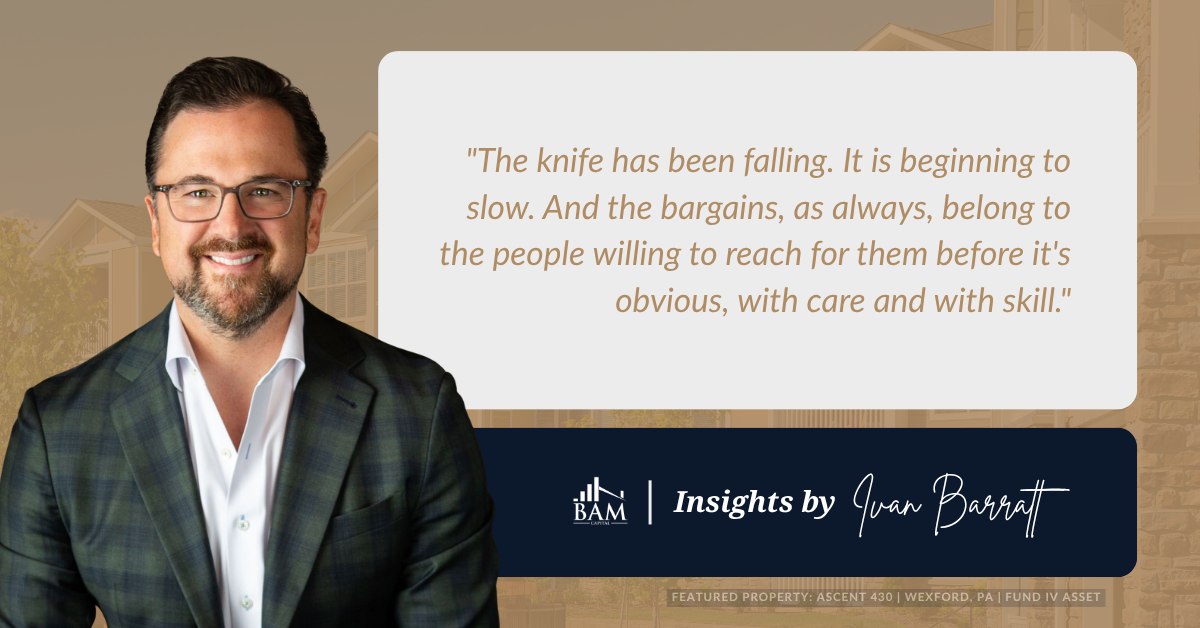
In the darkest week of 2008, Marks wrote to his clients that “in a few years we’ll reminisce together about how easy it was to take advantage of the bargains” of that era. He was right. I think we are in a smaller, quieter version of that same moment in multifamily—less dramatic than a global financial crisis, but built on the identical logic. The knife has been falling. It is beginning to slow. And the bargains, as always, belong to the people willing to reach for them before it’s obvious, with care and with skill.
That is what we intend to do.

Ivan Barratt
Founder & CEO
The BAM Companies
This letter reflects the author’s views and is provided for informational and educational purposes only. It is not investment, legal, or tax advice, and it is not an offer to sell or a solicitation of an offer to buy any security. Forward-looking statements involve assumptions and uncertainties; actual results may differ materially. Past performance and market conditions are not indicative of future results. Real estate investments involve risk, including the possible loss of principal. Market data referenced is drawn from third-party industry sources believed to be reliable as of May 2026 but has not been independently verified.
Disclaimer: This content is for informational purposes only and is not financial, tax, legal, or investment advice, nor an offer or solicitation to buy or sell securities. Investment opportunities offered by BAM Capital and its affiliates are made pursuant to Rule 506(c) of Regulation D, available exclusively to accredited investors, as defined by the Securities and Exchange Commission (SEC) and, if applicable, qualified purchasers, as defined by Section 2(a)(51) of the Investment Company Act of 1940. Verification of accredited investor status is required before participation in any investment.
Contact BAM Capital for details on current offerings. BAM Capital and its representatives are not fiduciaries or investment advisors. The information provided is general and may not reflect individual financial goals. Financial terms, projections, or forward-looking statements contained herein are hypothetical and should not be interpreted as guarantees of future performance or safety. Such statements reflect BAM Capital’s opinion and are subject to market fluctuations, economic conditions, and investment risks. Investing in private real estate securities involves significant risks, including, without limitation, illiquidity, economic downturns, and potential loss of invested funds or capital. Past performance does not predict or guarantee future results. Historical transaction figures represent past performance across multiple deals as of the date this information was published, not a single investment transaction. BAM Capital and its affiliates do not guarantee the accuracy or completeness of this information. Prospective investors are strongly encouraged to conduct independent due diligence and consult with legal, tax, and financial advisors before making any investment decisions.
© 2026 BAM Capital. All rights reserved.