
Expensive Markets, Concentrated Portfolios, and the Case for Owning Housing
Dear Partners,
I want to use this letter to step back from the quarter-to-quarter updates and talk about the bigger picture: what the next decade of returns is likely to look like from here, how the wealthiest families in the country have positioned for it, and why I believe multifamily housing — bought carefully, at today’s prices — is one of the best answers available. I’ll keep the jargon out and put the charts in. If you read nothing else, read the bolded sentences and look at the pictures.
1. The Price You Pay Sets the Return You Get
Let me start with the stock market, because that is where most of the country’s savings sit. I am not going to predict a crash. Nobody can, and the people who try are usually wrong for years before they are briefly right. What I can tell you is arithmetic, and the arithmetic is uncomfortable.
The single best predictor of what stocks return over the next ten years is what you paid for them at the start. Howard Marks at Oaktree put it as well as anyone: it’s not what you buy, it’s what you pay, that determines whether something is a good investment. Right now, by nearly every measure that has ever mattered, U.S. stocks are as expensive as they have ever been. The market’s value relative to the size of the economy is at an all-time high. The Shiller CAPE ratio — a price-to-earnings figure smoothed over ten years — sits near 40, a level exceeded only at the peak of the dot-com bubble.
Here is what history says happens next when you start from levels like this:
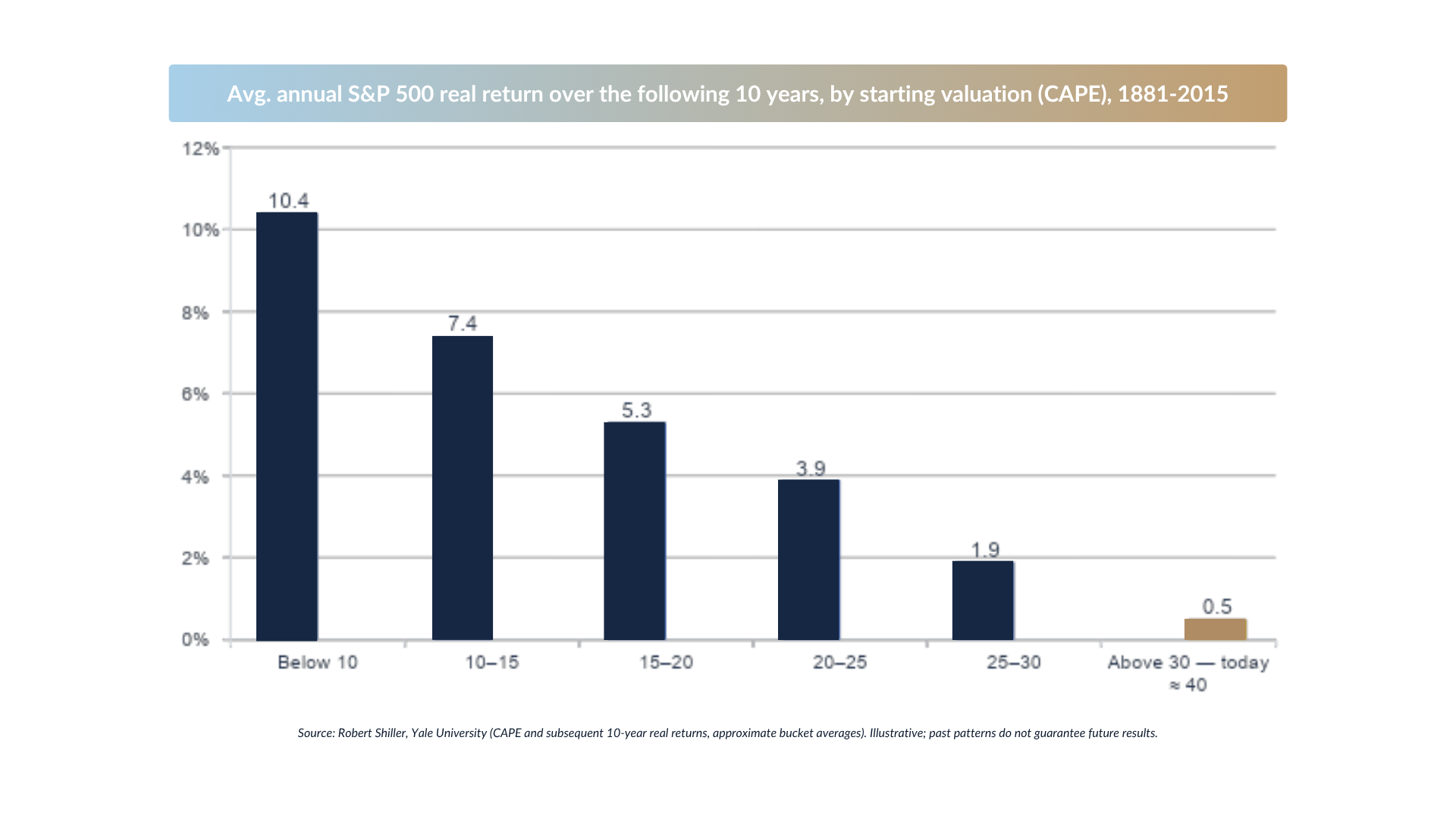
Every bucket in that chart tells the same story: the more you pay going in, the less you earn coming out. From today’s starting point, history points to low single-digit real returns from U.S. stocks over the coming decade — and J.P. Morgan’s own analysis, cited by Marks, found that when investors bought at price-to-earnings levels like today’s, their ten-year returns landed everywhere from plus 2% to minus 2% per year. Not a crash. Just a lost decade.
There is a second, related problem that most people don’t see because it hides inside a name that sounds diversified: the S&P 500. It is not 500 equal companies. Ten of them now make up almost 40% of its value.
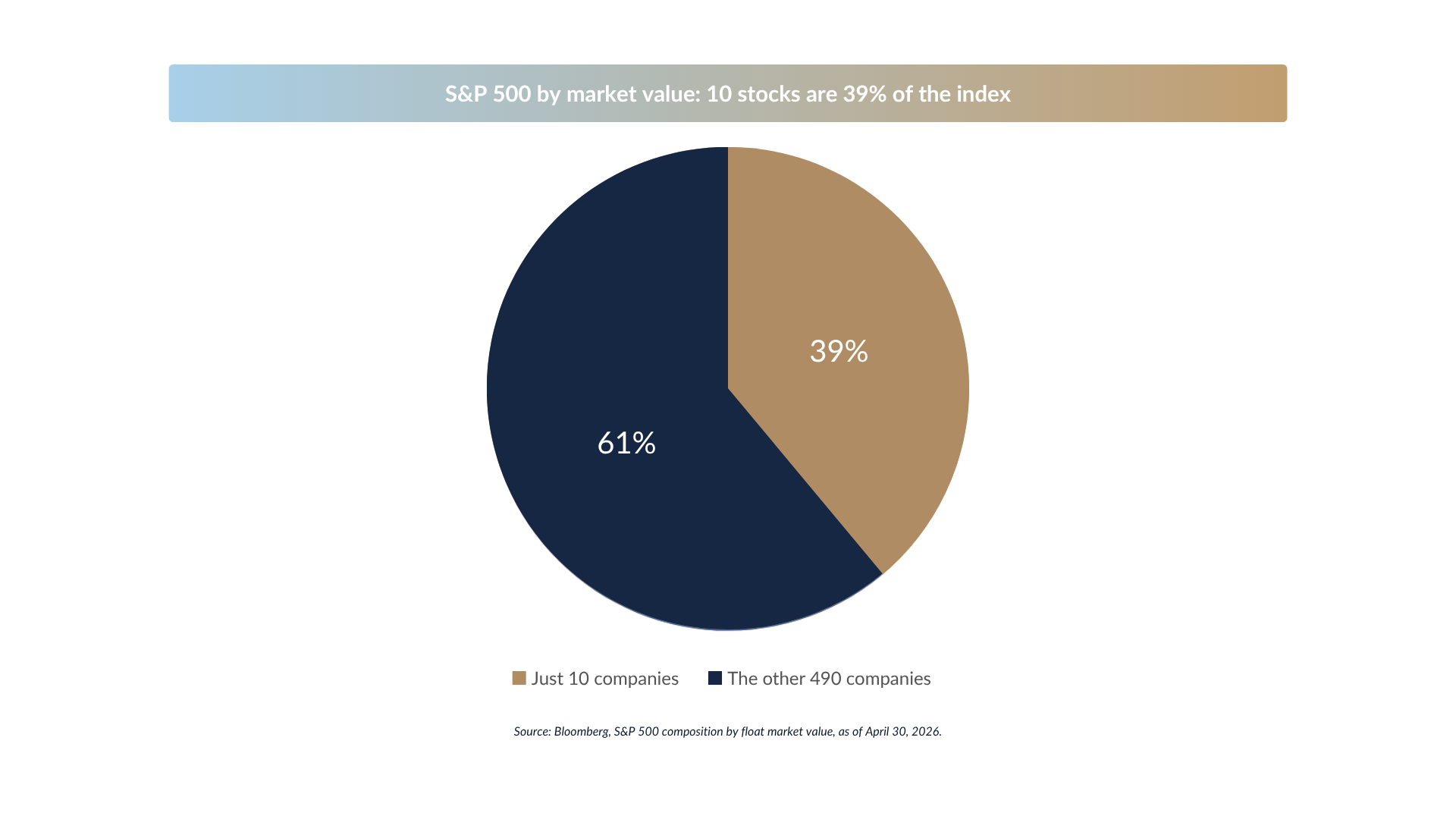
If you run a business, you would never let ten customers make up 40% of your revenue. Yet that is exactly the concentration most index-fund investors are carrying, and those same ten stocks fell 39% in 2022 when the wind shifted. Expensive and concentrated at the same time is not where I want the bulk of my family’s wealth, and I suspect it is not where you want yours either.
2. Where the Diversification Went
The traditional answer to expensive stocks was simple: own bonds. For decades, when stocks fell, bonds rose, and the classic 60/40 portfolio did its job. That relationship has broken. In 2022, stocks and bonds fell together — the worst year for a balanced portfolio in almost a century — and it was not a fluke.
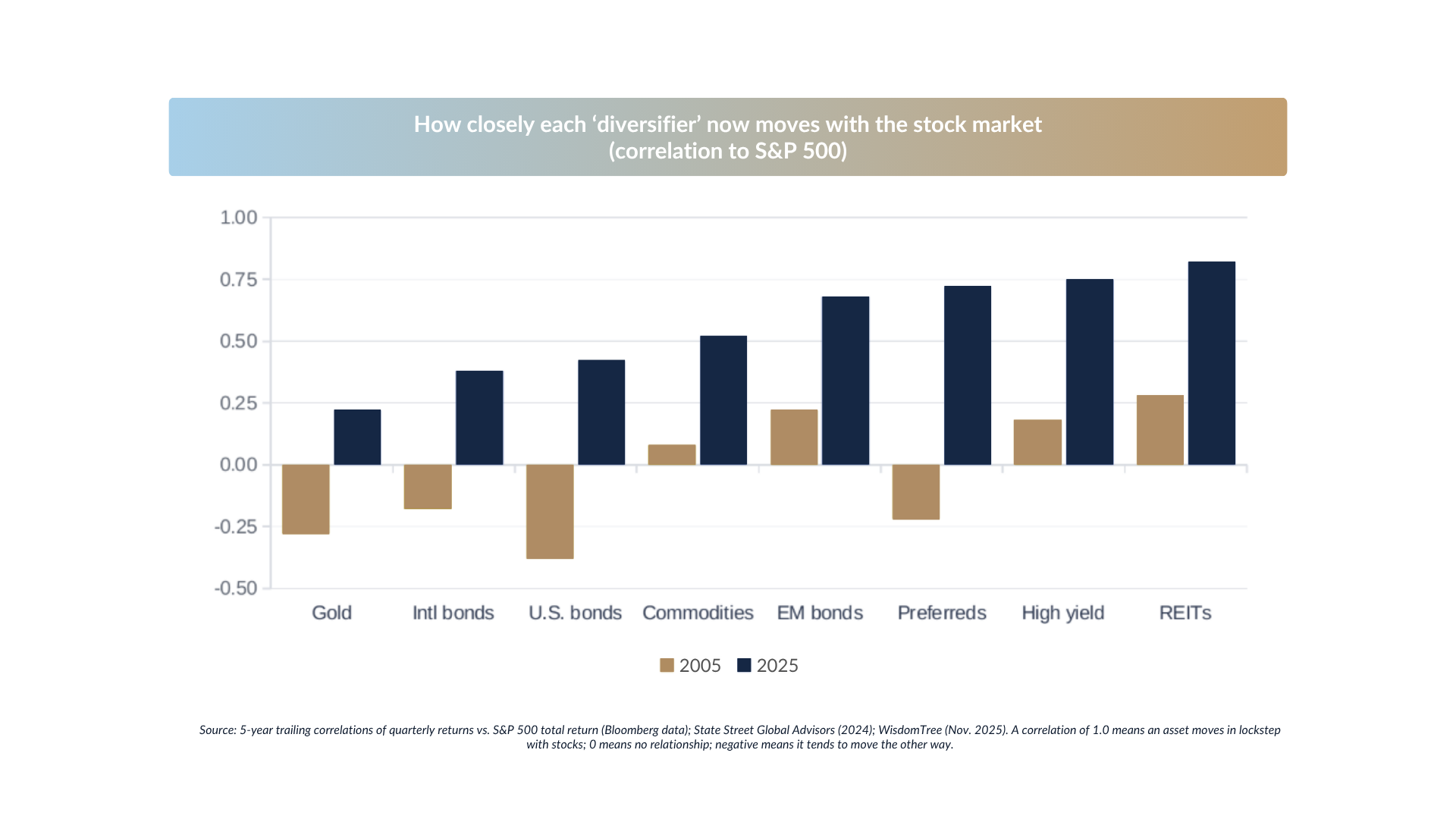
Look at the gold bars versus the blue. Twenty years ago, bonds, gold, and preferred stocks tended to move opposite to the stock market — that is what made them useful. Today every one of them moves with it, and in stress periods the relationship gets tighter, not looser. The things that used to protect a portfolio now fall alongside it precisely when protection matters most. Much of this is structural: trillions of dollars now flow through ETFs that get sold together the moment markets get scared.
I want to be honest about one thing here, because sophisticated readers will raise it. Private real estate looks uncorrelated to stocks partly because it is appraised quarterly rather than priced every second. I do not lean on that statistic. The diversification I believe in is economic, not statistical: an apartment building’s cash flow is driven by rents and occupancy, not by fund flows — and the fact that you cannot sell it in a panic on a Tuesday afternoon is a feature, not a bug. It prevents the forced selling that now synchronizes everything else.
3. What the Wealthiest Families Actually Do
None of this is news to the people with the most to lose. I find it clarifying to look at how families worth $100 million or more actually allocate — not what they say, but where the money sits.
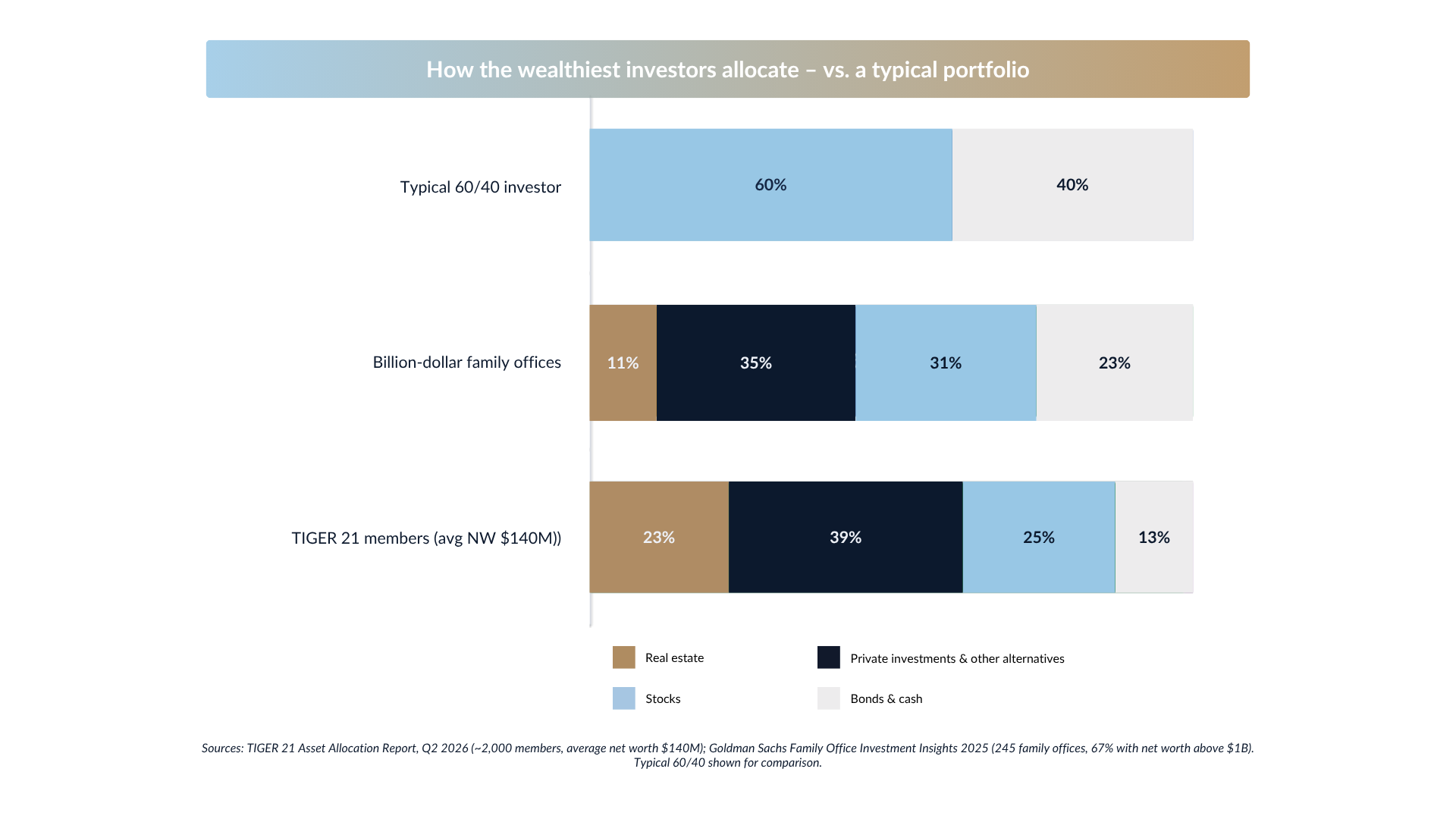
Two independent surveys of the wealthiest investors in the country land on the same pattern: roughly a quarter to a third of their money in the stock market, and somewhere between 46% and 62% in real estate and private investments. Real estate has been the anchor allocation of TIGER 21 members for two decades. These are not people chasing a fad; they are people who have already made their money and are focused on keeping it and compounding it — and they hold nearly half of it outside the public markets entirely.
You do not need $100 million to invest the way they do. That is, in large part, the reason BAM exists: to give accredited investors the same access to institutional-quality private real estate that the largest families have always had. And a reasonable version of that playbook does not require anyone to abandon stocks — it means treating private real estate as a real allocation, in the range of five to ten percent of a portfolio to start, rather than an afterthought.
4. The Case for Multifamily, Specifically
Within real estate, I have spent sixteen years in one corner of it — apartments — and I have never been more convinced of the long-term case than I am right now. It rests on three facts, and I’ll take them one at a time.
Fact one: the math forces people to rent.
For most of the last decade, owning a home cost roughly $300 a month more than renting one — the long-run norm, and a gap most families could stretch to close. Since 2022, that gap has exploded.
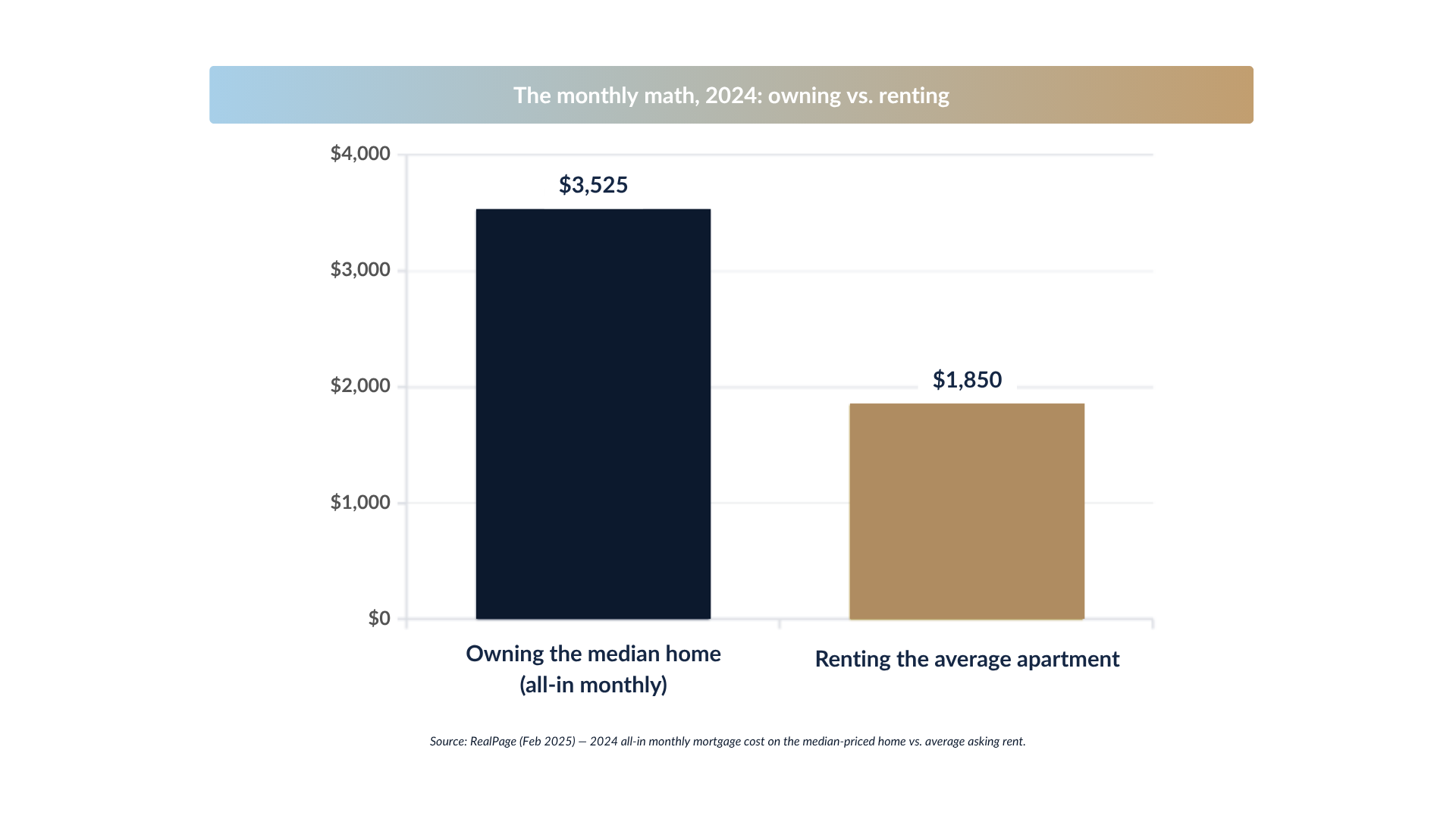
Owning now costs roughly $1,700 a month more than renting. The median first-time homebuyer is now 40 years old, a record; their share of purchases is at a record low; and by John Burns’ math, mortgage rates would need to fall to about 3.5% — from roughly 6.7% today — for the buy-versus-rent decision to normalize. That is not happening soon. So people rent, and in 2025 nearly four out of every five new households in America were renter households. This is a decade-long demand story, not a cyclical blip.
Fact two: nobody is building.
Demand alone doesn’t make an investment; you need supply to be scarce. It is. Construction starts have collapsed to levels last seen in 2011, and the pipeline of apartments under construction — which peaked at a million units in mid-2023 — is draining fast.
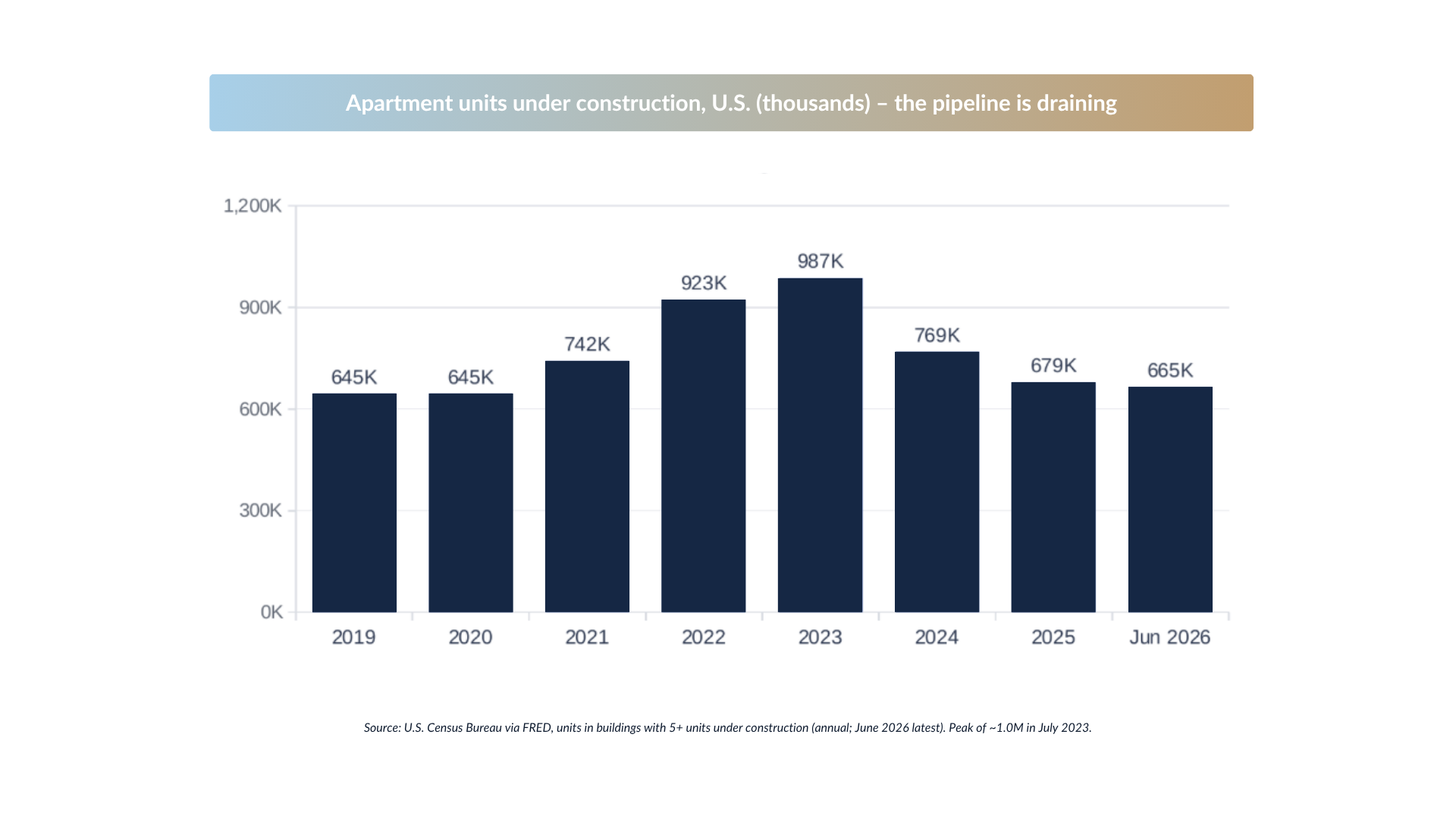
Deliveries fall through 2027 to the fewest since 2013 — and last quarter renters absorbed 2.4 times as many apartments as were completed. More renters and fewer new buildings is the simplest equation in economics, and it resolves in one direction: rising rents. Why can’t builders just build more? Because at today’s interest rates and construction costs, new projects don’t pencil — and they won’t until rents rise enough to justify them. That is exactly the point. The shortage protects the buildings that already exist.
Fact three: great buildings are on sale — because their owners’ loans are not.
The last piece is the entry price, and this is where the opportunity becomes unusual. Between 2021 and 2022, a great deal of multifamily was bought at peak prices with floating-rate, short-term debt that only made sense when money was nearly free — and a wave of developers broke ground on the same assumptions. Rates jumped, apartment values fell roughly 19% from their peak, and now roughly $330 billion of those loans come due in 2026 and 2027. Those owners and builders are not selling because their buildings are bad. They are selling because their balance sheets are broken.
The result is the best buying window I have seen in nearly twenty years: institutional-quality — in some cases brand-new — apartments trading at roughly 20% below what it would cost to build them today. You cannot build the competition for that price. And because the distress is in the capital structures rather than the assets, a disciplined buyer with fresh equity and conservative leverage is not catching a falling knife — they are buying good real estate from a motivated seller at the bottom of the cycle, just as the fundamentals turn.
5. Putting It Together
If you take one thing from this letter, take this: the next decade will probably not look like the last one. Starting from today’s prices, the public markets are likely to deliver less than people have grown accustomed to, and the old hedges will protect less than they used to. The wealthiest families have already positioned for that world by holding a large share of their wealth in real assets and private investments. And within real assets, apartments in supply-constrained markets — bought at a discount, from forced sellers, into structurally rising demand — offer something rare: a business you can understand, income you can see, and an entry price that does most of the work for you.
An apartment building, after all, is just a business. Rents minus operating costs is its earnings; the value of the building is those earnings times a multiple. Grow the earnings, and the value follows — the same playbook any operator would run. We happen to run it on buildings, with our own capital invested alongside yours.
As always, none of this is a guarantee, and I would rather you understand the risks than be surprised by them: private real estate is illiquid, funds use debt, values move in cycles, and targeted returns are exactly that — targets. If anything in this letter raises questions about your own allocation, please call. My team and I are glad to walk through it with you and your advisor.
Thank you for the trust you place in me and in our team. It is a privilege to steward your capital through what I believe will be remembered as one of the great buying windows of our careers.
Most sincerely,

Ivan Barratt
Founder & CEO, BAM Capital
This letter is for informational and educational purposes only and does not constitute an offer to sell or a solicitation of an offer to buy any security. Any offering is made only through the applicable Private Placement Memorandum to verified accredited investors. Statements about future returns, market conditions, and targeted results are forward-looking, are based on current beliefs and assumptions, and are subject to risks and uncertainties; actual results may differ materially. Private real estate investments are illiquid, use leverage, and can lose value. This is not financial, legal, or tax advice — please consult your own advisors. Third-party data is from sources believed reliable but is not guaranteed. PAST PERFORMANCE IS NOT A GUARANTEE OF FUTURE RESULTS.
Disclaimer: This content is for informational purposes only and is not financial, tax, legal, or investment advice, nor an offer or solicitation to buy or sell securities. Investment opportunities offered by BAM Capital and its affiliates are made pursuant to Rule 506(c) of Regulation D, available exclusively to accredited investors, as defined by the Securities and Exchange Commission (SEC) and, if applicable, qualified purchasers, as defined by Section 2(a)(51) of the Investment Company Act of 1940. Verification of accredited investor status is required before participation in any investment.
Contact BAM Capital for details on current offerings. BAM Capital and its representatives are not fiduciaries or investment advisors. The information provided is general and may not reflect individual financial goals. Financial terms, projections, or forward-looking statements contained herein are hypothetical and should not be interpreted as guarantees of future performance or safety. Such statements reflect BAM Capital’s opinion and are subject to market fluctuations, economic conditions, and investment risks. Investing in private real estate securities involves significant risks, including, without limitation, illiquidity, economic downturns, and potential loss of invested funds or capital. Past performance does not predict or guarantee future results. Historical transaction figures represent past performance across multiple deals as of the date this information was published, not a single investment transaction. BAM Capital and its affiliates do not guarantee the accuracy or completeness of this information. Prospective investors are strongly encouraged to conduct independent due diligence and consult with legal, tax, and financial advisors before making any investment decisions.
© 2026 BAM Capital. All rights reserved.