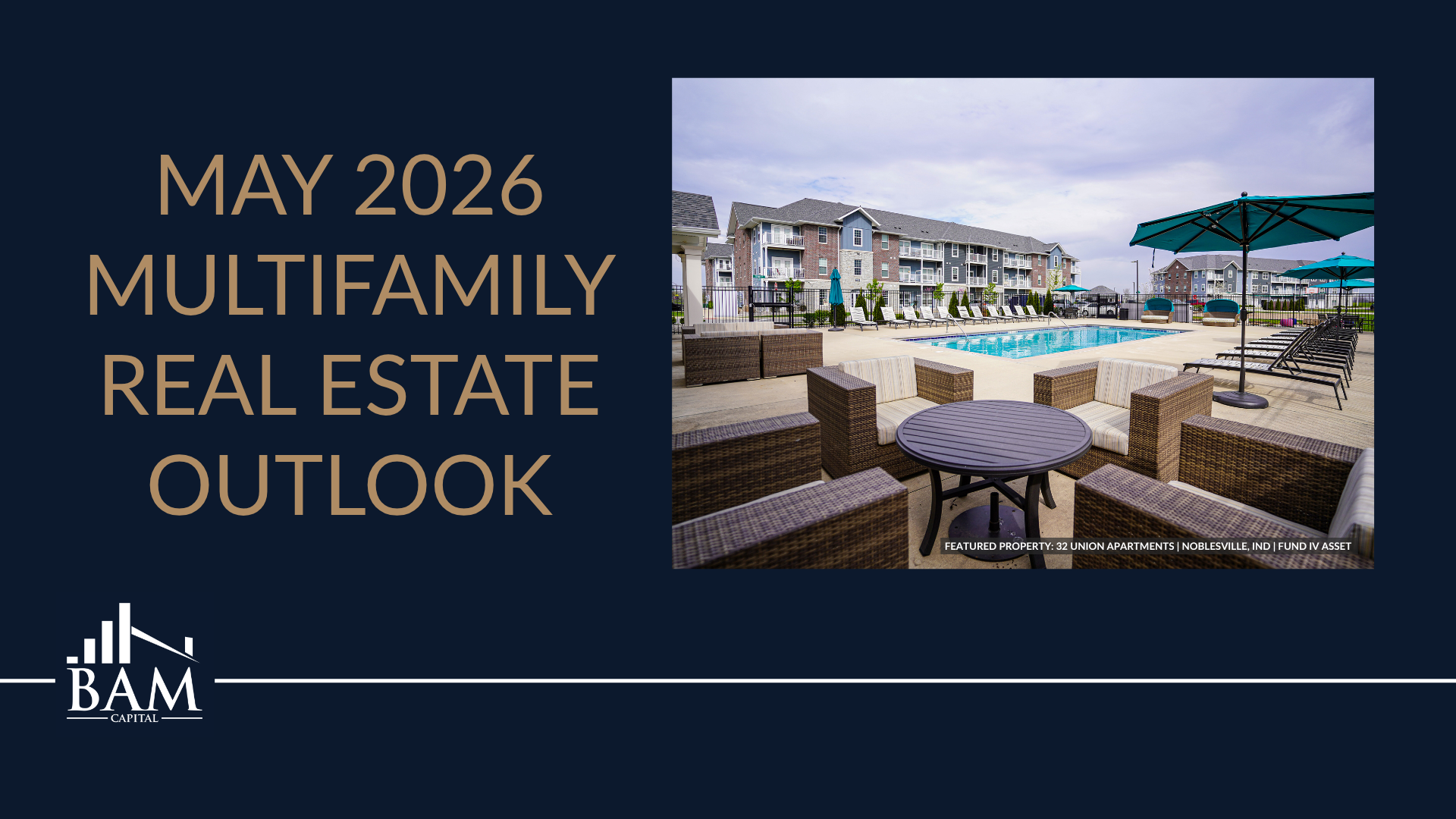
The multifamily real estate market is showing encouraging signs this spring. Nationally, steady renter demand outpaced new completions during the first quarter of 2026, signaling that the industry is beginning to work through the recent supply wave. Across BAM Capital’s core footprint, market fundamentals remain healthy, and the Midwest continues to lead the nation in rent growth.
In our May Multifamily Real Estate Report, we break down the latest national and regional market trends and what they mean for our investors.
The Big Picture: Demand Takes the Lead
The multifamily market started to shift earlier this year. National apartment demand totaled 78,100 units, while new completions were 58,100 units.¹ This was the first time in three quarters where demand outpaced new supply.
Leasing activity was positive in 63 of the 69 tracked markets, indicating steady absorption of the inventory delivered during 2024 and 2025. Regionally, the Midwest led the U.S. in year-over-year rent growth at +2.2%, aligning directly with BAM Capital’s core geographic footprint.
Inflation in April was higher than expected, with the Consumer Price Index (CPI) reaching 3.8%.² This pushed the 10-year Treasury yield to 4.595% and made interest rate cuts from the Federal Reserve less likely in the coming months.
While higher borrowing costs may slow transaction activity in the short term, they also make new construction projects more difficult to finance. Over time, fewer new starts should reduce competitive supply and help support existing assets.
Indiana: A Healthy Balance Between Supply and Demand
Indiana continues to benefit from steady renter demand and new development.
Occupancy across the Indianapolis metro remains near 94%, with surrounding submarkets like Carmel, Lawrence, Bloomington, and Fort Wayne showing even stronger performance and solid rent growth.
Although more than 4,400 units³ remain under construction throughout the Indianapolis area, the pipeline represents only a small portion of total inventory. Demand has remained strong enough to absorb new deliveries without disrupting the market.
Affordability is also supporting long-term rentals. While Indianapolis continues to receive national recognition as an attractive housing market, owning a home now costs substantially more than renting. As that gap widens, many households are choosing to rent longer before transitioning to homeownership.
For BAM Capital’s Indiana portfolio, this creates a larger and more stable renter base while supporting long-term occupancy.
Des Moines, Iowa: Supply Pressure Continues to Ease
Des Moines is stabilizing as the market works through a recent period of new apartment deliveries.
Demand has surged over the past year, with apartment absorption hitting roughly 1,900 units, nearly 70% above historical averages.⁴ At the same time, the development pipeline has declined significantly.
As fewer projects move forward, several favorable trends typically follow:
- Vacancy rates begin to stabilize
- Competition from new deliveries decreases
- Rental concessions become less common
- Existing communities gain greater pricing power
Local economic growth also continues to support the market. Vermeer Corporation recently announced plans for a new advanced manufacturing facility in the Des Moines area, which is expected to bring more than $100 million in investment and create hundreds of jobs, according to news reports.
For BAM Capital’s Iowa portfolio, slowing supply and steady job growth support long-term performance.
Kansas City, Missouri: Demand Absorbs New Deliveries
Renter demand in Kansas City remains steady. Leasing activity is outpacing the number of new units coming online, helping the market absorb the new supply delivered over the past several years. Occupancy across the metro area remains stable at approximately 94.9%, and rents continue to trend upward, with submarkets like Platte and Clay counties posting rent growth above 5% YoY.
The area is also benefiting from large-scale investment projects. The planned $3 billion Royals ballpark district development is a major mixed-use project driven by private investment. Along with expected population growth downtown, it is likely to bring new residents, businesses, and economic activity to the area.
For BAM Capital assets like Altitude 970 and Kinsley Forest, a slower pace of new construction should support leasing activity as the local market stabilizes further.
Northwest Arkansas: Population Growth Drives Demand
Northwest Arkansas is one of the strongest long-term growth markets for BAM Capital.
Rent growth has slowed as the market works through recent supply, but demand remains strong. Home prices have almost doubled since 2020, making homeownership less accessible and keeping people renting longer.
The region adds about 38 new residents every day (roughly 13,000+ annually),⁵ which creates consistent housing demand across the market. Northwest Arkansas also recently earned recognition as the No. 1 Best-Performing Large Metro in the U.S. (Milken Institute 2026), driven by wage growth, job creation, and business expansion. Major employers—including Walmart, Tyson Foods, and J.B. Hunt—continue to support the area’s economic growth.
Pittsburgh, Pennsylvania: Limited Supply Supports Stability
In Pittsburgh, occupancy remains above the national average at approximately 94.6%, and new apartment deliveries represent just 1.1% of total inventory in 2025,⁶ one of the lowest supply rates among major U.S. metros. Unlike many Sun Belt markets that saw rapid development in recent years, Pittsburgh has experienced slower construction growth.
With limited new supply, existing properties face less competition and benefit from more stable conditions.
The city is also seeing continued investment downtown. A proposed convention center/hotel and related projects are expected to bring hundreds of millions of dollars in investment and spark ongoing revitalization efforts.
For BAM Capital properties such as Ascent 430 and Nox Apartments, continued reinvestment in downtown Pittsburgh increases the long-term appeal of nearby neighborhoods and supports future leasing.
The Bottom Line for Investors
The data points to a market transitioning into a more balanced phase after two years of elevated supply.
Across BAM Capital’s target markets, a few key trends stand out:
- Demand is now exceeding new supply in many areas
- Construction activity is slowing
- Occupancy remains healthy across core regions
- Job growth and investment continue to support renter demand
- Higher development costs are limiting new competition
While interest rates continue to influence the real estate market, underlying fundamentals are gradually improving as supply pressure eases.
For investors, execution matters more than ever in this environment. As markets normalize, performance is increasingly driven by strong operations, disciplined asset management, and local market expertise.
Overall, the data continues to point to a more stable and balanced cycle across BAM Capital’s portfolio.
¹ CBRE, Figures | U.S. Multifamily | Q1 2026
² U.S. Bureau of Labor Statistics, April 2026 CPI Summary
³ MMG Real Estate Advisors, Indianapolis Q1 2026 Pipeline Report
⁴ CoStar Market Analytics, Multifamily Market Report
⁵ Axios NW Arkansas
⁶ Yardi Matrix, Matrix Multifamily Pittsburgh Report-April 2026
Disclaimer: This content is for informational purposes only and is not financial, tax, legal, or investment advice, nor an offer or solicitation to buy or sell securities. Investment opportunities offered by BAM Capital and its affiliates are made pursuant to Rule 506(c) of Regulation D, available exclusively to accredited investors, as defined by the Securities and Exchange Commission (SEC) and, if applicable, qualified purchasers, as defined by Section 2(a)(51) of the Investment Company Act of 1940. Verification of accredited investor status is required before participation in any investment.
Contact BAM Capital for details on current offerings. BAM Capital and its representatives are not fiduciaries or investment advisors. The information provided is general and may not reflect individual financial goals. Financial terms, projections, or forward-looking statements contained herein are hypothetical and should not be interpreted as guarantees of future performance or safety. Such statements reflect BAM Capital’s opinion and are subject to market fluctuations, economic conditions, and investment risks. Investing in private real estate securities involves significant risks, including, without limitation, illiquidity, economic downturns, and potential loss of invested funds or capital. Past performance does not predict or guarantee future results. Historical transaction figures represent past performance across multiple deals as of the date this information was published, not a single investment transaction. BAM Capital and its affiliates do not guarantee the accuracy or completeness of this information. Prospective investors are strongly encouraged to conduct independent due diligence and consult with legal, tax, and financial advisors before making any investment decisions.
© 2026 BAM Capital. All rights reserved.