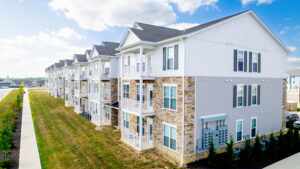

Multifamily acquisition criteria are the checklist a sponsor uses to decide if a property is worth the time and capital. It is a set of clear signals, such as market trends, property fundamentals, and financial benchmarks, that help separate solid opportunities from risky bets. This guide walks investors through what to look for, enabling them to understand what makes a substantial acquisition.
What This Guide Covers:
- Location criteria that signal long-term demand
- Property fundamentals that drive durable performance
- Financial metrics that support risk-adjusted returns
- Management and operational standards
- Exist strategy assumptions that protect investor capital
- Red flags to watch for in any sponsor
- How BAM Capital applies institutional-grade multifamily acquisition criteria
Location Criteria
In multifamily investing, location is a salient predictor of long-term performance. Savvy multifamily sponsors seek to identify metros where demand is durable, growth is sustainable, and risk remains contained.
| Location Criteria | Strong Market Indicators | Red Flags |
| Population Growth | +1–2% YoY growth | Flat or declining |
| Job Market | Unemployment <5% | Job losses rising |
| Rent Affordability | Rent burden <30% | 30%+ rent burden |
| Economic Mix | Diverse industries | Single-sector heavy |
| Supply Pipeline | New supply <2% | Oversupply pressure |
| Occupancy | 94–96% stabilized | Volatile occupancy |
| Rent Growth | 2–4% YoY growth | Unsustainable spikes |
- Population & Job Growth: Strong markets share one trait: people are moving in. Steady population and employment growth naturally increase housing demand.
- Rent Growth & Affordability: Healthy markets keep rent-to-income ratios in balance, allowing rent growth without straining tenants or destabilizing occupancy.
- Economic Diversification: Markets with diverse industries tend to perform better across different market cycles. A diverse job base keeps rental demand resilient even if one sector slows.
- Supply Pipeline: Too much new construction can dilute demand. Strong markets maintain moderate supply growth relative to population and job gains, supporting occupancy and long-term rent growth.
Property Criteria
Once a market clears the first round of evaluation, the next step is assessing the property itself. Institutional sponsors follow a checklist to ensure the physical condition, operational profile, and financial performance support long-term returns.
| Property Criteria | Typical Metrics Used | What This Means for You |
| Class & Vintage | Class A–B; 1990s+ builds | Lower operational risk |
| Physical Condition | Systems w/ 10–15 yrs life | Fewer surprise expenses |
| Value-Add Potential | $100–$200 rent premiums | Real NOI growth |
| Cap Rates | 5–6% Midwest typical | Priced with margin |
| Occupancy Trends | 94–96% stabilized | Strong, steady demand |
| Expense Ratio | 35–45% of EGI | Efficient operations |
| Turnover | Under 45% annually | Better resident retention |
- Class & Vintage: Sponsors favor Class A and B communities, or B assets with upgrade potential, because they offer strong rent growth without the volatility of older, distressed buildings.
- Physical Condition: Roofs, HVAC, plumbing, and major systems are evaluated closely. Properties with clean fundamentals avoid costly surprises that can erode returns.
- Value-Add Potential: Strong deals show a realistic path to higher NOI through renovations, efficiency gains, or amenity upgrades backed by market comps.
- Cap Rates: Cap rates help determine whether the price reflects risk. Sponsors look for a margin of safety that accounts for rate shifts and future cap-rate changes.
- Occupancy Trends: Stabilized properties provide predictable income; lease-up or high-vacancy assets carry higher risk and require stronger operational execution.
Financial Criteria
Institutional underwriting relies on key financial metrics to determine whether a property can generate stable cash flow, withstand shifting market conditions, and deliver competitive risk-adjusted returns. While exact figures vary by strategy, most multifamily deals fall within a predictable range.
| Financial Criteria | Typical Industry Range | What It Indicates |
| DSCR | 1.20x-1.35x | Strong debt coverage |
| IRR | 8-18%+ | Risk-adjusted returns |
| Equity Multiple | 1.8x–2.2x | Total wealth created |
| LTV (Leverage) | 60–75% | Balanced leverage risk |
| Stress Testing | –5% rents, +10% expenses, +50–100 bps cap rate | Downside resilience |
- Debt Service Coverage Ratio (DSCR): Measures how well NOI covers debt. A DSCR above 1.20x is healthy; most conservative sponsors underwrite to 1.25x–1.35x for added protection.
- Internal Rate of Return (IRR): Captures the annualized return over the life of the investment, Core/Core-Plus assets target 8–12%; value-add deals typically model 13–18%+.
- Equity Multiple: Indicates total wealth created. A 2.0x multiple means investors double their money over the hold period.
- Loan-to-Value (LTV): Indicates leverage level. Institutional sponsors typically use 60–75% LTV to balance returns with downside protection.
- Sensitivity Analysis: Models rent drops, expense increases, and cap-rate expansion to ensure performance holds up under tougher conditions, not just best-case scenarios.
*These targets are theoretical, are based on specific underwriting assumptions (e.g., exit cap
rates, rent growth, and hold period), and are not a guarantee of future returns. Actual
returns may differ.
Management Criteria
Even the strongest acquisition can underperform if day-to-day operations aren’t handled with discipline. That’s why institutional sponsors evaluate who is running the property and how efficiently the asset can be operated over time.
| Management Criteria | Typical Benchmark | What It Indicates |
| Expense Ratio | 35–45% of revenue | Operational efficiency |
| Turnover Rate | 40–55% annually | Resident stability |
| Maintenance Response | < 24–48 hours | Strong service and resident satisfaction |
| Work Order Completion | 90%+ on time | Effective operations |
| Renewal Rate | 50–60%+ | High retention |
| Collections | 98–99% monthly | Income reliability |
| Occupancy | 94–96% stabilized | Healthy demand |
| Delinquency Rate | < 1–2% | Strong credit control |
- In-House vs. Third-Party Management: Sponsors with vertically integrated teams, i.e., those who handle acquisition, construction, and property management under one roof, maintain stronger cost control and execute operational decisions faster.
- Operational KPIs: Metrics like expense ratios, turnover rates, and maintenance response times show how efficiently a property is running.
- Technology & Reporting: Top operators use real-time analytics to track occupancy, collections, and work orders.
- Resident Experience: Retention-focused management helps keep occupancy stable and reduces turnover costs.
Exit Strategy Criteria
An acquisition isn’t complete without a clear, realistic exit plan. Institutional sponsors model multiple pathways to ensure investors understand how and when value will be realized.
| Exit Strategy Criteria | Typical Benchmark | What It Signals |
| Hold Period | 2–10 years | Timeline to execute plan |
| Exit Cap Rate | +50–75 bps from entry | Conservative valuation |
| Market Liquidity | Strong buyer depth | Efficient disposition |
| Refinance Window | Years 3–5 (typical) | Equity return potential |
| Valuation Stress Test | +50–100 bps cap movement | Downside protection |
| Disposition Timing | Market-cycle aligned | Optimized exit pricing |
- Hold Period Targets: Most institutional acquisitions underwrite to a 2–10 year hold, depending on renovation scope, market cycle positioning, and the timing needed to fully execute the business plan.
- Exit Cap Rate Assumptions: Sponsors use conservative exit cap rates: typically 50–75 basis points higher than the entry cap to guard against market softening and avoid relying on aggressive future valuations.
- Disposition Readiness: A strong exit depends on market liquidity and buyer demand. Sponsors evaluate how easily similar assets have traded to ensure the property can be sold efficiently once value is created.
- Refinance Opportunities: Some assets offer a chance to recapitalize mid-cycle, returning a portion of investor equity while extending the hold and letting long-term appreciation compound.
Red Flags to Look Out for When Choosing a Sponsor
Not all sponsors operate with the same discipline. Understanding the most common red flags helps investors avoid deals that look attractive on paper but rely on assumptions that don’t hold up in the real world.
- Overly optimistic rent growth: Projections not supported by local wages, comps, or demographic trends. These assumptions create unrealistic pro formas and increase the risk of missed returns.
- Aggressive leverage: High LTV or interest-only loans that increase vulnerability to rate shifts. When debt costs rise or cash flow dips, these deals become unstable quickly.
- Weak market liquidity: Few comparable sales, making future exits slower or less profitable. Limited liquidity can trap capital longer than intended.
- Deferred maintenance gaps: Major repairs are often underestimated or ignored, resulting in unexpected capital needs. Unexpected CapEx cuts into distributions and reduces total returns.
- Limited local expertise: Sponsors without on-the-ground experience may misread demand, rents, or operational needs. Weak local knowledge often leads to underperformance and higher vacancy.
BAM Capital’s Institutional Acquisition Criteria
BAM Capital applies the same rigorous standards used by leading private equity firms, but with a level of operational control and risk management designed specifically for long-term, stable performance.
- Midwest Focus: BAM invests primarily in Midwest metros known for consistent rent growth, low volatility, and healthy DSCR ratios.
- Vertical Integration: In-house construction, management, and asset oversight create tighter cost and timeline control.
- Underwriting Discipline: Deals are stress-tested under tougher economic scenarios to ensure performance isn’t dependent on perfect conditions.
- Sponsor Alignment: BAM Capital has skin in the game and co-invests significant capital alongside investors in every fund, ensuring incentives are shared and risk is mutually held.
- Track Record of Consistency: BAM has never missed a preferred return across all completed funds to date, speaking to the resilience of its process, markets, and management approach.
The Bottom Line: Why Disciplined Multifamily Acquisition Criteria Matter
Multifamily acquisitions are won or lost long before closing day. The sponsors who deliver steady returns aren’t guessing. They follow disciplined, data-driven multifamily acquisition criteria from start to finish. This means targeting strong markets with job growth, employing conservative underwriting, building resilient cash flow models, and establishing a clear exit plan. It’s not about chasing trends. It’s about sticking to fundamentals that hold up when conditions change.
At BAM Capital, we apply these standards to every acquisition and execute them through fully integrated operations. With acquisition, asset management, construction, and property management all under one roof, we maintain control at every stage and keep performance aligned with investor goals.
This approach helps reduce risk, protect capital during downturns, and create a clear path toward income and long-term appreciation. It’s a simple formula, but it works: steady hands, smart assets, and a focus on building wealth over time.
Ready to see if we’re the right fit for your portfolio? Schedule a call today to learn how BAM Capital can help you build long-term wealth through our real estate syndication returns.
For additional multifamily real estate insights, visit Pathways to Passive Wealth, BAM Capital’s new platform designed to make real estate investing more accessible, transparent, and achievable for aspiring and experienced investors.