
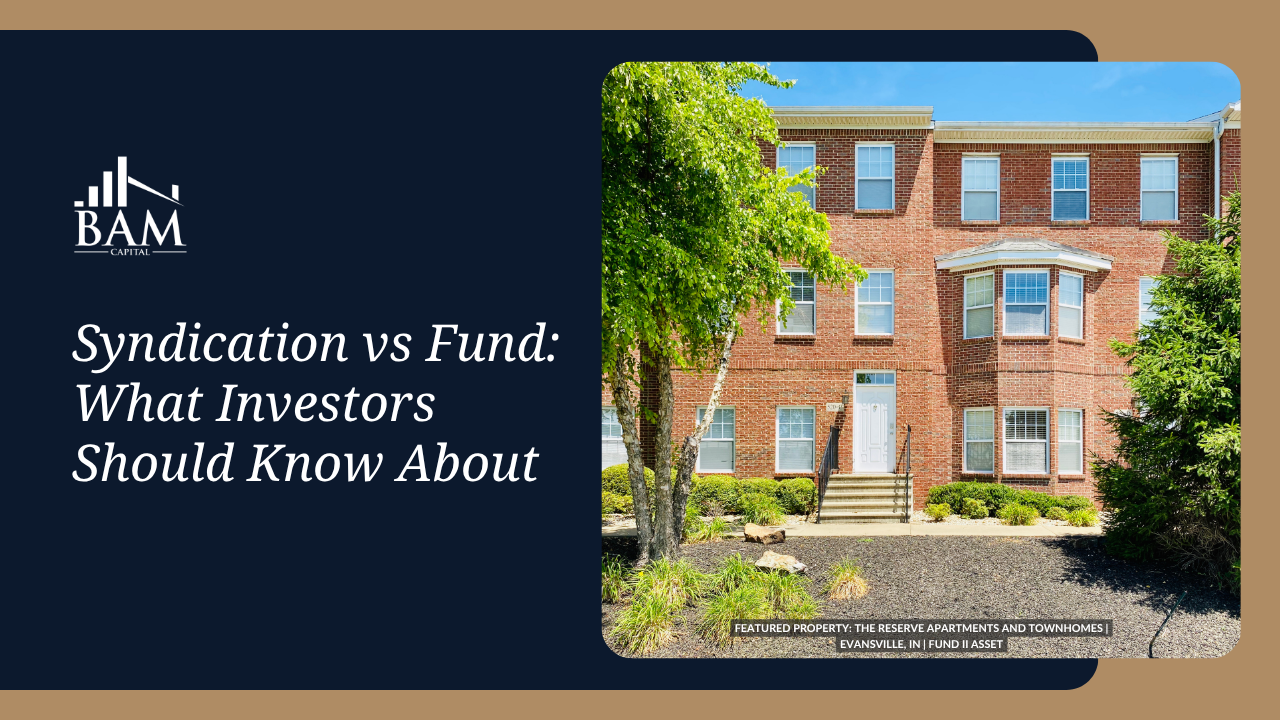
Syndications and funds are often used interchangeably in multifamily real estate, but they are structured differently and offer distinct experiences for investors, even though both provide access to the asset class.
In a traditional syndication, investors typically place capital into a single, specific property. That means you can review the individual asset, the market, and the business plan before deciding whether to invest.
A fund works differently: your capital is pooled and allocated across multiple investments selected by the sponsor. While this involves risks related to the sponsor’s discretion and fund-level administrative expenses, a fund can also leverage economies of scale—such as consolidated legal, accounting, and operational costs—spread across a broader portfolio.
Why It Matters
The difference often comes down to what matters most to you.
A syndication can offer:
- More visibility into each property
- A clearer connection to a single asset
- Ability to select investments on a deal-by-deal basis
A fund can offer:
- Broader diversification
- Less concentration risk
- A more hands-off experience
The Trade-Off to Understand
With a fund, you may not need to evaluate every deal yourself, but that also means placing more trust in the sponsor making those decisions for you.
That is why experience, discipline, and operational quality matter even more in a fund structure.
For investors who want passive exposure without reviewing every opportunity individually, a fund can provide a simpler way to invest.
Access the Fund Offering Memorandum
If you would like to see how BAM Capital’s fund structure works, request access to the Fund Offering Memorandum to review the strategy in more detail.
Disclaimer: This content is for informational purposes only and is not financial, tax, legal, or investment advice, nor an offer or solicitation to buy or sell securities. Investment opportunities offered by BAM Capital and its affiliates are made pursuant to Rule 506(c) of Regulation D, available exclusively to accredited investors, as defined by the Securities and Exchange Commission (SEC) and, if applicable, qualified purchasers, as defined by Section 2(a)(51) of the Investment Company Act of 1940. Verification of accredited investor status is required before participation in any investment.
Contact BAM Capital for details on current offerings. BAM Capital and its representatives are not fiduciaries or investment advisors. The information provided is general and may not reflect individual financial goals. Financial terms, projections, or forward-looking statements contained herein are hypothetical and should not be interpreted as guarantees of future performance or safety. Such statements reflect BAM Capital’s opinion and are subject to market fluctuations, economic conditions, and investment risks. Investing in private real estate securities involves significant risks, including, without limitation, illiquidity, economic downturns, and potential loss of invested funds or capital. Past performance does not predict or guarantee future results. Historical transaction figures represent past performance across multiple deals as of the date this information was published, not a single investment transaction. BAM Capital and its affiliates do not guarantee the accuracy or completeness of this information. Prospective investors are strongly encouraged to conduct independent due diligence and consult with legal, tax, and financial advisors before making any investment decisions.
© 2026 BAM Capital. All rights reserved.