

It’s an underrated but essential metric. The concept of “yield on the last dollar” or “last dollar basis” in real estate refers to the total capitalization of a project, including all financing layers (such as senior debt, preferred equity, etc.) or a specific layer’s position within the capital stack. The “last dollar yield” is often discussed with the underwriting of preferred equity investments. Preferred equity sits above the common equity in the capital stack but is subordinate to the senior debt. Therefore, the “last dollar” refers to the preferred equity’s highest loan-to-value or the total capitalization achieved when including the preferred equity alongside the senior debt.
Understanding the Last Dollar Basis
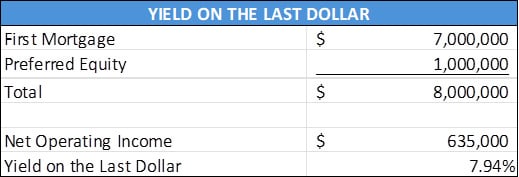
- Example: If a multifamily property has a senior loan of $7 million and a preferred equity slice of $1 million, the preferred equity’s last dollar basis is $8 million (senior loan + preferred equity). The net operating income (NOI) is then divided by the last dollar basis of $8 million to derive a yield. A higher NOI translates to a higher potential yield for all capital providers, including preferred equity investors, as more income is available to service debt and distribute to the equity holders.
- Margin for Error: The last dollar basis helps investors assess the risk associated with preferred equity and ensure an adequate capital cushion for repayment. Employing a margin for error in investment strategies is essential for navigating market uncertainties and protecting capital against unforeseen events. For example, an 8% yield on the last dollar basis in a cap rate environment of 5.5% to 6.0% is a comfortable spread and a safeguard for the preferred equity investment.
- Refinances: When a multifamily property is refinanced, the preferred equity’s last dollar basis should align with the new senior lender’s loan-to-value (LTV) limit. Senior lenders typically lend up to 75% of the property’s value. Therefore, the preferred equity’s last dollar basis would ideally fall within this range to ensure a successful refinance and repayment of the preferred equity investment.
Examples of Influential Factors
- Market Demand and Supply: The multifamily sector is currently experiencing strong demand in conjunction with a diminishing supply pipeline, creating a favorable environment for investors. While record-breaking deliveries are slowing, demand remains robust, driven by factors like household formation and population growth in certain regions. This imbalance between supply and demand can lead to positive apartment fundamentals.
- Interest Rates: Rising interest rates can increase borrowing costs, impacting the profitability of each invested dollar and potentially lowering the overall yield. Conversely, lower interest rates can increase investor confidence and make financing more accessible, further boosting the yield.
- Demographic Shifts: Changes in population size, age distribution (like the rise of millennials preferring renting or baby boomers downsizing), and household structures influence housing needs and preferences, impacting demand and the types of multifamily properties that generate optimal returns.
In essence, understanding the yield on the last dollar in multifamily investments helps assess the risk-reward profile, particularly for those investing in preferred equity or evaluating the overall capitalization structure of a project. The last dollar yield in multifamily investment is a complex metric influenced by a combination of internal property-specific factors and broader external market forces. Investors must carefully assess all these factors to make informed decisions and manage potential risks effectively.
Disclaimer: This document is for informational purposes only and is not financial, legal, or investment advice, nor an offer or solicitation to buy or sell securities. Investment opportunities offered by Bam Capital are made pursuant to Rule 506(c) of Regulation D and are available exclusively to accredited investors, as defined by the Securities and Exchange Commission (SEC). Verification of accredited investor status is required before participation in any investment. The information contained herein reflects the opinions of the author and does not necessarily represent the views of Bam Capital. Any financial terms, projections, or forward-looking statements contained herein are hypothetical in nature and should not be interpreted as guarantees of future performance or safety. Such statements reflect opinions and are subject to market fluctuations, economic conditions, and investment risks. Investing in private real estate securities involves significant risks, including but not limited to illiquidity, economic downturns, and potential loss of invested funds. Past performance does not guarantee future results. Prospective investors are strongly encouraged to conduct independent due diligence and consult with legal, tax, and financial advisors before making any investment decisions. Bam Capital makes no representation or warranty regarding the accuracy or completeness of the information contained herein.
© 2025 Bam Capital. All rights reserved.
Author: Tony Landa, Senior Economic Advisor, The BAM Companies, October 2025


