
The multifamily market has seen its share of ups and downs over the past few years. Rising interest rates, a wave of new apartment construction, and changing property values have created challenges for owners and investors alike. But in some markets, conditions are beginning to become more favorable, creating potential opportunities for disciplined investors to acquire high-quality apartment communities at prices well below what it would cost to build them today.
The Carolinas are one region where we’re seeing particularly attractive opportunities.
For years, BAM Capital has focused primarily on multifamily investments in the Midwest. It’s where we got our start, built our business, and continue to see opportunities. Meanwhile, our acquisitions team has been closely studying markets throughout the Southeast, particularly in the Carolinas.
Recently, we began seeing the combination of market fundamentals we look for, including growing populations, strong employment, rising rental demand, and attractive property prices—though these historical indicators do not guarantee future investment performance. That led us to acquire two properties in the Wilmington, North Carolina, area, in late 2026, with another acquisition underway in Little River, South Carolina.
Where the Multifamily Market Stands Today
While the past few years put pressure on rents and occupancy in oversupplied markets, we’re beginning to see that supply cycle turn.
With higher financing and construction costs making fewer new projects financially viable, apartment construction has slowed, giving markets time to absorb the units delivered over the past several years.
Meanwhile, the cost of buying a home has climbed well beyond the cost of renting. For roughly a decade, owning a home carried an average monthly premium of approximately $300 over renting. Today, that gap has widened to approximately $1,300 per month, with the all-in cost of owning the median-priced home reaching roughly $2,700 per month. As a result, renting remains a more affordable option for many households. In 2025, renters accounted for approximately four out of five new U.S. households, according to U.S. Census Bureau data.
At the same time, some owners and developers are facing debt maturities, refinancing challenges, or fund deadlines that are forcing them to sell. This is creating opportunities for buyers with the capital and experience to be selective about what they buy, where they buy it, and what they pay.
“Unfortunately, for them, it’s one of the worst times in the market that we’ve seen in maybe 15 years to sell an asset,” BAM Capital Founder and CEO Ivan Barratt said. “On the opposite side of that coin, it’s one of the best times I’ve seen in that same time period to buy assets.”
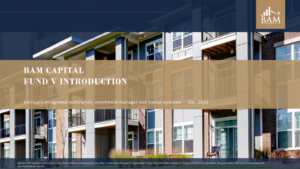
Webinar: BAM Capital Fund V Introduction
Why the Southeast? Why Wilmington? Why Now?
Of course, identifying the right investment also means choosing the right market. The Southeast has caught our attention for several reasons, starting with its population and employment growth.
In recent years, the South recorded approximately 6% population growth, nearly double the national average of 3.1%, according to the U.S. Census Bureau, while the Southeast has benefited from strong job growth and durable rental demand.
Those numbers are encouraging, but they don’t automatically make every market in the Southeast a good investment. Our acquisitions team looks closely at individual markets and neighborhoods, considering population trends, employment diversity, rental demand, affordability, future apartment supply, and what properties are selling for.
The Wilmington area checked a lot of those boxes.
A Growing Population and Employment Base
The Wilmington MSA has experienced 32% population growth since 2010, with another 10% projected through 2030, based on third-party demographic data. Within approximately 25 minutes of our two properties in Leland, NC—The Marling at Town Creek and Leland Station—is access to 129,000 jobs, along with significant investments from employers such as Amazon and Novant Health.
Wilmington offers coastal living at a cost of living comparable to many Midwest markets. Renting also remains substantially less expensive than owning a home, making apartments an attractive option for people moving to the area.
Supply Is Finally Catching Up With Demand
Like many areas of the country, Wilmington and some areas of the Southeast experienced a substantial wave of apartment construction over the past several years. About 43% of the area’s existing apartment inventory was delivered between 2017 and 2025, based on third-party market data.
That supply has largely been absorbed. Based on current market data, occupancy is approximately 93%, and our pipeline research shows no new market-rate apartment units currently scheduled for delivery through 2030 within a five-mile radius of our Wilmington acquisitions, though future development activity could change over time.
Continued population and employment growth, coupled with limited new apartment construction, may provide favorable supply-and-demand conditions for our existing communities.
Buying at the Right Price Matters
Strong market fundamentals matter, but so does what you pay. Attractive acquisition pricing is another reason the Carolinas have caught our attention.
The Marling at Town Creek: Approximately 82 Cents on the Dollar
Our acquisition of The Marling at Town Creek is a good example.
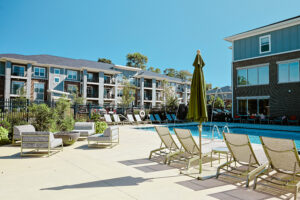
Built in 2024, BAM Capital acquired it for about $206,000 per unit. Comparable replacement costs are estimated at about $250,000 per unit.
That means we’re buying the property for roughly 82 cents on the dollar compared to what it would cost to build a similar community today. We also acquired it below recent comparable sales.
Leland Station: A Significant Discount to Its Previous Sale
We saw a similar opportunity with Leland Station, our second acquisition in the Wilmington area.
The property sold in 2021 for $274,000 per unit. BAM Capital acquired it for about $208,000 per unit, a discount of roughly 24%.
The difference largely comes down to market conditions. Some owners and developers in the Southeast are dealing with financing challenges or other circumstances that make it difficult to hold their properties. That creates opportunities for buyers like us to step in and acquire quality assets at prices that would have been difficult to achieve just a few years ago.
Expanding Into the Myrtle Beach Area
Our third Southeast opportunity is in Little River, South Carolina, where we’re under contract to acquire a 240-unit community that is already approaching 95% occupancy. Located just north of Myrtle Beach, the community is roughly an hour southwest of our Leland acquisitions, providing an opportunity to realize economies of scale.
Like our Wilmington acquisitions, this is a newer property that we’re acquiring below replacement cost. We also see an opportunity to increase rents as existing leases turn over.
Why BAM Capital Is Finding Opportunities in the Southeast Over the Midwest
The Midwest remains an important part of BAM Capital’s investment strategy, and we’ll continue looking for opportunities there. But right now, the Carolinas are offering some particularly compelling acquisition opportunities, driven by strong population growth, rental demand, and favorable pricing.
The numbers help illustrate the difference in acquisition pricing and projected returns. Based on third-party transaction data compiled and analyzed by our acquisitions team since the start of 2026, Midwest acquisitions have averaged approximately $253,000 per unit with an in-place cap rate of 4.37%. By comparison, our Southeast acquisitions range from approximately $189,600 to $208,000 per unit, with projected stabilized yields on cost between 5.59% and 5.96%.
Horry County, home to Myrtle Beach, has also experienced significant population growth, increasing 58% since 2010. Both markets continue to attract new residents, while apartment construction has slowed. That’s why we’re focused on the Carolinas right now.
“We really like the market dynamics down there,” Barratt said. “Namely, supply has gone to almost zero and you’ve still got population growth and a lot of job growth.”
How These Acquisitions Fit Into Fund V
The three Carolina acquisitions join two existing BAM Multifamily Growth Fund V properties in Bloomington, Indiana, and the Kansas City area, giving the fund exposure to several markets with different economic drivers.
BAM Capital focuses on acquiring quality properties at attractive prices and creating value through hands-on management and disciplined operations.
For Fund V, we’re targeting net returns in the high teens and a net equity multiple of approximately 2.0x to 2.5x over an anticipated five- to seven-year hold period. These are targets, not guarantees, and actual results will depend on property performance and market conditions.
Since 2010, BAM Capital has completed nearly $2 billion in real estate activity and acquired more than 10,000 apartment units. Today, our experienced team spans acquisitions, asset management, property management, construction, and investor relations.
We believe that experience, combined with a disciplined approach to buying and operating properties, puts us in a good position to pursue opportunities as they emerge in both the Midwest and Southeast.
Interested in learning more about Fund V and whether it fits your investment goals? Schedule a call with our Capital Markets team today.
Disclaimer: This content is for informational purposes only and is not financial, tax, legal, or investment advice, nor an offer or solicitation to buy or sell securities. Investment opportunities offered by BAM Capital and its affiliates are made pursuant to Rule 506(c) of Regulation D, available exclusively to accredited investors, as defined by the Securities and Exchange Commission (SEC) and, if applicable, qualified purchasers, as defined by Section 2(a)(51) of the Investment Company Act of 1940. Verification of accredited investor status is required before participation in any investment.
Contact BAM Capital for details on current offerings. BAM Capital and its representatives are not fiduciaries or investment advisors. The information provided is general and may not reflect individual financial goals. Financial terms, projections, or forward-looking statements contained herein are hypothetical and should not be interpreted as guarantees of future performance or safety. Such statements reflect BAM Capital’s opinion and are subject to market fluctuations, economic conditions, and investment risks. Investing in private real estate securities involves significant risks, including, without limitation, illiquidity, economic downturns, and potential loss of invested funds or capital. Past performance does not predict or guarantee future results. Historical transaction figures represent past performance across multiple deals as of the date this information was published, not a single investment transaction. BAM Capital and its affiliates do not guarantee the accuracy or completeness of this information. Prospective investors are strongly encouraged to conduct independent due diligence and consult with legal, tax, and financial advisors before making any investment decisions.
© 2026 BAM Capital. All rights reserved.