

 WHY MULTIFAMILY INVESTMENT?
Multifamily has long been considered the darling child of real estate among investors for many reasons; cash flow stability, capital preservation, and appreciation potential are the first things that come to mind. Investing in multifamily also affords investors tax advantages and more liquidity (i.e., easier exit opportunities) than other real estate asset classes. It’s a testament to its cash flow stability and capital preservation. These are real and tangible benefits. Most importantly, the multifamily asset class has stood the test of time and proven its resiliency during the most difficult economic times. It has consistently provided above-average, risk-adjusted returns throughout its history. With over 30 years of experience, I’d like to share a few attributes about multifamily investment.
Cash Flow Stability
Multiple rental units within one or more buildings provide a consistent income stream, mitigating the impact of vacancies. For example, a 300-unit, 100% occupied apartment community that loses ten residents over the summer results in an occupancy of 97%. Losing twenty residents will result in an occupancy of 93%. This loss in vacancy doesn’t move the needle in cash flow, unlike other real estate asset classes.
In contrast, imagine owning a 100,000-square-foot office building with three tenants, each occupying 1/3 of the space. One tenant vacates, leaving the building at 67% occupancy. It’s not covering its debt service, and the loan is potentially more than the property’s actual value—not a great feeling for the owner. Unfortunately, I’ve been there. The devil wouldn’t walk in my shoes during those difficult times.
Cash flow stability is a consistent theme with multifamily investment. It always has been and shouldn’t be taken for granted.
Capital Preservation
Capital preservation refers to an investment strategy that prioritizes protecting the initial value of an investor’s capital by minimizing risk to avoid significant losses rather than achieve the highest returns. Capital preservation is often used by investors with a low-risk tolerance or who are near retirement and want to safeguard their funds during market fluctuations.

It is an essential pillar of multifamily investment. In the words of Warren Buffet, “Rule No. 1: Never lose money. Rule No. 2: Never forget Rule No. 1.” This message rings true for BAM Capital and its real estate investments. Our vertically integrated platform strives for excellence all day, every day. It resonates throughout the organization and our residents. As a result, our firm has consistently preserved investor capital and produced outsized returns relative to the risk.
Appreciation Potential
Multifamily properties tend to appreciate over time, contributing to long-term wealth creation. Why? More people are renting than owning, especially with younger generations. It’s much less expensive due to the cost of homes, the lack of inventory, and elevated mortgage rates. Additionally, these generations want to remain flexible in their living arrangements as new jobs materialize, regardless of the location. As a result, year-over-year rent growth and lease trade-outs have remained positive, while occupancies have held steady in most markets. The renewal probability of existing residents has also increased because of these dynamics, which lowers the unit turnover costs for owners/operators. These factors help contribute to appreciation or a rise in value.
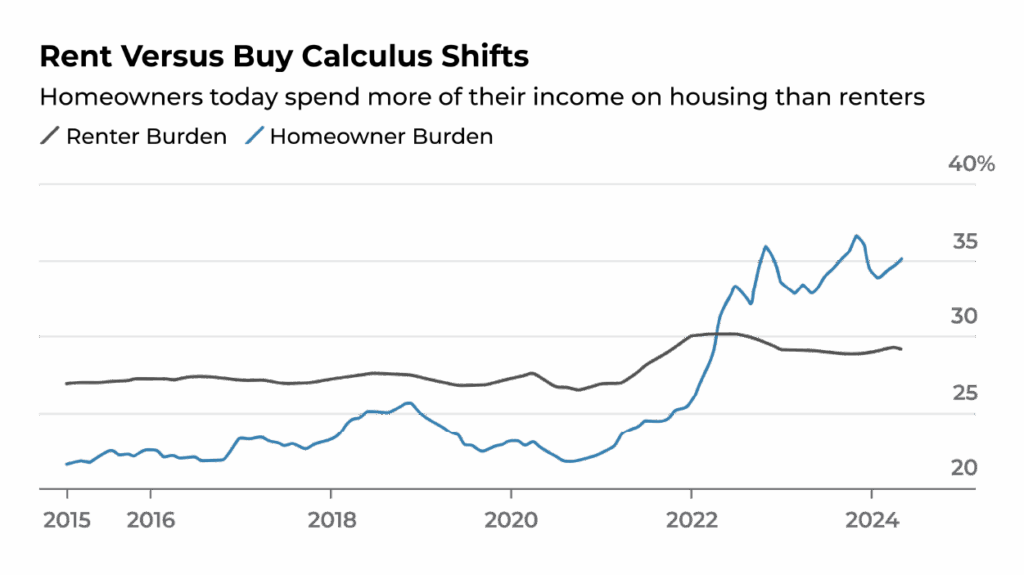
Source: Zillow Group Inc.
Note: Homeowner burden is the share of income spent on housing costs including mortgage, property taxes and homeowners insurance for the typical US home. Rent burden is the share of income spent on market rate asking rents of typical unit.
Above Average, Risk-Adjusted Returns
If I have said it once, I have said it one thousand times: multifamily will remain the darling child among real estate investors. There is no dearth of money on the sidelines waiting to pounce on quality multifamily acquisition or recapitalization opportunities. Cash flow stability, cash preservation, and appreciation potential are consistent pillars defining the multifamily industry. In case you missed it from my previous white paper, the attached chart from NCREIF displays the return relative to the risk over time. The attraction of this return/risk profile is tough to deny. Multifamily is a top performer by almost every measure.
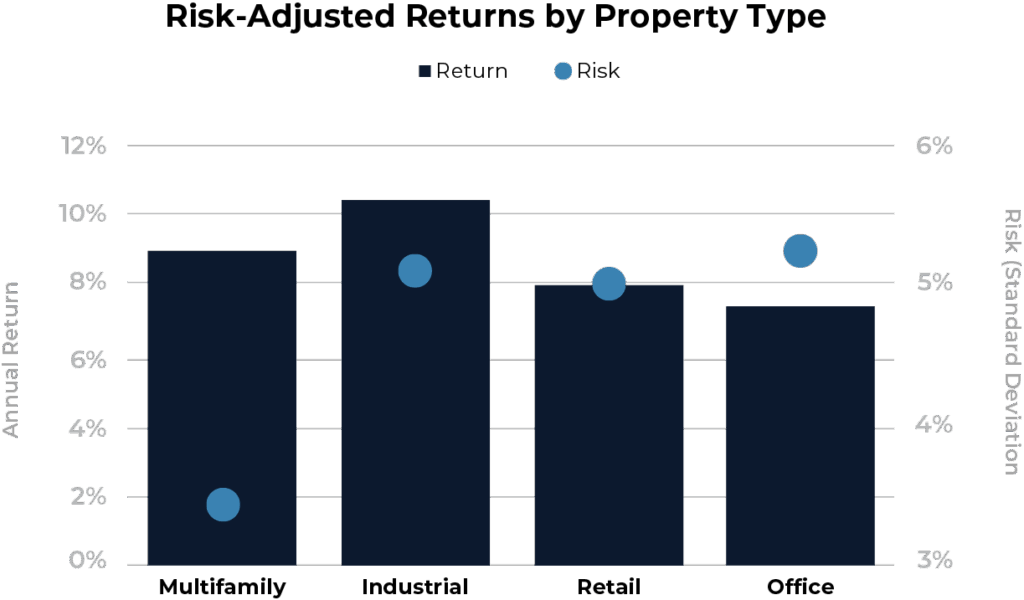
Average annualized return over each five-year period from 1/1/1990 to 12/31/2023. Returns are unlevered.
Source: National Council of Real Estate Investment Fiduciaries (NCREIF) Property Index. National Council of Real Estate Investment Fiduciaries. (2023). “Average Annualized Return.”
https://user.ncreif.org/data-products/property/
 Tax Advantages
Various tax benefits, such as accelerated depreciation and mortgage interest, can be utilized when owning multifamily properties and real estate.
Depreciation has an underestimated impact and is often overlooked in multifamily real estate as an essential tax benefit. It is based on the premise that properties lose value over time because of wear and tear, so the government allows investors to deduct this perceived decrease in value from taxable income. Prudent owners utilize a reputable tax consultant to engage in services for a cost segregation study, which identifies and reclassifies personal property assets to shorten the depreciation time for taxation purposes, further reducing the current taxable income of passive real estate investing.
Mortgage interest is an easy one. The mortgage interest deduction is a tax incentive for property and homeowners. If you own a home, you will quickly understand this dynamic. It allows these owners to write off some of the interest charged by their loans. This deduction reduces your taxable income by the interest paid on the loan during the annual year.
Liquidity
Multifamily is arguably the most liquid asset of the real estate asset classes. It’s simply a favored asset class and always has been over time. From a lender’s perspective, borrowers have many options, such as Fannie Mae, Freddie Mac, HUD, regional banks, life insurance companies, and debt funds with capital allocated for multifamily. Additionally, there is no dearth of buyers for quality multifamily opportunities. Institutional capital, REITs, private equity, family offices, and individual investors all clamor for quality acquisition and recapitalization opportunities.
Multifamily has consistently provided above-average, risk-adjusted returns relative to other real estate investments. For the aforementioned reasons, cash flow stability, capital preservation, and appreciation potential are clear and consistent staples for multifamily investment.
Resiliency
The demand for rental housing tends to remain stable even during economic downturns, making multifamily a relatively recession-resistant investment. It was evident while working through the dot-com bubble and the Great Financial Crisis. Vacancies increased while effective rental rates declined but not to catastrophic levels. Despite the new apartment supply hitting its highest levels since the 1980s, demand remains robust, outpacing supply in 2024 and resulting in positive net absorption. Strong renewal rates and the sustained need for rental housing are key contributors to this resiliency. Absorption rates are incredibly sound—a testament to the sector’s strength and underlying long-term apartment fundamentals.

During my career, I’ve acquired and managed virtually every real estate asset class: multifamily, industrial, office, and retail. Multifamily has an amazing attribute that few realize: short-term leases. It allows owners to pivot quickly by adjusting rents amid inflation and higher operating costs. It’s an important hedge and always will be. It’s safe to say that apartments are my darling child as a real estate investment. Focus on the underwriting and operations of the investment first and foremost. Once comfortable, BUY AND DON’T BLINK!
Author: Tony Landa, Senior Economic Advisor, The BAM Companies, April 2025


