
The world of real estate investing offers a wide range of opportunities, each with its own structure, risk profile, and return potential. Among the most popular passive investment options are real estate syndications and public real estate investment trusts (REITs): both of which give investors access to professionally managed real estate without the responsibilities of direct ownership.
At a glance, they may seem similar. However, once you look closer, key differences emerge in areas like investor visibility, tax treatment, liquidity, and long-term growth potential.
In the sections below, we’ll break down real estate syndications vs public REITs to help you choose the option that best suits your investment goals.
Real Estate Syndication vs Public REIT
When comparing real estate syndications vs REITs, it’s essential to understand the key differences, because even a single factor could significantly impact how well each option fits within your overall investment strategy.
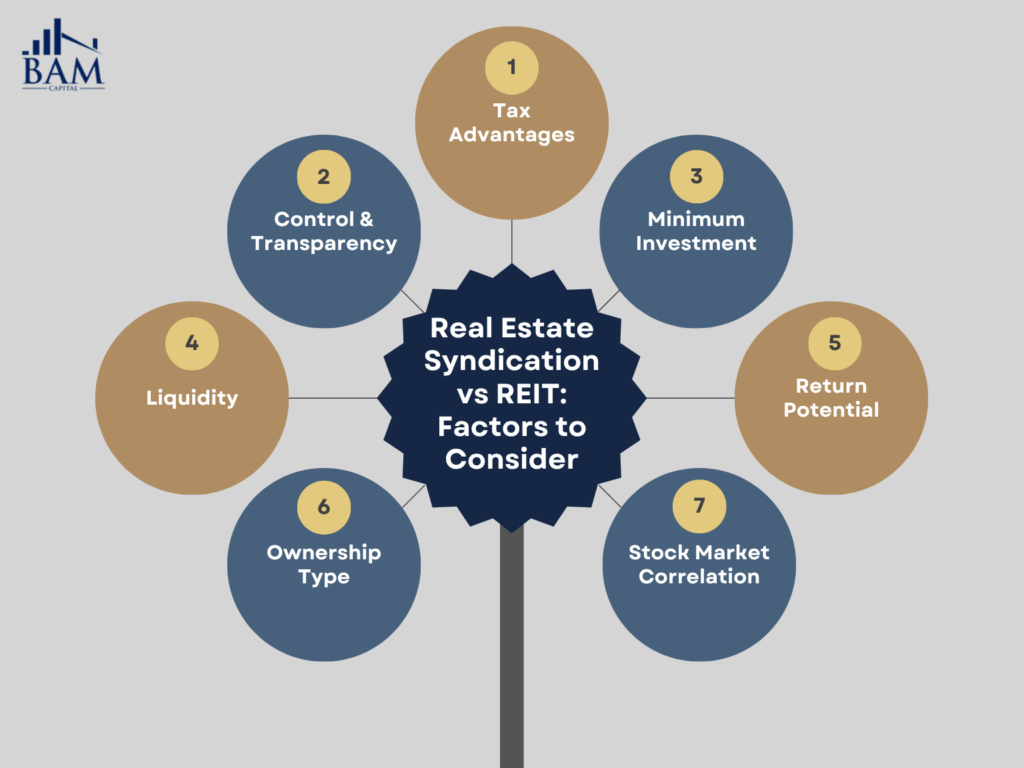
Below is a table that outlines some crucial considerations for each.
|
Real Estate Syndication vs REIT: Quick Comparison |
||
|---|---|---|
| Feature | Real Estate Syndication | REIT |
| Ownership Type | Direct equity (via LP interest) | Indirect (shares in a company) |
| Liquidity | Low (3–10 year hold periods) | High (if publicly traded) |
| Visibility & Transparency | Higher – investors review deals and sponsor | Lower – portfolio decisions made by managers |
| Tax Advantages | Strong potential – depreciation, 1031 exchanges, etc. | Limited – dividends taxed as ordinary income, pass through taxation offered |
| Minimum Investment | Often higher (e.g., $100K+ for BAM Capital) | Often lower (often $100 or less for public REITs) |
| Return Potential | Potentially higher – tied to deal performance | Potentially more modest – focused on stability/liquidity |
| Stock Market Correlation | Minimal – not publicly traded | High – public REITs trade like stocks |
Real Estate Syndications: A Closer Look
Real estate syndications are a way for multiple investors to pool their capital to acquire and manage large-scale real estate assets, typically through a fund structure. This approach gives individuals access to properties that are usually out of reach on their own, such as apartment communities, commercial buildings, or condominium portfolios.
Syndications typically involve two key roles: the General Partners (GPs), who manage the investment, and the Limited Partners (LPs), who contribute capital and receive passive returns.
- General Partners (GPs): The sponsors who source deals, manage operations, and execute the business plan
- Limited Partners (LPs): The passive investors who contribute capital in exchange for equity
Why Investors Choose Syndications
✅ Multifamily properties are often the focus due to their strong historical performance, cash flow reliability, economies of scale, risk-adjusted returns, and recession resistance.
✅ GPs manage everything, from acquisition and renovation to leasing and exit, giving investors a passive option.
✅ Potential tax efficiencies in the form of depreciation, cost segregation, passive losses, and potential 1031 exchange opportunities.
✅ Syndications are typically exclusive to accredited investors, making syndications a curated way to access higher-quality opportunities.
Syndications may offer what you’re looking for if you’re an accredited investor looking for direct real estate exposure, upside potential, unique tax benefits, and passivity.
Public REITs: A Closer Look
A REIT is a company that owns, operates, or finances income-producing real estate within a trust structure. While some REITs are private, most are publicly traded and can be bought and sold like stocks or bonds.
Similar to syndications, REITs offer passive real estate investment opportunities—but with greater accessibility, since public reits are available to all investors, not just accredited investors.
Why Investors Choose Public REITs
✅ High liquidity means investors can buy and sell shares of a public REIT like stocks.
✅ Because minimum investments can be as low as $100, they’re more accessible than syndications.
✅ They offer diversified exposure since public REITs typically own dozens of hundreds of assets, offering portfolio-level risk mitigation.
For investors with limited capital who prioritize convenience and liquidity, REITs can be a strong entry point into real estate. However, they typically offer more modest return potential and often less tax advantages, as earnings are generally taxed as ordinary income.
Which is Best for Me?
Choosing between real estate syndications vs public REITs will come down to your goals. For example:
- A REIT may be a great fit if you want hands-off exposure with low commitment, low barrier to entry, and high liquidity.
- A real estate syndication–particularly one with BAM Capital–could be the right choice if you want potentially greater access, options for efficiencies, and higher upside potential with a team managing the asset for you.
The BAM Capital Advantage: Syndication Built for Results
At BAM Capital, we specialize in multifamily real estate syndications. We’re proud to offer accredited investors seeking long-term, tax-advantaged growth outlet with our funds and investment strategies.
Here’s what sets us apart:
- Passivity: No landlord duties, ever
- Potential Tax Advantages: Including pass through losses from depreciation and other deductions
- Cash Flow + Appreciation: Value-add strategies targeting returns
- Direct Access: Real assets (housing), not abstractions
- Preferred Returns: Investors get paid first and all targeted returns are net of fees
- Proven Strategy: Focused on high-quality, Class A multifamily
- Vertical Integration: In-house teams oversee acquisition, construction, and property management
When you invest with BAM Capital, you’re not just investing in a property–you’re investing in a disciplined, performance-focused, investor-centric team with a proven track record of results.
Think Syndication Might Be a Good Fit? BAM Capital Can Help
REITs can make sense for folks looking for quick access, stock market-style liquidity, and low barriers to entry. But if you’re an accredited investor more interested in attaching your investment to a tangible asset, tax benefits, and stronger long-term returns, then real estate syndication is worth a serious look.
At BAM Capital, we believe the difference is in the details and the discipline. While REITs offer exposure, our syndications and funds offer access to real assets: equity in high-quality multifamily properties in stable, growing Midwest markets.
We don’t chase trends. We aim to underwrite conservatively, operate hands-on, and give our investors the transparency and trust they deserve.
So if you’re comparing real estate syndications vs public REITs and leaning toward a more tailored, long-term approach, we’re here to help.
Ready to see if we’re the right fit for your portfolio? Schedule a call today to learn how BAM Capital can help you build long-term wealth through our real estate syndication returns.
Disclaimer: This article is for informational purposes only and is not financial, legal, or investment advice, nor an offer or solicitation to buy or sell securities. Investment opportunities offered by Bam Capital are made pursuant to Rule 506(c) of Regulation D and are available exclusively to accredited investors, as defined by the Securities and Exchange Commission (SEC) and, if applicable, qualified purchasers. Verification of accredited investor status is required before participation in any investment.
Any financial terms, projections, or forward-looking statements contained herein are hypothetical in nature and should not be interpreted as guarantees of future performance or safety. Such statements are based on current expectations, estimates, and assumptions, which are inherently subject to uncertainties and contingencies, many of which are beyond Bam Capital’s control. Such statements reflect Bam Capital’s opinion and are subject to market fluctuations, economic conditions, and investment risks. Actual results could differ materially from those projected or implied in any forward-looking statements.
Investing in private real estate securities involves significant risks, including but not limited to illiquidity, economic downturns, and potential loss of invested funds. Past performance does not guarantee future results. Prospective investors are strongly encouraged to conduct independent due diligence and consult with legal, tax, and financial advisors before making any investment decisions.
© 2025 Bam Capital. All rights reserved.