
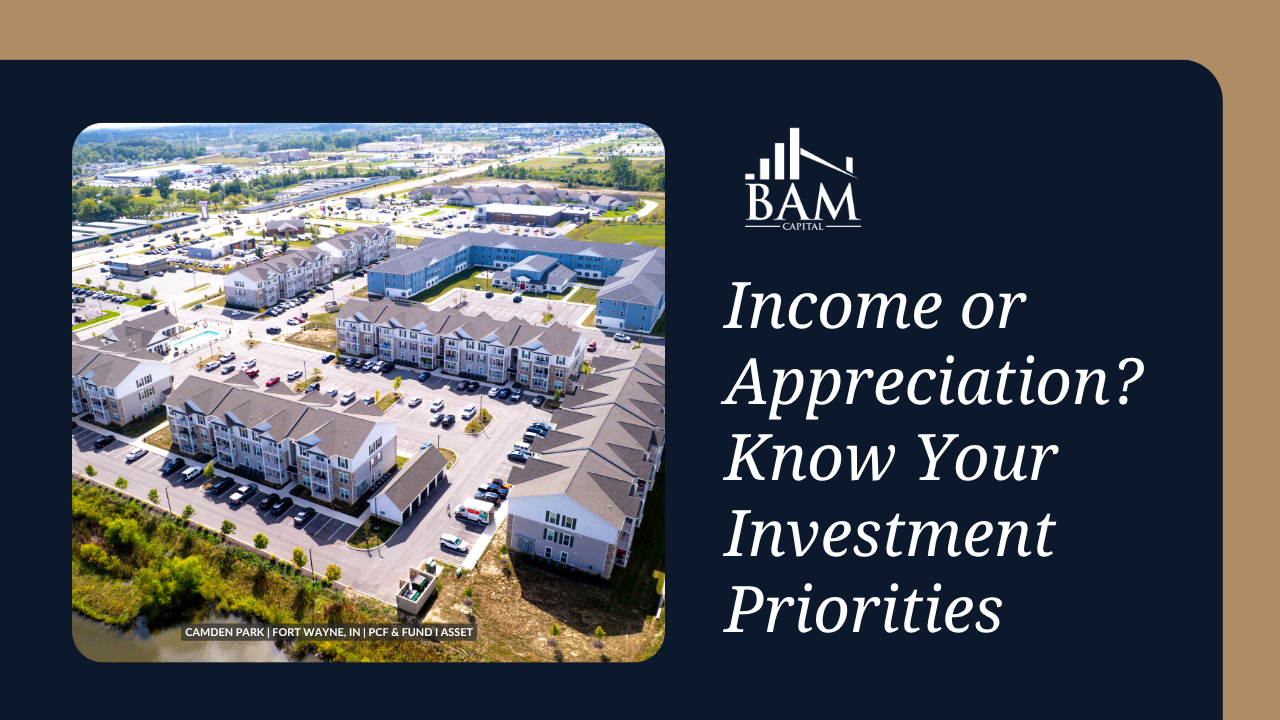
When it comes to investing, would you rather have money coming in today or focus on growing your wealth over the next five, 10, or 20 years? That answer largely depends on your financial goals, when you expect to need the money, and what you want your investments to accomplish.
Investments that prioritize current income are designed to generate cash flow investors can use today, while those aimed at long-term appreciation seek to increase in value over time. Some investors prioritize one goal over the other, while others want a combination of income and appreciation.
Understanding cash flow vs. appreciation can help you determine which investment strategy best fits your financial goals and timeline.
What Is Current Income?
Current income is money an investment generates and distributes to investors. In real estate, it might come from net rental income or interest earned on real estate-backed loans. Depending on the investment, distributions may be made monthly, quarterly, or on another schedule.
For investors who want to supplement their retirement income, help cover everyday expenses, or have more flexibility in their spending, these payments can make a real difference.
Consider a 62-year-old business owner who recently sold their company. They have accumulated substantial assets but would prefer not to sell investments whenever they need money for a major expense. An income-focused investment could provide a source of cash flow to help cover those costs.
Income-focused investments still carry risk. Distributions aren’t guaranteed, and the amount investors receive can vary. The goal is to generate income throughout the investment period rather than relying primarily on a future sale to realize returns.
The BAM Preferred Credit Fund is one example. It focuses on real estate-backed credit and currently targets an 8% distribution rate and a 10–12% total return, gross of fees. Subject to the fund’s terms and available distributions, investors may choose to receive monthly distributions when declared or reinvest them. These targets are not guarantees of future results.
What Is Long-Term Appreciation?
Long-term appreciation focuses on increasing an investment’s value over time. Rather than prioritizing regular distributions, this approach aims to build wealth through the asset’s long-term growth.
Multifamily real estate is one example. An operator might acquire an apartment community, renovate units, improve property management, increase occupancy, or reduce operating expenses. If those efforts increase the property’s net operating income and market value, investors may benefit when the property is eventually sold or refinanced, depending on the investment structure.
Consider a 40-year-old physician with a high income and another 15 to 20 years before retirement. With no immediate need to draw income from their real estate investments, they can focus on building wealth over time. They may be comfortable committing capital to an investment focused on long-term growth rather than regular distributions.
The trade-off is that private real estate investments are typically illiquid. Investors generally can’t withdraw their money or sell their investment whenever they choose, so they need to be comfortable leaving their capital invested for an extended period.
BAM Multifamily Growth Fund V is designed with long-term appreciation in mind. The fund targets a five- to seven-year hold period, a 15-20% Net internal rate of return (IRR), and a 2.0x-2.5x Net equity multiple. These are targets, not guarantees, and actual results may differ.
Can You Invest for Both Income and Growth?
Yes. You don’t necessarily have to choose between current income and long-term appreciation. Depending on your financial situation, you may be able to allocate different portions of your portfolio to each.
For example, an executive planning to retire within the next decade might invest in a growth-oriented multifamily fund while also allocating capital to a real estate credit fund designed to generate current distributions. They could use those distributions to supplement their income, set them aside for retirement, or reinvest them.
As retirement approaches, they might shift more of their portfolio toward income. If they have other reliable sources of income, however, they may choose to keep prioritizing growth.
The right balance depends on your financial situation and can change over time. What matters is understanding the role each investment plays in your broader financial plan.
When Does an Income-Focused Strategy Make Sense?
An income-focused investment may be worth considering if you:
- Want regular cash flow from your investments.
- Are approaching retirement or are already retired.
- Need to supplement income from Social Security, a pension, or other sources.
- Have investments geared toward growth but want more current income.
- Prefer receiving distributions rather than relying primarily on a future sale.
For these investors, current income can help cover expenses and provide greater flexibility in managing their finances. Before investing, it’s important to understand the investment’s risks, how reliable its distributions may be, and any restrictions on accessing your capital.
When Does a Growth-Focused Strategy Make Sense?
A growth-oriented investment may be worth considering if you:
- Have a long investment horizon.
- Don’t need significant income from your investments right now.
- Want to build wealth over several years.
- Can commit capital for an extended period.
- Are comfortable with the risks of private real estate investing.
This approach may appeal to investors who can leave their money invested while the underlying assets have time to grow. However, appreciation isn’t guaranteed—results depend on factors such as property performance, market conditions, financing, and the timing and terms of a sale or refinance.
How Do You Decide Which Approach Is Right for You?
When comparing income vs. appreciation in real estate funds, start by looking at your financial goals and when you’ll need access to your money. An investment that makes sense for someone building wealth over the next 20 years may not be the right fit for someone who needs income in retirement.
BAM Capital offers strategies designed for different objectives. The BAM Preferred Credit Fund focuses on real estate-backed credit and current distributions, while BAM’s Multifamily Growth Fund V emphasizes long-term appreciation and wealth creation. Each has its own risks, terms, and investment considerations.
Before committing capital, consider your liquidity needs, risk tolerance, tax situation, existing investments, and investment timeline. Make sure you understand the fund’s strategy, fees, distribution terms, and potential outcomes.
Ultimately, the goal isn’t necessarily to choose the investment with the highest targeted return or the largest potential distribution. It’s to choose investments that align with your goals and fit into your broader financial plan.
For accredited investors interested in learning more about BAM Capital’s current offerings, contact the BAM Capital Investor Relations team at invest@bamcapital.com.
Disclaimer: This content is for informational purposes only and is not financial, tax, legal, or investment advice, nor an offer or solicitation to buy or sell securities. Investment opportunities offered by BAM Capital and its affiliates are made pursuant to Rule 506(c) of Regulation D, available exclusively to accredited investors, as defined by the Securities and Exchange Commission (SEC) and, if applicable, qualified purchasers, as defined by Section 2(a)(51) of the Investment Company Act of 1940. Verification of accredited investor status is required before participation in any investment.
Contact BAM Capital for details on current offerings. BAM Capital and its representatives are not fiduciaries or investment advisors. The information provided is general and may not reflect individual financial goals. Financial terms, projections, or forward-looking statements contained herein are hypothetical and should not be interpreted as guarantees of future performance or safety. Such statements reflect BAM Capital’s opinion and are subject to market fluctuations, economic conditions, and investment risks. Investing in private real estate securities involves significant risks, including, without limitation, illiquidity, economic downturns, and potential loss of invested funds or capital. Past performance does not predict or guarantee future results. Historical transaction figures represent past performance across multiple deals as of the date this information was published, not a single investment transaction. BAM Capital and its affiliates do not guarantee the accuracy or completeness of this information. Prospective investors are strongly encouraged to conduct independent due diligence and consult with legal, tax, and financial advisors before making any investment decisions.
© 2026 BAM Capital. All rights reserved.