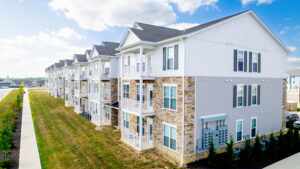

In multifamily real estate, market saturation occurs when the supply of rental units significantly exceeds the demand, leading to high vacancy rates and potentially lower rental prices. [1]
Several factors, including overbuilding, recessions, and widespread shifting demographics, can cause market saturation. Experienced investors and market analysts can determine a saturated market by its high vacancy rates, decreased rental prices, and increased competition. [1][2] Consequently, properties experiencing difficulty finding residents and increased operating costs result in lower rental income and potentially reduced investment returns. [1][2]
This article will dive into the characteristics of a saturated market in multifamily real estate and describe effective strategies to mitigate this risk.
EFFECTIVE RESPONSES TO MARKET SATURATION
Focusing on the property’s overall quality is critical to successfully navigating a saturated market. High-quality assets draw and retain high-quality residents. [2] This is partly due to an investor and renter behavior called a “flight to quality,” where renters, faced with more options and falling prices, gravitate toward Class A properties that offer superior finishes, amenities, and living experiences. In an oversupplied market, the price difference between lower and higher-tier properties often narrows, making Class A more accessible and appealing.
As lifestyle preferences develop with technological advancements, adapting to these changing demands can sustain profitability. For example, the Samsung SmartThings app allows residents to control their smart devices remotely. Plus, it’s no secret that package thieves are a reality in most regions, so another advancement is secure package delivery systems. On-site smart package lockers streamline package management and offer convenience to residents. Implementing innovative technology throughout your property is one way to control the quality of the narrative and stand out in a climate of abundance. [3]
Other effective responses when navigating a saturated market include differentiation, segmentation, and renovation. [4]
-
Differentiation:
When a business differentiates itself within its respective market, it strategically distinguishes its products or services from competitors, aiming to create a unique and attractive value proposition that resonates with a specific target market. In multifamily real estate, market differentiation means answering the question: what makes your property different from the nearby properties? [4] Properties that distinguish themselves from their competitors might have an attractive brand identity. They might address the need for recreation if, for example, there aren’t any parks in the area. The properties might also recognize the need for a specific type of unit. Are studios limited in this market, or do the units lack access to outdoor space (e.g., patios, balconies, etc.)? Visually appealing, thoughtfully branded, or lifestyle-driven properties tend to outperform in saturated markets.
-
Segmentation:
Market segmentation is the process of dividing a broad target market into distinct groups (i.e., segments) based on shared characteristics, needs, or behaviors, allowing businesses to tailor their marketing efforts for better effectiveness. [5] Multifamily real estate utilizes segmentation to optimize investment decisions, increase occupancy and revenue, and enhance property management. Operators will examine a market’s psychographics and demographics to assess its segmenting needs. Perhaps only Class B and C properties are nearby, but the average salary of the market’s workforce can afford Class A prices. This might cause the operator to target specific income brackets for their property. Maybe the collective attitude of a market is environmental awareness. An operator would consider implementing sustainability strategies to reduce their ecological footprint.
-
Renovation:
The value-add strategy in investment real estate entails making physical and conscientious operational improvements to a property to provide residents with exceptional living and justify a higher valuation when it is ready to sell. [6][7] Adding physical value to a property typically involves improving the facade, exteriors, interiors, amenities, and overall property structure. Some physical value-add projects can be as inexpensive as restoring old cabinets and replacing outlet covers. With a larger budget, you can replace the roof, upgrade the windows, and overhaul the landscaping. The following are slightly more technical and may require expertise, but repainting the exterior and interior, leveling floors, and replacing cladding can go a long way. [6] As RentSpree points out, “ensure that your rent estimate covers both the cost of the renovation and the increased market value of the property itself.” [4]
WORK WITH BAM CAPITAL FOR MULTIFAMILY REAL ESTATE INVESTING
BAM Capital is a vertically integrated owner/operator that partners with accredited investors who want to enjoy passive income and all the other benefits of multifamily private placement. As the private equity arm of The BAM Companies, BAM Capital has been focusing on buying the most profitable assets and staying disciplined in its investment thesis. BAM Capital’s investment strategy aims to create forced appreciation while mitigating investor risk. To date, the brand has successfully managed over $1.7 billion in assets across ~9,000 apartment units.
Remember that no investment is risk-free. Before making financial decisions, consult your investment advisor and schedule a call with a BAM Capital investment team member.
Disclaimer: All investments carry risk, including potential loss of capital. This content is for informational purposes only and is not financial, legal, or investment advice, nor an offer or solicitation to buy or sell any security. Consult an independent advisor for personalized guidance and contact BAM Capital for details on current offerings. BAM Capital and its representatives are not fiduciaries or investment advisors. The information provided is general and may not reflect individual financial goals. Any financial terms, projections, or forward-looking statements contained herein are hypothetical in nature and should not be interpreted as guarantees of future performance or safety. Such statements reflect Bam Capital’s opinion and are subject to market fluctuations, economic conditions, and investment risks. Past performance does not predict future results. BAM Capital and its affiliates do not guarantee the accuracy or completeness of this information. Bam Capital offers investment opportunities under Rule 506(c) of Regulation D exclusively for accredited investors as defined by the SEC. Verification of accredited investor status is required prior to participating in any investment.
© 2025 Bam Capital. All rights reserved.
SOURCES:
[1]: Google Genreative AI. (2025). “What is market saturation in multifamily real estate?” https://www.google.com/search?q=what+is+market+saturation+in+multifamily+real+estate
[2]: Matthews Real Estate Investment Services. (2023). “Trends and concerns in multifamily market amidst supply surge.” https://www.matthews.com/thought-leadership-trends-and-concerns-in-multifamily-market-amidst-supply-surge/#:~:text=Multifamily%20real%20estate%20has%20been,Multifamily%20Demand
[3]: Gatewise. (2024). “The Best Smart Amenities for Apartment Buildings in 2024: Our Extensive List.” https://gatewise.com/blog/best-smart-amenities-for-apartments
[4]: RentSpree. (2021). “Rental Market Saturation.” https://www.rentspree.com/blog/rental-market#:~:text=If%20newly%20available%20rental%20properties,with%20multiple%20bedrooms%20and%20baths.
[5]: Qualtrics XM. (n.d.). “Market segmentation: Definition, types, benefits, & best practices.” https://www.qualtrics.com/experience-management/brand/what-is-market-segmentation/#:~:text=Market%20segmentation%20is%20the%20practice,better%20understand%20the%20target%20audience.
[6]: BAM Capital. (2025). “Operational and physical value-add strategies in multifamily private placement.” https://bamcapital.com/operational-and-physical-value-add-strategies-in-multifamily-private-placement-32-union-apartments/
[7]: Forbes. (2023). “Multifamily Investment Strategy: Maximizing ROI With Value-Add Properties.“ https://www.forbes.com/councils/forbesbusinesscouncil/2023/09/01/multifamily-investment-strategy-maximizing-roi-with-value-add-properties/