

WHY MULTIFAMILY INVESTMENTS?
For RIAs seeking to complement traditional portfolios with alternatives that offer income, long-term growth, and downside protection, multifamily has long been considered the favored real estate asset class. The sector has stood the test of time and proven its resiliency, even during the most challenging economic events. The National Council of Real Estate Investment Fiduciaries (NCREIF), a non-profit association providing analytics and education on the private real estate investment industry, has produced data showing that multifamily properties generate optimal risk-adjusted returns compared to other property types like industrial, office, and retail. This resiliency and risk-return profile represent only a fraction of the benefits that multifamily provides when investing with a proven sponsor.
(Primior. (2024). “Why Multifamily Real Estate Investing Outperforms Other Commercial Investments.” https://primior.com/why-multifamily-real-estate-investing-outperforms-other-commercial-investments/)
How do multifamily investments benefit an investor’s portfolio?
Multifamily can play a strategic role in an RIA’s toolkit, offering attractive opportunities for those clients seeking cash flow stability, capital preservation, and appreciation potential—a recipe for building generational wealth. These traits are consistent pillars with multifamily, providing investors with portfolio diversification, tax benefits, and an important hedge against inflation. Unlike the unpredictable swings of the stock and bond markets, multifamily real estate typically marches to the beat of its own drum (in other words, low market-correlated), offering a relatively sturdy hedge during economic downturns. This independent movement can be a lifeline in stabilizing your investments when other markets are in turmoil.
What do apartment fundamentals look like today?
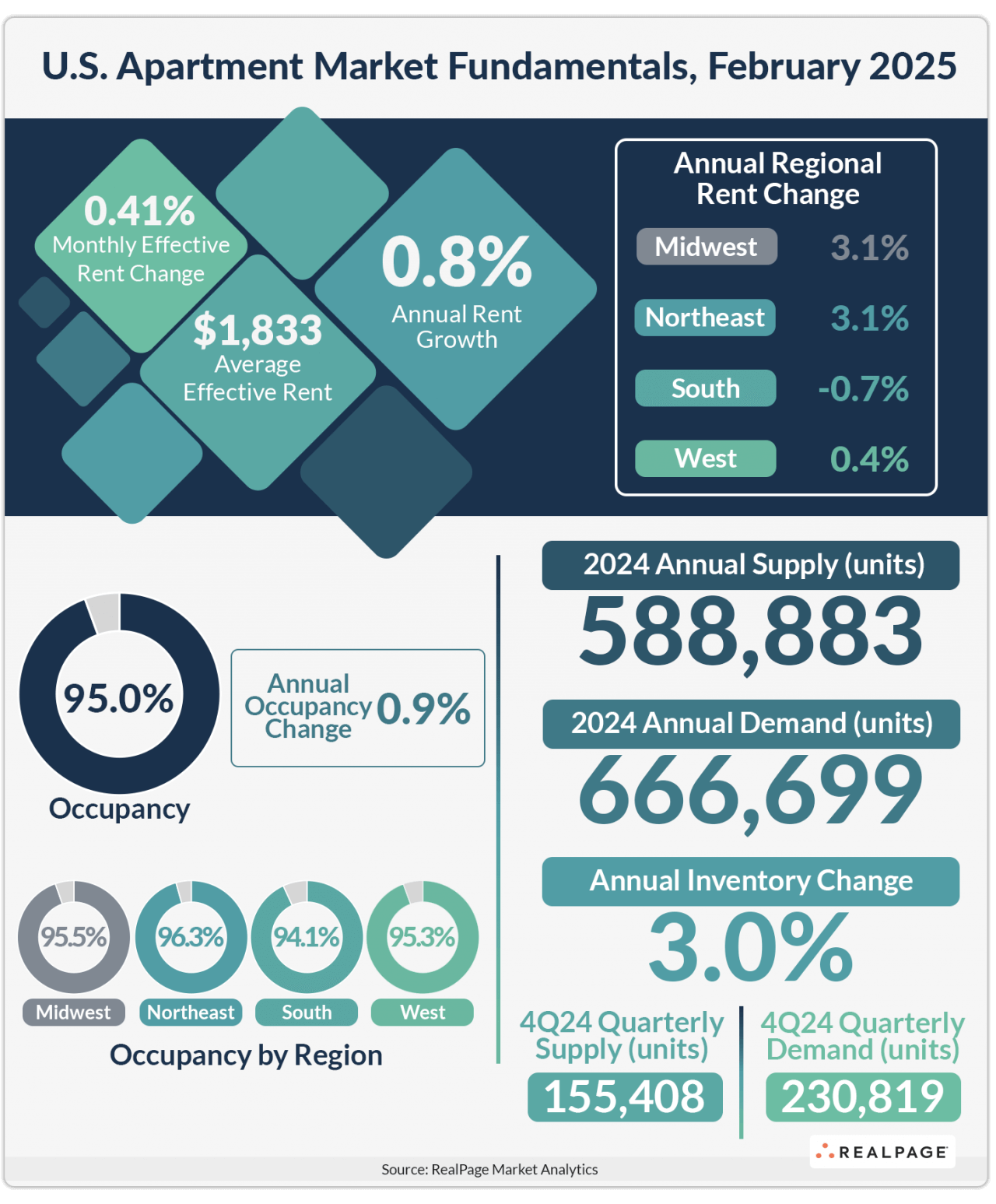
Despite the apartment supply hitting its highest level since the 1980s, demand remains robust and has outpaced supply in 2024. The attached chart illustrates this point. From a national perspective, annual rent growth was positive at 0.8%. Occupancy was also positive, at 0.9%, a direct result of positive net absorption. The annual demand of 666,669 units outpaced the supply of 588,883 in 2024, a remarkable statistic given this unprecedented number of new deliveries. It speaks volumes about resident demand for institutional-quality apartment communities.
RealPage. (2025). “Modest Momentum Builds in February Rent Growth, Occupancy Readings.” https://www.realpage.com/analytics/february-2025-data-update/
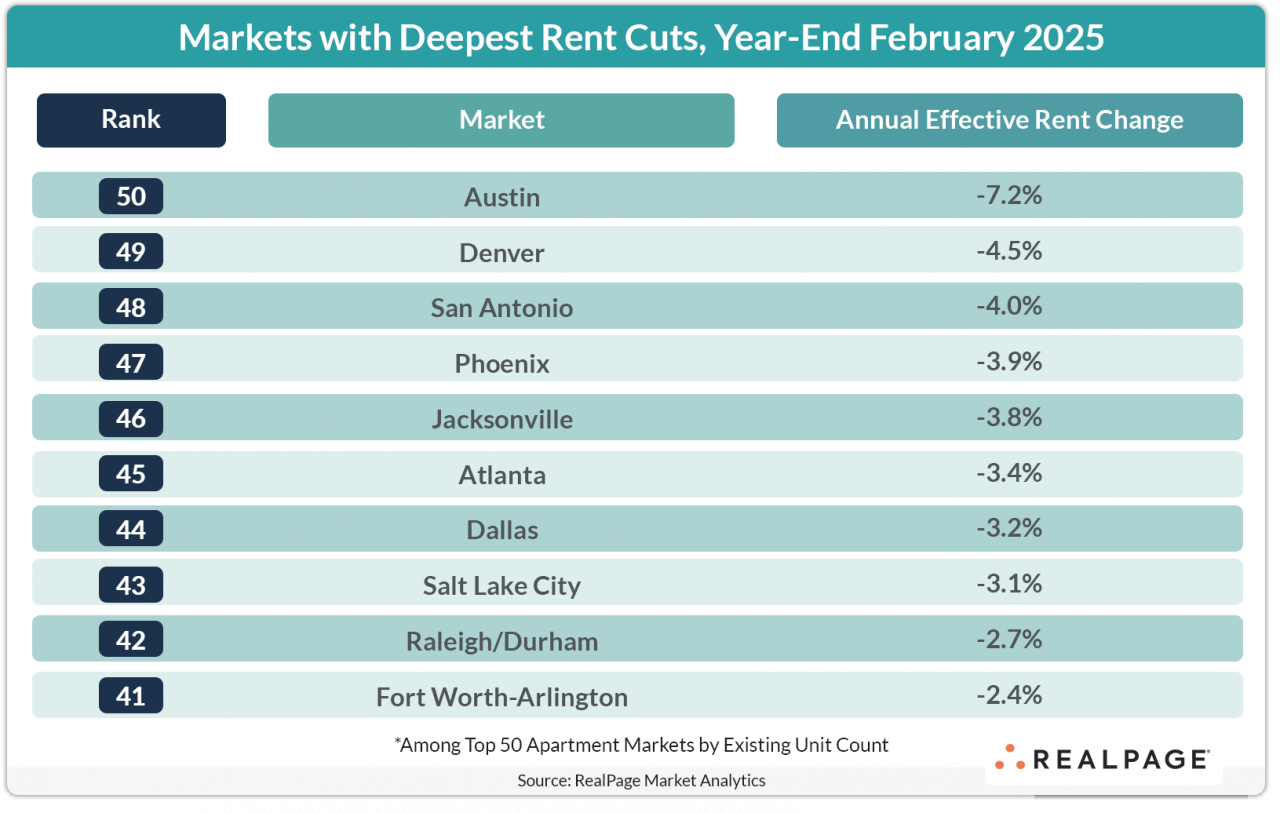
The Midwest continues to shine, leading the nation in annual rent growth of 3.1%. In fact, seven of the top ten markets for apartment rent growth are in the Midwest. Occupancy at 95.5% has also remained steady. Both statistics reflect sustained demand and limited new apartment deliveries relative to the existing stock. The Midwest also offers appealing opportunities for multifamily investments due to its affordability and moderate cost of doing business. These traits can lead to a favorable acquisition basis and potentially higher yields compared to other regions in the country. This is particularly relevant for RIAs focused on long-term capital deployment and stable income.
RealPage. (2025). “Modest Momentum Builds in February Rent Growth, Occupancy Readings.” https://www.realpage.com/analytics/february-2025-data-update/
With apartment supply cresting and the construction pipeline slowing, these statistics should improve in the coming years with sustained resident demand. The multifamily market has once again proven its resiliency in the face of high levels of new supply, showing year-over-year rent growth, albeit modest, and stable occupancy. The long-term fundamentals of the multifamily sector and its outlook remain strong.
Where do ultra-wealthy or high-net-worth (HNW) individuals invest capital?
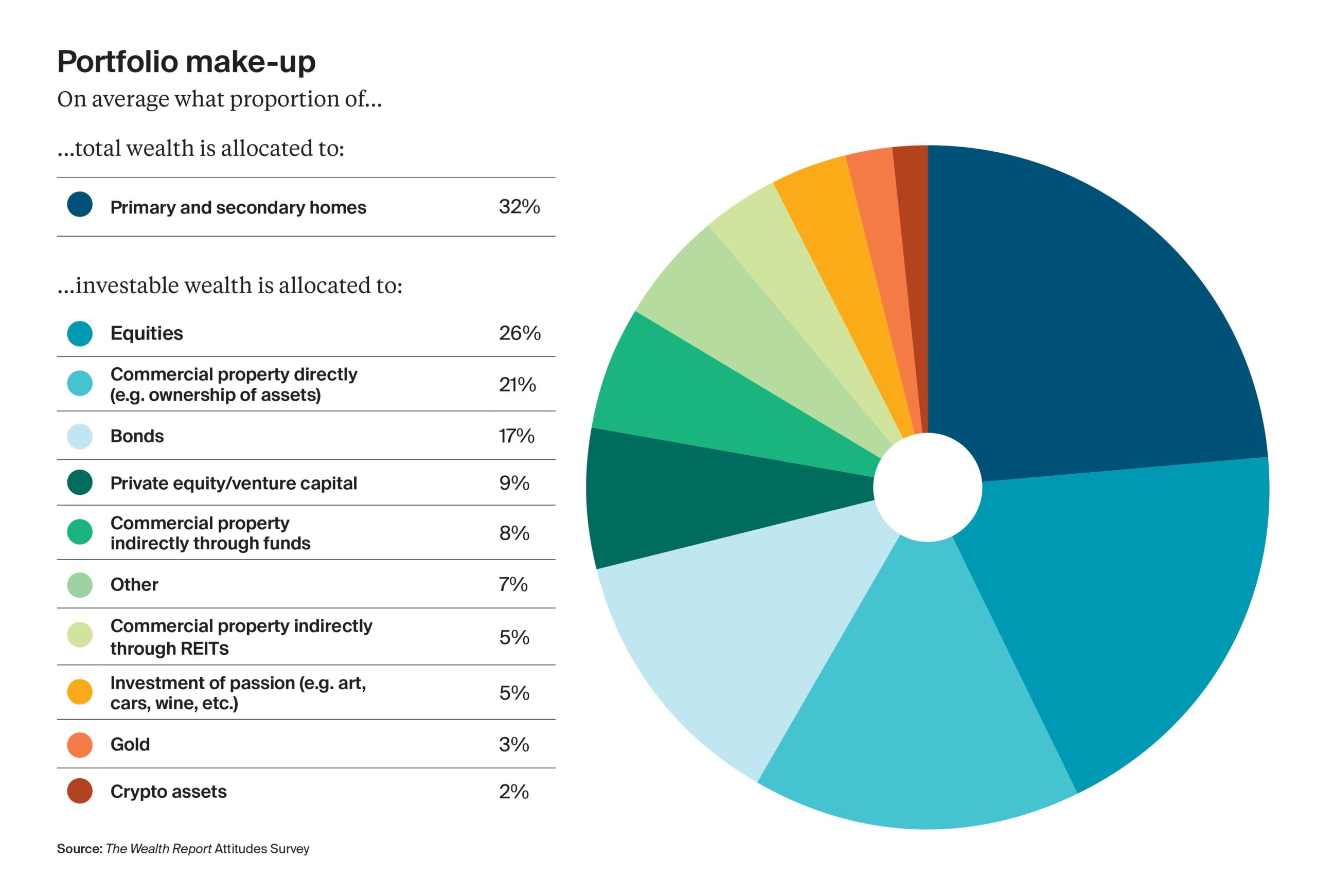
Some might picture portfolios heavy in stocks, bonds, gold, or luxury assets. But in reality, real estate is the top asset for many high-net-worth individuals. It often incorporates a substantial chunk of these individuals’ wealth. According to Knight Frank, high-net-worth investors or individuals with $30 million or more in net worth allocate about 32% of their wealth to residential properties and around 21% to commercial real estate, not including the 5% invested in real estate investment trusts (REITs). Altogether, that is more than half of their respective portfolio of assets. Multifamily is an exceptional long-term investment in wealth building while also providing portfolio diversification. With volatility in the public markets, multifamily real estate provides an appealing alternative, anchored by consistent demand, institutional backing, and recession-resilient fundamentals.
Knight Frank. (2023). “The Wealth Report 2023: top trends and key highlights.” https://www.knightfrank.com/research/article/2023-03-06-the-wealth-report-2023-key-highlights-
Disclaimer: This document is for informational purposes only and is not financial, legal, or investment advice, nor an offer or solicitation to buy or sell securities. Investment opportunities offered by Bam Capital are made pursuant to Rule 506(c) of Regulation D and are available exclusively to accredited investors, as defined by the Securities and Exchange Commission (SEC). Verification of accredited investor status is required before participation in any investment. The information contained herein reflects the opinions of the author and does not necessarily represent the views of Bam Capital. Any financial terms, projections, or forward-looking statements contained herein are hypothetical in nature and should not be interpreted as guarantees of future performance or safety. Such statements reflect opinions and are subject to market fluctuations, economic conditions, and investment risks. Investing in private real estate securities involves significant risks, including but not limited to illiquidity, economic downturns, and potential loss of invested funds. Past performance does not guarantee future results. Prospective investors are strongly encouraged to conduct independent due diligence and consult with legal, tax, and financial advisors before making any investment decisions. Bam Capital makes no representation or warranty regarding the accuracy or completeness of the information contained herein.
© 2025 Bam Capital. All rights reserved.
Author: Tony Landa, Senior Economic Advisor, The BAM Companies, July 2025


