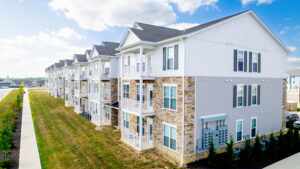

Multifamily real estate has earned a reputation as a steady, reliable investment with the potential for meaningful upside.
Returns are determined by how the deal is structured, how the sponsor runs it, and what the market is doing in the background. Below, we’ll be covering the interplay of these factors and the numbers you should actually be paying attention to.
| Average Multifamily Real Estate Returns | ||
| Asset Class | Average Annual Return Range | Risk Profile / Notes |
| Multifamily | 9–12% | Historically strong performer; steady rent demand, diversification of tenants, resilient even in downturns. |
| Industrial | 8–10% | Driven by e-commerce and logistics; low vacancy but higher sensitivity to economic cycles. |
| Retail | 6–9% | Highly location-dependent; struggling in some markets due to e-commerce disruption. |
| Office | 6–8% | Historically stable, but recent hybrid work trends have created headwinds. |
| Hospitality | 7–9% | Can outperform in strong economies but highly cyclical; impacted by tourism and business travel trends. |
Key Performance Metrics Explained
Evaluating multifamily returns means understanding how each metric reflects a different part of the investment lifecycle.
| Hypothetical Multifamily Return Key Performance Metrics | |||
| Metric | What it Measures | Use Case | Target Ranges* |
| Cash-on-Cash Return | Annual cash flow ÷ invested capital | Best for income-focused investors. Reflects yield before sale. | Good: 6–10% annually; Low: <5% |
| IRR | Time-weighted rate of return | Most common metric. Accounts for the timing of all cash flows. | Good: 13–18% over hold; Low: <10% |
| Equity Multiple | Total profit ÷ invested capital | Shows total return over the hold period (e.g., 2x = doubled investment). | Good: 1.8x–2.5x+ over 5–7 years; Low: <1.5x |
| Annualized Return | Simple average return per year | Suitable for back-of-napkin comparison, but ignores cash flow timing. | Good: 10–15% annually; Low: <8% |
*Ranges vary by market cycle, asset class, and risk profile. Value-add and development deals may target higher IRRs, while core stabilized deals often sit lower but with more stability.
Tip: Look beyond the IRR alone. A 15% IRR with no interim cash flow differs greatly from an 11% IRR with consistent distributions and lower risk.
Understanding the Risk Profile Behind Returns
The composition of these returns, I.E., how much comes from yield vs backend growth, depends on the risk profile of the strategy behind the deal. For example:
| Hypothetical Return Target/Risk Profiles | ||||
| Strategy | Description | Avg. Target IRR | Avg. Equity Multiple | Risk Profile |
| Core and Core-Plus | Multifamily deals that emphasize stabilized income often have lower IRR targets but higher predictability. | ~8-12% | 1.3x-2.0x | Low/Moderate |
| Value-Add | Slightly more aggressive targets with IRRs in the mid-teens by improving unit interiors, increasing rents, or cutting expenses. | ~12-20% | 2.0x-2.5x | Moderate |
| Development or Opportunistic | Much more volatile plays for higher return targets. Carries heavier entitlement, lease-up, and timing risks. | 18%+ | 2.5x-3.0x+ | High |
Evaluating projected returns also requires understanding the underlying assumptions behind a deal:
- Cap rate movement, rent growth, and exit timing can shift IRRs by several hundred basis points.
- Higher leverage amplifies both return potential and downside exposure.
- Sponsor fees, waterfall structures, and distribution schedules materially affect net outcomes.
Historical Return Ranges and Risk Profile
Historically, multifamily has offered competitive, risk-adjusted returns compared to other commercial assets.
| Multifamily Return & Risk Profile: Historical Estimates | ||
| Metric | Typical Multifamily Range | Context |
| IRR | 10%–16% | Higher for value-add, lower for stabilized |
| Cash-on-Cash Return | 6%–10% annually | Attractive to income-focused investors |
| Equity Multiple | 1.6x–2.0x over 2-10 years | Balanced growth and income |
| Volatility | Lower than equities | Moderate correlation to interest rates |
| Recession Resilience | Historically stronger than retail/office | Occupancy and rent collections tend to hold steadier |
Understanding Multifamily Real Estate Returns
Most investors will access multifamily investments at the behest of a sponsor or General Partner (GP).
These multifamily real estate returns are typically driven by a blend of stabilized income, capital appreciation, and tax efficiency. However, the actual return profile varies significantly by asset class, strategy, structure, and market cycle. Unlike equities or fixed income, returns in multifamily are highly dependent on the sponsor’s ability to underwrite risk, execute operational improvements, and time capital events effectively.
Returns are most often structured within syndications or funds, where Limited Partners (LPs) receive:
- Preferred returns: Usually 6–10% annually and distributed before sponsor profit-sharing.
- Ongoing cash flow distributions: Generated from operating income, impacted by occupancy, rent growth, and operating margin and often paid quarterly or monthly.
- Equity upside: Realized when refinancing or selling the property(s), typically realized via cap rate compression or net operating income (NOI) expansion.
Core Return Components of Multifamily Investing Returns
Understanding the components that make up multifamily returns is critical for evaluating how a deal produces value, especially in a syndication or fund structure.
Recurring NOI
NOI is what drives ongoing cash flow. It’s calculated as gross rental income minus operating expenses (excluding debt service and capital expenditures). Higher NOI means more distributable cash for investors.
Value Creation Through Operational Upside
In operational value-add strategies, sponsors aim to grow NOI through:
- Rent Increases: Upgrading units or repositioning the property to justify higher rents.
- Expense Reduction: Streamlining maintenance, improving energy efficiency, or renegotiating service contracts.
- Improved Occupancy and Retention: Better property management reduces turnover and increases leasing velocity.
This “forced appreciation” increases the property’s value without relying solely on market growth, major rehab, and/or construction projects..
Capital Appreciation Upon Exit
- Sale Events: Occur at the end of the hold period, ideally after NOI growth and market appreciation.
- Refinancing: Allows equity to be returned to investors without triggering a taxable event or requiring asset disposition.
A successful exit, especially with conservative cap rate assumptions, can significantly boost IRR and equity multiple.
Tax Advantages That Enhance Net Returns
Multifamily investing is one of the most tax-efficient passive investment strategies available to accredited investors:
- Depreciation and Cost Segregation: Paper losses can offset passive income, even when cash distributions are healthy.
- Passive Loss Offsets: These can be used against gains from other passive investments.
- 1031 Exchange Compatibility: In specific structures, investors may have the option to defer capital gains via a 1031 exchange.
- K-1s Instead of 1099s: Investors receive partnership tax forms reflecting their income and depreciation share.
These advantages don’t boost the gross return but materially improve the after-tax yield, especially for high-income individuals.
What Influences Multifamily Real Estate Returns?
Multifamily returns are not plug-and-play. Several factors coalesce to influence what kind of returns you can expect from a multifamily real estate deal. That means no investment is quite the same. For example, two properties with similar unit counts and locations can deliver vastly different results depending on how they’re acquired, operated, financed, and exited.
The core factors that shape the return profile of any multifamily real estate deal are:
Market Fundamentals
Local economic health is the backdrop against which every multifamily investment performs.
- Population and job growth: A market adding a %+ annual population growth or steady job creation is usually a sign of strong rental demand. Stagnant or negative growth is a red flag.
- Rent-to-income ratios: Healthy markets keep rents around 25-30% of median income. Ratios above 35% can signal affordability strain.
- New supply and absorption trends: A balanced market absorbs new units at pace with deliveries. Oversupply depresses rents while undersupply supports rent growth.
Asset Class and Submarket
Not all properties or neighborhoods are built to perform the same.
- Class A (newer, luxury): Lower yield, higher stability
- Class B/C (older, working-class): Higher yield, more upside via physical value-add
- Strong submarkets often outperform broader MSAs
Operational Efficiency
Execution makes or breaks NOI, and NOI powers cash flow and valuation.
- Leasing strategy: Determines how quickly and effectively units are filled.
- Expense management: Directly affects NOI, the key driver of property cash flow.
- Turnover and maintenance cycles: Higher resident retention and well-managed upkeep translate into steadier NOI.
Debt Structure
Financing is a risk vector.
- Loan-to-value (LTV) ratio: Indicates how much of the property’s value is financed with debt.
- Debt coverage ratios (DSCR): Measures how comfortably cash flow covers debt obligations.
- Fixed vs floating rate exposure: The structure of debt influences risk, particularly in charging interest rate environments.
Hold Period
How long you hold, and how well that aligns with the market cycle, matters.
- Short-term repositioning vs long-term cash flow play
- Short-term: Often tied to repositioning or value-add strategies.
- Long-term: Geared toward steady income and compounded appreciation.
- Refinance vs sale timing: The decision to return capital through refinancing or a disposition depends on market conditions and fund strategy.
Cap Rate Dynamics
Cap rates determine exit value, and assumptions here drive projections.
- Entry cap rate vs. projected exit cap rate: The difference between the cap rate at acquisition and sale drives valuations.
- Compressions vs expansion: Compression boosts value, but expansion during rising rates can erode it
What Accredited Investors Should Expect
- Hold periods: Typically 2–10 years.
- Internal Rate of Returns (IRR) targets: Depending on the strategy behind the deal, they range from 8% to 20%.
- Tax treatment: K-1s and depreciation losses can offset passive income.
BAM Capital’s Perspective
Multifamily real estate returns are the outcomes of hundreds of decisions made over the life of the investment. From start to finish, from debt structuring to rent growth assumptions to cap rate forecasting and everything in between, every detail compounds.
The asset class has strong bones, no doubt about it. But at the end of the day, your returns depend heavily on the sponsor you partner with.
At BAM Capital, we take a disciplined approach to acquiring and managing multifamily properties in strong Midwest markets. We focus on risk-adjusted returns, with conservative underwriting and in-house teams that handle everything from property management to construction. That vertical integration helps us keep costs in check and performance on track.
We’re not in this for flash. We aim to deliver consistent income, long-term equity growth, and real-world results. For accredited investors looking for steady hands and a clear strategy, that’s exactly what we’re built for.
Explore Opportunities with BAM Capital
If you’re evaluating multifamily investment opportunities and want a sponsor who prioritizes downside protection, consistent returns, and looks out for investors first, we’d love to talk.
Ready to see if we’re the right fit for your portfolio? Schedule a call today to learn how BAM Capital can help you build long-term wealth through our real estate syndication returns.
Disclaimer: This article is for informational purposes only and is not financial, legal, tax, or investment advice, nor an offer or solicitation to buy or sell securities. BAM Capital and its representatives are not fiduciaries. Investment opportunities offered by BAM Capital are made pursuant to Rule 506(c) of Regulation D and are available exclusively to accredited investors, as defined by the Securities and Exchange Commission (SEC) and, if applicable, qualified purchasers. Verification of accredited investor status is required before participation in any investment.
Any financial terms, projections, or forward-looking statements contained herein are hypothetical in nature and should not be interpreted as guarantees of future performance or safety. Such statements are based on current expectations, estimates, and assumptions, which are inherently subject to uncertainties and contingencies, many of which are beyond BAM Capital’s control. Such statements reflect BAM Capital’s opinion and are subject to market fluctuations, economic conditions, and investment risks. Actual results could differ materially from those projected or implied in any forward-looking statements.
Investing in private real estate securities involves significant risks, including but not limited to illiquidity, economic downturns, and potential loss of invested funds. Past performance does not guarantee future results. Prospective investors are strongly encouraged to conduct independent due diligence and consult with legal, tax, and financial advisors before making any investment decisions.
© 2025 Bam Capital. All rights reserved.