
 Real estate syndication minimum investments typically range from $50,000 to $250,000 or more. The exact number depends on a few key factors, such as the sponsor running the deal, the type of property, and how the investment is structured.If you’re an accredited investor thinking about jumping into syndications, it’s essential to understand why those minimums exist. It’s not just about writing the check—it’s about ensuring the opportunity (and the sponsor behind it) aligns with your goals.Below, we’ll walk through the most common minimum investment ranges, what drives them, and what it all means for you as an investor. We’ll also look at a few real-world examples so you know what to expect.
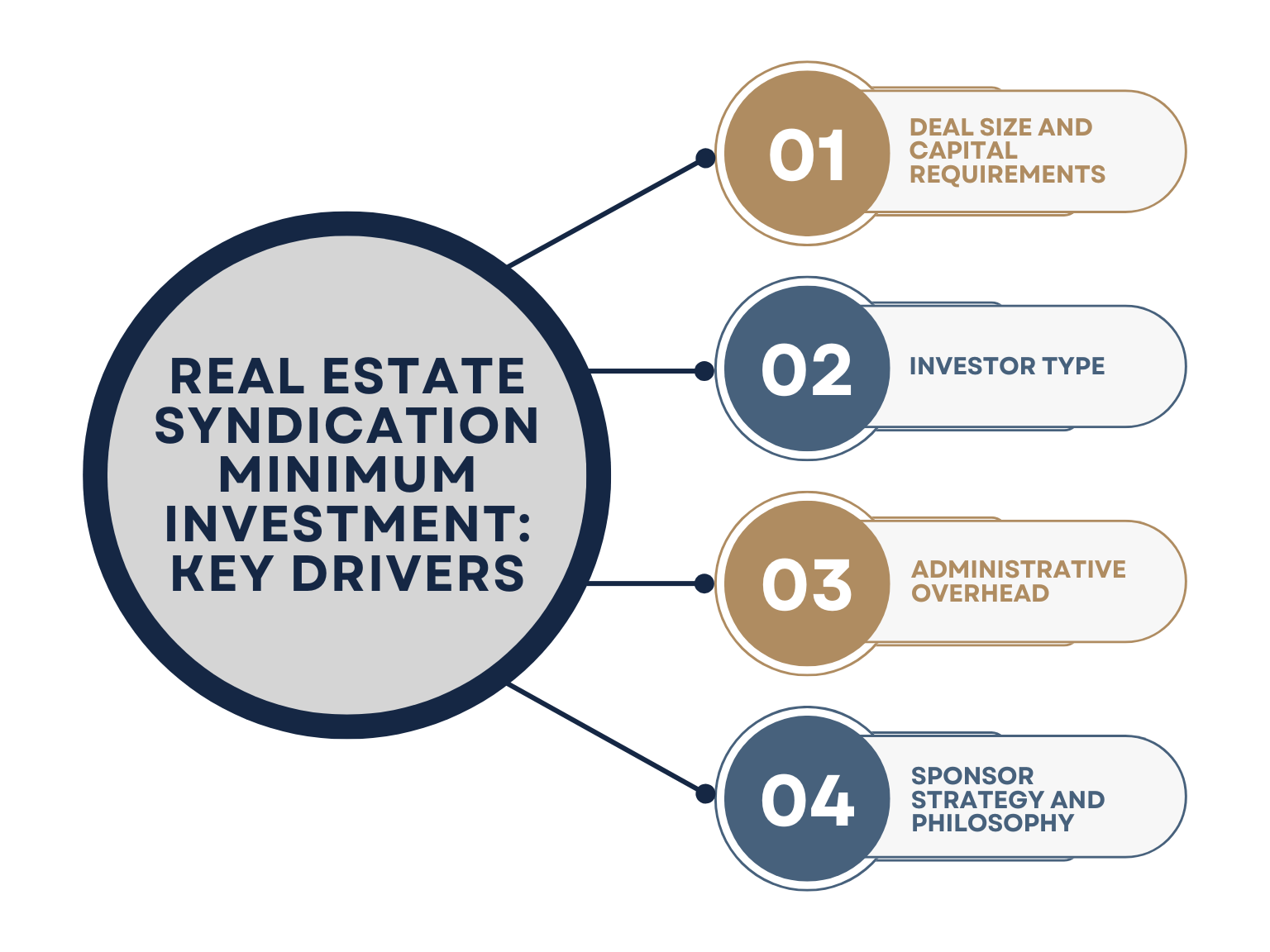
Real Estate Syndication Minimum Investment: Key Drivers
It may seem like it without diving deeper, but real estate syndication minimum investments aren’t really arbitrary, at least not most of the time. They’re typically shaped by strategic and legal factors that balance capital efficiency, investor experience, and regulatory compliance.Here’s what usually influences how sponsors set their minimums:
Deal Size and Capital Requirements
Larger acquisitions—like a $40M multifamily asset—require substantial capital. To meet that need efficiently, sponsors may set a higher minimum—say, $100,000—to reduce the number of individual investors and close the raise on schedule.
Investor Type
Most real estate syndications are conducted under Regulation D Rule 506(b) or 506(c), limiting them to accredited investors’ participation. These investors are thus presumed to be financially savvy and able to evaluate risk more thoroughly. Sponsors typically set minimums to reflect that investor profile.
Administrative Overhead
Every investor requires onboarding, document processing, reporting, and tax prep. Smaller investments (e.g., $10,000-$25,000) mean significantly more administrative burdens for the sponsors, making higher minimums more efficient from an operational perspective.
Sponsor Strategy and Philosophy
Some sponsors–like BAM Capital–prefer to work with a smaller pool of high-capital investors for a more boutique approach to real estate syndication. Others, like marketplace platforms, may favor lower thresholds for broader access. Neither is right nor wrong; it depends on the investor’s goals. Some sponsors prefer working with a small pool of high-capital investors for a more boutique experience. In contrast, others may open lower tiers to build community or allow broader access.
Examples of Minimum Investment Structures
Here are some theoretical examples showing how this would apply in real scenarios.
| Sponsor | Structure | Asset Strategy | Minimum Investment | Investor Type | Key Characteristics |
| BAM Capital | Rule 506(c) | Core-plus & value-add multifamily (Midwest) | $100,000-$250,000 | Accredited investors | Vertically integrated, institutional-grade assets, strong sponsor alignment, relationship-driven |
| Online Marketplace Sponsor | Marketplace platform | Mixed asset classes (multifamily, office, retail) | $100–$50K | Varies by offering | Lower entry point, broader access, flexible offering types |
Why Some Sponsors Have Higher Minimums (And Why That’s Not a Bad Thing)
Higher minimums may initially seem restrictive. However, they often reflect a sponsor’s commitment to quality and investor alignment.
- Fewer investors = stronger relationships: A smaller pool of LPs means more hands-on communication and transparency.
- More serious investors = better alignment Investors with larger stakes tend to understand that syndications are illiquid, multi-year investments.
- Raising Larger Capital Efficiently Higher minimums allow sponsors to raise larger amounts of capital with fewer investors, making it possible to pursue larger, higher-quality acquisitions. This streamlines operations and enables the sponsor to focus on executing the business plan and potentially delivering strong returns.
- Sponsor Confidence: A high minimum signal the sponsor’s confidence in the offering—they’re not raising capital from anyone with a checkbook.
As a general rule, if a sponsor is targeting institutional-quality acquisitions, their minimum will likely reflect that caliber.
Can You Negotiate a Lower Minimum Investment?
Yes—on rare occasions. Some sponsors may offer flexibility in these scenarios:
- Repeat investors with a history of participation
- Filling a final funding tranche
- Early-access referrals or strategic partners
For example, BAM Capital’s Fund V typically requires a $200,000 minimum investment. That said, there’s some flexibility. In some instances, investors may be allowed in at a lower amount if the fund manager approves, but it usually comes with a lower return.It works the other way, too. Investors who come in above the minimum may qualify for stronger terms, like a higher preferred return. That’s the case with Fund V, where larger commitments can unlock better upside.However, this is the exception, not the norm. Most professional sponsors maintain strict minimums to ensure consistency across their investor base.
BAM Capital is a Syndication Partner Built on Trust
At BAM Capital, our real estate syndication minimum investments aren’t just numbers—they reflect the quality of the opportunities we bring to the table. We’re not chasing volume. We’re building lasting partnerships with accredited investors who care about transparency, the pursuit of long-term stability, and consistent performance objectives. With over 215 years of combined leadership experience, a vertically integrated platform that gives us complete in-house control, from acquisition to management, and a sharp focus on institutional-grade multifamily properties in strong Midwest markets, BAM Capital is a sponsor that strives to be a reliable partner. If you’re looking for more than just returns—if you’re looking for confidence—you’re in the right place.
Need to learn more about real estate syndication minimum investments? We’re here to help. Schedule a call today to learn how BAM Capital can help you build long-term wealth through our real estate syndication returns.
Disclaimer: This content is for informational purposes only and is not financial, tax, legal, or investment advice, nor an offer or solicitation to buy or sell securities. Investment opportunities offered by BAM Capital and its affiliates are made pursuant to Rule 506(c) of Regulation D and are available exclusively to accredited investors, as defined by the Securities and Exchange Commission (SEC) and, if applicable, qualified purchasers, as defined by Section 2(a)(51) of the Investment Company Act of 1940. Verification of accredited investor status is required before participation in any investment.C
ontact BAM Capital for details on current offerings. BAM Capital and its representatives are not fiduciaries or investment advisors. The information provided is general and may not reflect individual financial goals. Financial terms, projections, or forward-looking statements contained herein are hypothetical in nature and should not be interpreted as guarantees of future performance or safety. Such statements reflect BAM Capital’s opinion and are subject to market fluctuations, economic conditions, and investment risks.
© 2025 Bam Capital. All rights reserved.