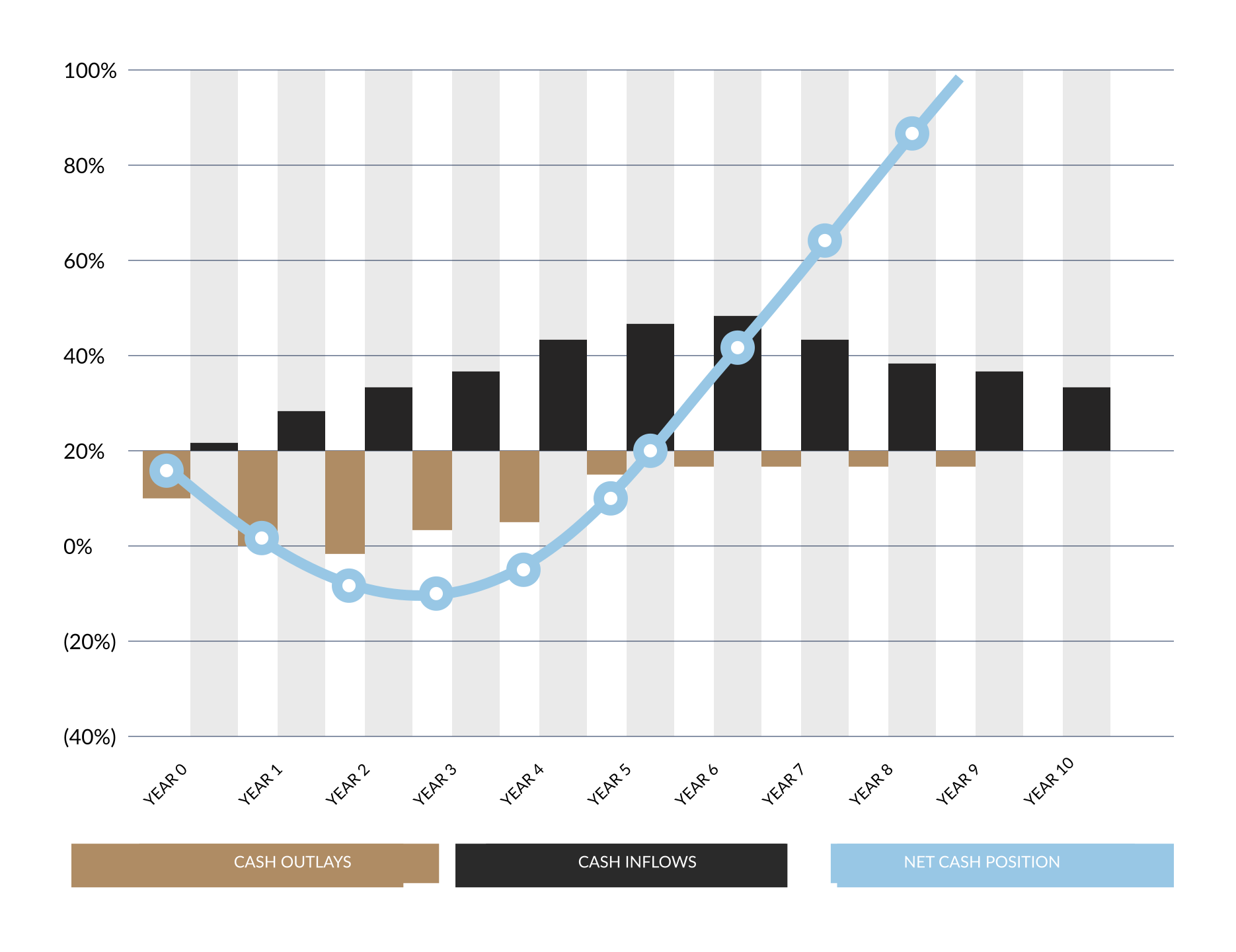
The “J-curve” in multifamily real estate investing refers to the typical pattern of returns where an initial period of negative or low returns is followed by a period of strong growth, resembling the shape of the letter “J” when graphed. This curve is commonly observed in value-add investments, where capital is initially deployed for renovations and operational improvements, resulting in a temporary decrease in cash flow. Upon stabilization, occupancy and rental rates are expected to improve, leading to a sharp increase in the investment’s value and returns.

The Elements of the “J” Curve
- Initial Decline: When a multifamily property is acquired, significant upfront expenses are often associated with renovations, repositioning, initial operational adjustments, and closing costs. These costs can result in a temporary or negative dip in investment value during the transition process.
- Turnaround Point: As renovations are completed and operations are streamlined, operating expenses are expected to decline, while rental rates and occupancy rates are expected to improve. This marks the point at which the investment begins to stabilize and the negative trend starts to reverse.
- Accelerated Growth: With optimized operations and increased rental income, the investment returns can proliferate, potentially exceeding initial expectations and above the original investment. This upward trajectory is where the “J” of the curve becomes apparent.
Contemplations for Investors
- Assists in Managing Expectations: The early stages of multifamily investments often involve significant upfront costs, such as property acquisition, renovations, and potential repositioning. These expenses can lead to negative cash flows. Understanding the J-curve helps investors anticipate this initial dip and maintain a long-term perspective, preventing premature exits based on short-term performance fluctuations.
- Guides Strategic Planning and Decision-Making: By recognizing the J-curve, investors can better plan for the initial period of lower returns and strategically allocate resources to mitigate the impact of the dip. This includes implementing value-added improvements to increase property value, enhancing operational efficiency, and increasing revenue streams through rental rate increases and higher occupancy.
- Facilitates Effective Cash Flow Management: The J-curve highlights the importance of managing cash flows throughout the investment lifecycle. Investors should prepare for negative cash flows and plan for positive cash flows to commence from the property upon a capital event (such as a sale or refinance), in the later stages.
- Encourages a Long-Term Investment Perspective: Multifamily investments, particularly those focused on value-add or development projects, inherently require a long-term commitment to creating value and achieving realized returns. The J-curve underscores this need, as returns are typically not immediate but rather materialize as the properties mature, stabilize, and are eventually sold or refinanced at a profit.
- Fosters a Sound Financial Structure: Proper financial structuring is crucial for navigating the initial downturn and ensuring the investment has sufficient capital to weather the period of negative returns. A disciplined financial structure and transparent communication about expected returns can shorten the trough of the J-curve and expedite the distribution of returns to investors. Factors such as interest rates, loan terms, and loan-to-value ratios can also influence the optimal mix of debt and equity in a multifamily investment.
- Necessitates an Effective and Efficient Operator: The skills and experience of the investment manager can significantly impact the length and severity of the J-curve, as the team is responsible for sourcing deals, managing renovations, and overseeing operations.
The J-curve is a fundamental concept in multifamily real estate and private equity investment, highlighting the initial period of negative returns that precedes realized profits. Understanding this phenomenon and adopting effective strategies to manage it are essential for investors aiming to optimize their returns and make informed decisions in the multifamily asset class. Being an operator at its core, The BAM Companies is acutely aware of the J-curve and plans accordingly, conducting in-depth due diligence with every acquisition, creating innovative financial structures, and maintaining sufficient cash reserves. All are necessary to minimize the trough in the J-curve.
Disclaimer: This document is for informational purposes only and is not financial, legal, or investment advice, nor an offer or solicitation to buy or sell securities. Investment opportunities offered by Bam Capital are made pursuant to Rule 506(c) of Regulation D and are available exclusively to accredited investors, as defined by the Securities and Exchange Commission (SEC). Verification of accredited investor status is required before participation in any investment. The information contained herein reflects the opinions of the author and does not necessarily represent the views of Bam Capital. Any financial terms, projections, or forward-looking statements contained herein are hypothetical in nature and should not be interpreted as guarantees of future performance or safety. Such statements reflect opinions and are subject to market fluctuations, economic conditions, and investment risks. Investing in private real estate securities involves significant risks, including but not limited to illiquidity, economic downturns, and potential loss of invested funds. Past performance does not guarantee future results. Prospective investors are strongly encouraged to conduct independent due diligence and consult with legal, tax, and financial advisors before making any investment decisions. Bam Capital makes no representation or warranty regarding the accuracy or completeness of the information contained herein.
© 2025 Bam Capital. All rights reserved.