
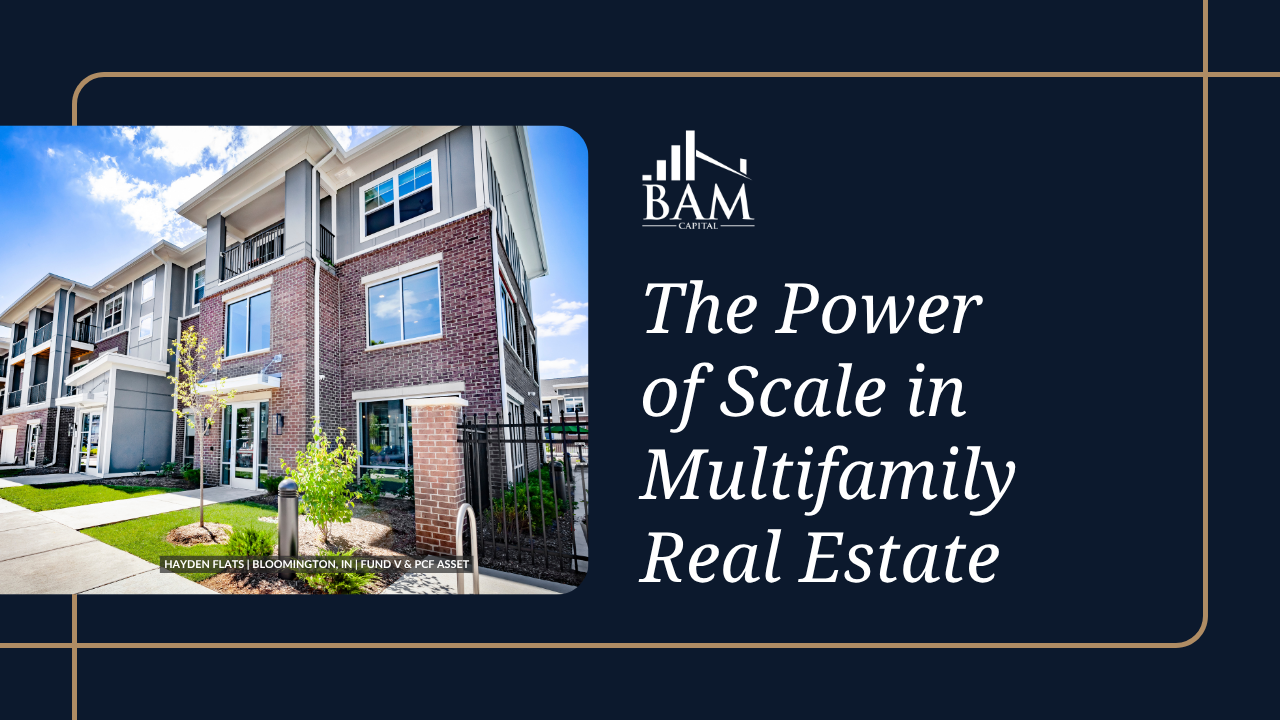
Imagine the difference between running one 200-unit apartment complex compared with 200 rental homes scattered across a city.
In an apartment community, a maintenance technician can fix a water heater and easily proceed to the next repair. A leasing agent, meanwhile, can show five available units without ever getting in a car.
That’s one reason many multifamily firms focus on large apartment communities over single-family rentals—because they benefit from economies of scale.
What Are Economies of Scale in Real Estate?
Economies of scale in multifamily real estate mean the cost to operate each apartment goes down as a property increases in size. This same concept allows businesses across industries to lower costs by operating at higher volume. For passive investors, these efficiencies can help improve operational performance and support long-term value creation.
The Benefits of Scale in Multifamily Real Estate
Lower Operating Costs
The costs of property management software, landscaping, office operations, and maintenance can be spread across hundreds of units instead of just a few, which can lower the cost of operating each apartment.
Buying at Scale
Buying flooring, appliances, and paint in bulk gives operators leverage to negotiate discounts from suppliers and keep renovation budgets in check.
Centralized Management
Instead of paying a manager to drive across multiple locations, an on-site leasing and maintenance team can handle operations from one location, helping teams respond faster and maintain consistent service across the property.
Stronger Vendor Relationships
Large apartment communities often generate enough business to become priority customers for roofing, plumbing, HVAC, and waste removal companies. These relationships may secure competitive pricing, priority service, and smoother overall operations.
A Safety Net Against Vacancies
When a single-family rental goes vacant, cash flow drops to zero. In a 250-unit apartment community, a few empty units have a smaller impact because the majority of residents are still paying rent. That built-in diversification can cushion your cash flow against individual vacancies, even during market slowdowns.
Cheaper Amenities Per Unit
High-end amenities like fitness centers, resort-style pools, and dog parks are expensive to build and maintain. However, spread across hundreds of apartments, those costs are easier to absorb and can support stronger demand from residents.
Faster Value-Add Renovation
Upgrading a large property is a repeatable process. This means contractors can complete one kitchen and move to the next unit without packing up trucks, traveling to new sites, or resetting their workflow.
How BAM Capital Leverages Scale
At BAM Capital, we focus on institutional-quality apartment communities—typically 200+ units—in high-growth markets like Indianapolis, Des Moines, and Kansas City. Properties this size naturally benefit from the scale needed to keep costs per unit lower.
Our vertically integrated model takes this a step further. Instead of outsourcing to third-party managers, we keep functions such as property management, maintenance, legal, and landscaping in-house. This gives us greater control over the quality of our assets, speeds up decision making, and helps maintain consistency across our portfolio. It also eliminates third-party markups and ensures our day-to-day operations directly support our investment goals.
We also concentrate some of our properties within specific markets. For example, owning multiple assets in the greater Indianapolis, Indiana, or Des Moines, Iowa, area allows our teams to share vendors, move maintenance resources where needed, and stay closely aligned on local market trends. Instead of spreading investments across the country, we focus on markets we know well.
Why Passive Investors Should Care
As a passive investor, you’re not vetting contractors, comparing bids, or dealing with maintenance issues—but you do benefit from how efficiently a property is run.
When an asset keeps costs under control and manages renovations efficiently, it can help support steady cash flow and long-term value. Real estate always carries risk, but these operational advantages are a key reason many investors focus on large-scale multifamily properties.
Disclaimer: This content is for informational purposes only and is not financial, tax, legal, or investment advice, nor an offer or solicitation to buy or sell securities. Investment opportunities offered by BAM Capital and its affiliates are made pursuant to Rule 506(c) of Regulation D, available exclusively to accredited investors, as defined by the Securities and Exchange Commission (SEC) and, if applicable, qualified purchasers, as defined by Section 2(a)(51) of the Investment Company Act of 1940. Verification of accredited investor status is required before participation in any investment.
Contact BAM Capital for details on current offerings. BAM Capital and its representatives are not fiduciaries or investment advisors. The information provided is general and may not reflect individual financial goals. Financial terms, projections, or forward-looking statements contained herein are hypothetical and should not be interpreted as guarantees of future performance or safety. Such statements reflect BAM Capital’s opinion and are subject to market fluctuations, economic conditions, and investment risks. Investing in private real estate securities involves significant risks, including, without limitation, illiquidity, economic downturns, and potential loss of invested funds or capital. Past performance does not predict or guarantee future results. Historical transaction figures represent past performance across multiple deals as of the date this information was published, not a single investment transaction. BAM Capital and its affiliates do not guarantee the accuracy or completeness of this information. Prospective investors are strongly encouraged to conduct independent due diligence and consult with legal, tax, and financial advisors before making any investment decisions.
© 2026 BAM Capital. All rights reserved.