

If you’re thinking about exploring a new investment strategy—especially in real estate—you’ve probably asked yourself, “Are multifamily properties a good investment?” The short answer: yes, if you align with the right investor profile.
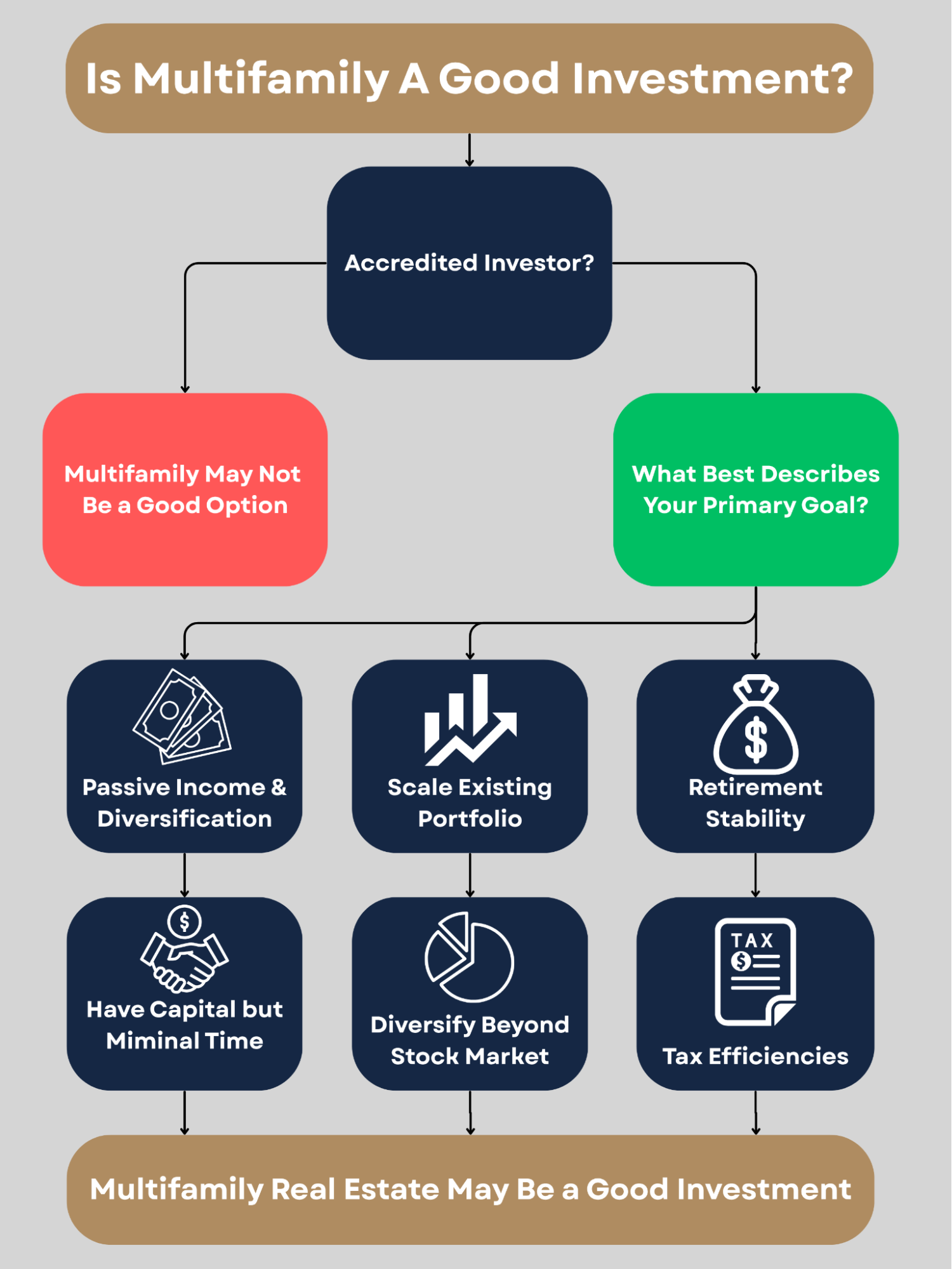
Below, we’ll explain what makes multifamily assets appealing, how they can be a great option when done right and align with an accredited investor’s strategy, and how real estate syndications can offer access to these potentially rewarding opportunities.
Topics Covered:
Are Multifamily Properties a Good Investment?
Multifamily properties are enticing investment options for many investors. It’s easy to see why, as they offer many benefits, some of which are unique to or combined uniquely in multifamily real estate.
Strong Demand Drivers
People will always need a place to live. That’s the foundation of any real estate investment, but multifamily sits in a sweet spot. With home prices and interest rates pushing ownership out of reach for many, more folks are renting longer, and that demand in stable markets isn’t going anywhere soon.
It becomes a durable, long-term play if you’re in the right market, especially one with steady job growth and tight inventory.
Stable Cash Flow
Multifamily can generate consistent monthly income, but let’s be clear—it depends on the deal. If you’re buying a stabilized property in a solid neighborhood, yes, cash flow is often reliable. But if you’re going after a value-add or distressed asset, early cash flow may dip while renovations or lease-ups are underway.
That’s not a flaw, it’s a different strategy with different upside. Savvy investors know which lever they’re pulling and why.
Economies of Scale
This is where multifamily starts to separate itself from smaller assets. When you own a 50-unit building, you’re not calling a plumber every time Unit 1A has a leaky faucet; you’ve got a maintenance team, and their cost is spread across every door.
That same scale applies to insurance, management, capital improvements, and even vendor relationships. The more doors under one roof, the more efficient your dollars become.
Forced Appreciation
Unlike single-family homes, which live and die by the comps on the block, multifamily properties are often valued like a business. Improve your net operating income by increasing rent, reducing expenses, or repositioning the property, and you can increase the value significantly.
It’s not speculative; it’s operational.
More Doors, More Stability
Here’s the risk management angle. If you own ten single-family homes and one resident moves out, you just lost 10% of your income.
But in a 100-unit multifamily, one vacancy barely moves the needle. The asset size buffers you against volatility in a way that smaller properties simply can’t.
Value by Performance, Not Just Comps
Comps still matter, but they aren’t the only driver. Multifamily is judged by performance, specifically, net operating income.
A well-run property with strong financials can maintain value even in a soft market. That gives the sponsor or owner more control over outcomes, which is a big deal when protecting capital over the long haul.
Multifamily in Today’s Market
It’s easy to see that homeownership has become exorbitantly expensive for many. We’re talking a mix of tight supply, rising construction costs, and increased demand in many key markets. Interest rates aren’t the only thing that has made owning a home out of reach for more people, but they certainly have poured gas on the fire.
Higher borrowing costs just make it harder for buyers to qualify, pushing more people towards renting by necessity rather than choice.
That’s why multifamily has become such a great concept for many investors. When folks rent longer, demand stays strong, which is the foundation for consistent occupancy and rental income.
If you’re investing in landlord-friendly regions (e.g., much of the Midwest), you’re stacking the deck in your favor with regard to multifamily. This gives multifamily investors:
- Pricing power in stable or growing rental markets
- Durability of income through consistent tenant demand
- Occupancy strength even during homeownership slowdowns
Who Multifamily is Right For
As we showed in the flowchart above, multifamily real estate can be an excellent fit for various accredited investors. But here’s the thing—just buying a multifamily property isn’t enough to guarantee success.
What really makes or breaks a deal is the operator behind it. The right sponsor knows how to find strong assets, manage them well, and make your money work harder.
Syndication Can Make Multifamily More Accessible
And since multifamily properties are often too expensive for even high-net-worth individuals to tackle alone, working with an experienced sponsor through a syndication can open the door to deals you couldn’t access on your own.
Take a look at the chart below; we’ve outlined which investor profiles benefit most from multifamily, and how a syndication helps make it happen.
| Investor Profile | Primary Goals | How Multifamily Syndication Supports That Goal |
|---|---|---|
| Long-term investors seeking diversification | Yield stability, portfolio balance | Exposure to real estate returns without direct management |
| Retirement-focused individuals | Capital preservation, steady cash flow | Potential for income-producing assets and inflation protection |
| Active real estate investors looking to scale | Operational efficiency, bigger deals | Access to larger assets with professional management infrastructure |
| Small operators / high earners priced out of full ownership | Asset exposure, lower barrier to entry | Partial ownership of institutional-grade properties via syndication |
| HNWIs seeking tax advantages | Depreciation, potential 1031 exchange, estate planning | Tax-efficient structure with pass-through benefits |
| HNWIs diversifying away from market correlation | Stability, downside protection | Real estate-backed assets with historically lower market volatility |
Why Syndications May Be a Better Path to Multifamily
For many accredited investors, real estate syndications offer a smarter, more efficient path into the realm of multifamily investing than going alone, even if they can afford to access multifamily properties on their own.
Here’s why:
- Disciplined Acquisition Process: A good sponsor isn’t going to buy emotionally. Instead, they buy based on sound underwriting, and a good syndication team vets dozens of deals to find one that fits a specific investment thesis, not just what looks good.
- Operational Expertise and Vertical Integration: Some syndications manage a property’s entire lifecycle in-house, from acquisition to leasing and exit. This hands-on control helps streamline decisions, reduce waste, and protect returns.
- Institutional-Level Debt Strategy: Fixed-rate debt isn’t just nice to have; it’s a hedge against interest rate volatility. Many syndications lock in favorable long-term rates, something most individual investors can’t negotiate alone.
- Aligned Incentives Through Preferred Returns: In good syndications, investors receive a preferred return before the sponsor earns a share of profits. This structure prioritizes investor capital and aligns all parties toward performance.
- Shared Risk Through Co-Investment: A quality sponsor will invest alongside you. When they have their own skin in the game, they aren’t just managing your money but protecting their own.
The Bottom Line
When you factor in long-term yield potential, income stability, and resilience across market cycles, multifamily real estate stands out, especially in strong, landlord-friendly markets. But to truly realize those benefits, you need the right sponsor.
At BAM Capital, we specialize in conservative underwriting, hands-on asset management, and investor-aligned structures built for performance.
Unlock Multifamily’s Potential Through BAM Capital’s Syndication Approach
Are multifamily properties a good investment? They can be when they match the right investor profile and are managed by a sponsor who knows how to unlock their full potential.
At BAM Capital, we specialize in helping accredited investors access institutional-quality multifamily opportunities through a disciplined, transparent approach. Our vertically integrated model means we handle every step in-house—from acquisition and asset management to exit; giving us tighter control over performance and costs.
We underwrite every property with conservative assumptions, factoring in realistic vacancy rates and market conditions so our investors aren’t caught off guard. And with over 215 years of combined leadership experience, we bring deep operational insight and a clear investment thesis: stable, cash-flowing assets in landlord-friendly Midwest markets.
Take it from our investors: If you’re looking for a multifamily investment partner you can trust to prioritize performance, alignment, and transparency, BAM Capital is built for you.
Ready to see if we’re the right fit for your portfolio? Schedule a call today to learn how BAM Capital can help you build long-term wealth through our real estate syndication returns.
Disclaimer: This article is for informational purposes only and is not financial, legal, or investment advice, nor an offer or solicitation to buy or sell securities. Investment opportunities offered by Bam Capital are made pursuant to Rule 506(c) of Regulation D and are available exclusively to accredited investors, as defined by the Securities and Exchange Commission (SEC) and, if applicable, qualified purchasers. Verification of accredited investor status is required before participation in any investment.
Any financial terms, projections, or forward-looking statements contained herein are hypothetical in nature and should not be interpreted as guarantees of future performance or safety. Such statements are based on current expectations, estimates, and assumptions, which are inherently subject to uncertainties and contingencies, many of which are beyond Bam Capital’s control. Such statements reflect Bam Capital’s opinion and are subject to market fluctuations, economic conditions, and investment risks. Actual results could differ materially from those projected or implied in any forward-looking statements.
Investing in private real estate securities involves significant risks, including but not limited to illiquidity, economic downturns, and potential loss of invested funds. Past performance does not guarantee future results. Prospective investors are strongly encouraged to conduct independent due diligence and consult with legal, tax, and financial advisors before making any investment decisions.
© 2025 Bam Capital. All rights reserved.