
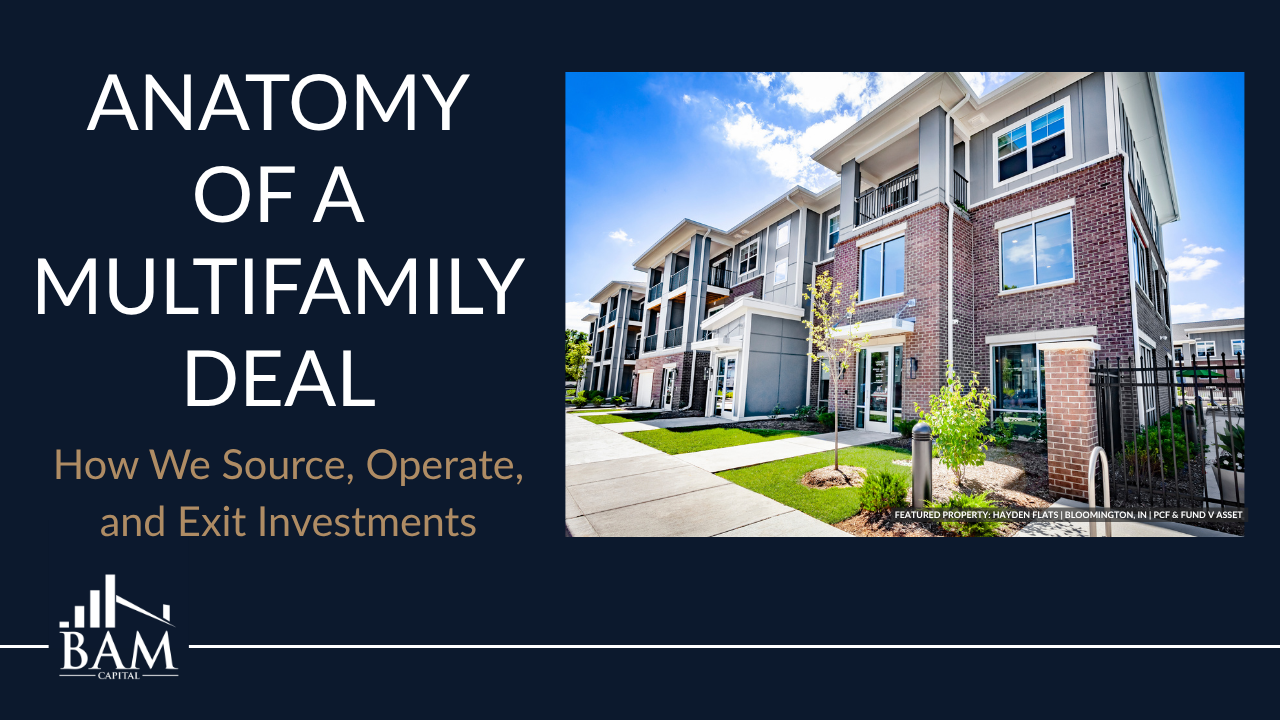
Behind every multifamily real estate deal is a disciplined process that goes far beyond simply finding a community and making an offer. In a recent webinar, BAM Capital leaders walked through how their multifamily investment strategy works from start to finish, covering sourcing, underwriting, operations, and exit planning to create long-term value.
Starting With the Right Markets and Properties
BAM Capital focuses on Midwest markets where we already have an established presence, including Indiana, Iowa, Missouri, Northwest Arkansas, and Western Pennsylvania.
BAM Capital primarily targets Class A apartment communities built within the last 10 to 12 years, typically with at least 200 units. We also prioritize submarkets—often in suburban areas—with highly rated schools, population growth, stable employment, and healthy supply conditions.
That scale matters. Larger communities often create stronger economies of scale, improved cash flow potential, and a wider buyer pool when it eventually comes time to sell. Our typical target is a three- to seven-year hold with goals of achieving at least a 15% net internal rate of return (IRR) and roughly a 2x equity multiple.
How BAM Capital Sources Deals
While many acquisitions across the industry are sourced through large institutional brokerage firms, the majority of BAM Capital’s opportunities come through long-standing relationships and off-market conversations.
Rather than competing in highly competitive bidding wars, we often work directly with brokers and sellers before deals formally hit the market.
“The majority of our deals come to us off market,” said Ryan Thie, BAM Capital’s VP of Asset Management. “A lot of that comes from our reputation for closing on time and doing what we say we’re going to do.”
Those relationships also extend to development and operating partners we have previously worked with on other transactions.
Identifying Where the Upside Exists
We believe some of the biggest opportunities come from operational improvements that increase net operating income (NOI) and create long-term value for investors. BAM Capital specifically looks for properties where value may be left on the table because the asset has not been operated efficiently. That can include:
- Owners facing financial distress
- Loan maturities forcing a sale
- Merchant developers focused more on building than long-term operations
- Recently leased-up properties
- Assets managed by third-party operators
Merchant developers, for example, are often highly skilled at getting projects built and occupied, but long-term operations may not be their primary focus. Similarly, third-party management companies are typically compensated based on revenue rather than NOI.
Market Analysis and Underwriting
Before pursuing an acquisition, BAM Capital spends significant time analyzing both broader market trends and local market conditions.
That includes evaluating:
- Diverse employment bases
- Sustainable rent-to-income ratios
- Landlord-friendly regulations
- Job creation and demand drivers
- Future apartment supply
At the same time, BAM Capital closely monitors construction pipelines to avoid markets where excessive new supply could impact occupancy or slow rent growth during our hold period.
The underwriting process is also highly selective. We may review hundreds of opportunities for every deal we ultimately move forward with.
Using discounted cash flow models, BAM Capital projects future performance, estimates potential returns, and evaluates whether a deal fits our investment criteria. Even then, we do not win every opportunity we pursue. In some cases, properties come back to us later if another buyer is unable to close.
Building the Business Plan
Once a property moves through underwriting, the focus shifts to building a clear investment strategy and operating plan.
This includes determining:
- How value can be added operationally
- What improvements may be needed
- How long execution could take
- What financing structure best fits the strategy
Physical due diligence is also a key part of the process. Rather than relying solely on reports or model-unit tours, we inspect every unit whenever possible while also evaluating the surrounding area, nearby developments, traffic patterns, and neighboring properties.
“We don’t want surprises after closing,” Jim Fox, BAM Capital CFO, explained. “Understanding the physical condition upfront is critical.”
Managing Risk From Day One
Another focus throughout the process is risk management.
Fox emphasized that no underwriting model unfolds exactly as projected, which is why BAM Capital builds contingency reserves, downside analysis, and interest-rate protection into deals from the beginning.
“Something will always go a little differently than planned,” Fox said.
Debt is structured around the business plan and targeted hold period, ensuring flexibility if market conditions shift or the investment timeline changes.
Operations Drive Value Creation
After we acquire a property, the focus shifts to operations. Our vertically integrated structure allows property management, maintenance, and construction teams to work closely together under one team rather than relying on outside vendors.
“We’re very aligned and integrated on what the strategy is for each asset,” Thie explained in the webinar.
One of the largest opportunities comes through controlling maintenance and repair costs internally. BAM Capital handles many tasks in-house that competitors may outsource, including HVAC replacements, appliance installation, plumbing, and electrical work.
BAM Capital also benefits from owning multiple properties within concentrated submarkets, allowing us to negotiate stronger vendor pricing and operate more efficiently at scale.
We also grow revenue through ancillary income streams such as valet trash, bulk internet programs, utility bill-backs, and pet-related fees. When scaled across large communities, these relatively small additions can meaningfully increase NOI.
The Exit Is Where Everything Comes Together
The exit strategy is where the investment lifecycle ultimately comes full circle.
While past performance does not guarantee future results, we believe disciplined execution throughout the hold period, where operational improvements and consistent asset management are applied, is designed to compound value over time. The goal is not to rely on major shifts in market conditions, but to drive performance through steady, intentional execution.
Alignment is also central to the structure. Sponsor compensation is designed so that investors receive their capital and preferred returns before any promote is earned.
Ultimately, successful multifamily investing is a full-cycle process. From sourcing and underwriting to operations and exit, each stage contributes to long-term performance and investor outcomes.
To learn more about investing with BAM Capital, contact our Investor Relations team.
Disclaimer: This case study is for informational purposes only and is not financial, tax, legal, or investment advice, nor an offer or solicitation to buy or sell securities. BAM Capital and its representatives are not fiduciaries. Investment opportunities offered by BAM Capital are made pursuant to Rule 506(c) of Regulation D, available exclusively to accredited investors, as defined by the Securities and Exchange Commission (SEC) and, if applicable, qualified purchasers, as defined by Section 2(a)(51) of the Investment Company Act of 1940. Verification of accredited investor status is required before participation in any investment. Any financial terms, projections, or forward-looking statements contained herein are hypothetical and should not be interpreted as guarantees of future performance or safety. Such statements reflect BAM Capital’s opinion and are subject to market fluctuations, economic conditions, and investment risks. Investing in private real estate securities involves significant risks, including but not limited to illiquidity, economic downturns, and potential loss of invested funds. Past performance does not guarantee future results. Historical transaction figures represent past performance across multiple deals as of the date this information was published, not a single investment transaction. Prospective investors are strongly encouraged to conduct independent due diligence and consult with legal, tax, and financial advisors before making any investment decisions.
© 2026 BAM Capital. All rights reserved.