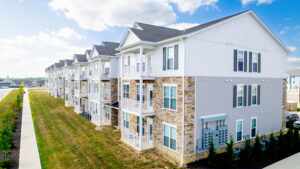

The multifamily market is showing continued improvement as new construction slows and renter demand holds up. After two years of elevated deliveries, demand is increasingly outpacing new supply across several markets.
The improvement is evident across BAM Capital’s core markets. Kansas City continues to stand out for strong demand and rent growth, while Indiana is seeing gains across its major metros. Des Moines and Pittsburgh are improving as new inventory is absorbed, and Northwest Arkansas is working through its construction cycle. Wilmington, North Carolina, is the newest market to watch, with rent growth recovering as its supply wave tapers.
BAM Capital’s August BLUF Report highlights the multifamily and economic development trends shaping these markets and their implications for the investment strategy.
The Big Picture: Demand Is Pulling Ahead
The biggest change in the multifamily market is happening on the supply side.
National apartment absorption reached roughly 167,500 units in the second quarter, compared with about 77,700 new deliveries, according to CBRE. That means demand outpaced new deliveries by more than 2-to-1, marking the second straight quarter where absorption exceeded deliveries. At the same time, July completions were down 25.6% year-over-year.
That’s an important change from earlier in the cycle. Markets are still working through apartments delivered over the past two years, but the supply wave is beginning to lose momentum as fewer new units come online.
That shift is beginning to show up in rents as well. The Midwest led the country with 2% year-over-year rent growth in Q2, while Kansas City and several BAM Capital markets are showing improving rent performance.
Indiana: Rent Growth Remains Broad-Based
Indiana is seeing strong rental growth across BAM Capital’s markets. Rents in the Indianapolis metro area are up about 3.2% over the past year, while Bloomington is up nearly 6.5%, with Fort Wayne also posting positive growth and occupancy holding in the mid-90% range across several strong submarkets.
The Indianapolis metro area construction pipeline is moving in the right direction as well. Marcus & Millichap expects 2026 deliveries to be down 55% from the market’s 2024 peak, while vacancy is projected to fall to approximately 5% by year end. As recently delivered communities continue to lease, slowing supply should create a more favorable operating environment.
development remains a positive driver. Fishers District recently announced a $169 million economic expansion that includes the new headquarters for JD North America, 600 jobs, a $65 million fieldhouse, and additional residential development.
For BAM Capital’s Indiana portfolio, continued economic investment and a slowing construction pipeline should support occupancy and rent growth.
Des Moines, Iowa: Vacancy Is Moving Lower
Des Moines is showing signs that the recent supply wave is being absorbed. CBRE data reported by the Business Record indicates metro vacancy fell to 6.3% in mid-2026, down from 6.8% at the end of 2025, while asking rents have continued to rise.
New inventory is still coming to the market, but the pace of development is becoming more manageable as existing apartments lease up. Asking rents increased 2.9% over the past six months, reaching $1,216, while 723 new units were delivered in the first half of the year and another 1,019 are projected for the second half.
The local economy is providing another source of support. Greater Des Moines has grown its population 13.4% over the past decade, while the Capital City Reinvestment District now includes the Market District, representing more than $600 million in planned and active investment, according to the Business Record.
Ongoing economic investment and job growth in the Des Moines MSA create positive fundamentals for BAM Capital’s Des Moines assets, though actual fund performance across Funds I-III will depend on broader economic conditions.
Kansas City Continues to Stand Out
Kansas City continues to separate itself from many other major markets.
Northmarq estimates the metro absorbed roughly 2,300 apartments in Q2 compared with just over 1,000 deliveries, meaning absorption was more than twice the level of new deliveries. Occupancy reached 96.2%, above the market’s five-year average.
Rent growth is holding up well, too. Yardi Matrix ranks Kansas City among the strongest major markets nationally, with advertised rents up roughly 3.1% year-over-year through the latest reporting period.
The economic outlook is strong as well. Two major hyperscale data center projects are moving forward in the Northland, including developments in Platte and Clay counties.
For BAM Capital communities such as Altitude 970 and Kinsley Forest, strong renter demand and continued regional economic investment offer a supportive environment for long-term operational fundamentals.
Northwest Arkansas: Supply Is Still the Story
Northwest Arkansas remains one of the fastest-growing regions in the country, but it is also one of the markets still working through elevated new deliveries.
Occupancy remains above 93%, while the construction pipeline has fallen 32% year-over-year and multifamily starts have declined sharply. As fewer projects move forward, the market has more room to absorb the inventory already delivered.
The region’s employment base continues to thrive, with NWA employment reaching a record 308,900 jobs in April and the area posting the lowest unemployment rate in Arkansas. Major investments, including the Walton-backed STEM university campus, are also strengthening the region’s long-term economic base.
For BAM Capital, the near-term focus remains absorption. With development slowing and employment continuing to grow, demand may strengthen relative to supply, potentially positioning the market for further improvement into 2027.
Pittsburgh, Pennsylvania: Limited Supply Supports Market Conditions
Pittsburgh is benefiting from slowing new supply and improving multifamily fundamentals.
Occupancy is near 95%, while new deliveries have slowed significantly. Northmarq reported that Central Pittsburgh rents increased 4.2% over the trailing year, while vacancy fell 100 basis points. With fewer new communities entering the market, existing properties face less competition for renters.
The region is also seeing continued investment in advanced manufacturing, energy, and defense-related industries. Eos Energy is building a 432,000-square-foot battery plant in Marshall Township that is expected to create 735 jobs, while Curtiss-Wright is investing another $80 million in the region.
For BAM Capital properties such as Ascent 430 and Nox Apartments, tightening regional occupancy and slowing supply align with the broader recovery across the Pittsburgh multifamily market.
Wilmington, North Carolina: A New Market to Watch
Wilmington is a new market in this month’s outlook, and the latest data points to an improving multifamily environment.
After a period of elevated apartment construction, the market is beginning to show signs of recovery. Wilmington ranks 19th nationally for rent growth, with same-store effective rents up 3.2% year over year through July, according to RealPage.
Like several other high-growth markets, Wilmington experienced pressure from new supply over the past two years. As that wave begins to taper, rent growth is starting to recover.
The local economy is also showing strong momentum. Amazon has started hiring for its new Wilmington-area fulfillment center, which is expected to create more than 1,000 full-time jobs. Population growth is another positive, with Brunswick County growing 4.7%, the fastest rate among North Carolina counties.
Disclaimer: This content is for informational purposes only and is not financial, tax, legal, or investment advice, nor an offer or solicitation to buy or sell securities. Investment opportunities offered by BAM Capital and its affiliates are made pursuant to Rule 506(c) of Regulation D, available exclusively to accredited investors, as defined by the Securities and Exchange Commission (SEC) and, if applicable, qualified purchasers, as defined by Section 2(a)(51) of the Investment Company Act of 1940. Verification of accredited investor status is required before participation in any investment.
Contact BAM Capital for details on current offerings. BAM Capital and its representatives are not fiduciaries or investment advisors. The information provided is general and may not reflect individual financial goals. Financial terms, projections, or forward-looking statements contained herein are hypothetical and should not be interpreted as guarantees of future performance or safety. Such statements reflect BAM Capital’s opinion and are subject to market fluctuations, economic conditions, and investment risks. Investing in private real estate securities involves significant risks, including, without limitation, illiquidity, economic downturns, and potential loss of invested funds or capital. Past performance does not predict or guarantee future results. Historical transaction figures represent past performance across multiple deals as of the date this information was published, not a single investment transaction. BAM Capital and its affiliates do not guarantee the accuracy or completeness of this information. Prospective investors are strongly encouraged to conduct independent due diligence and consult with legal, tax, and financial advisors before making any investment decisions.
© 2026 BAM Capital. All rights reserved.