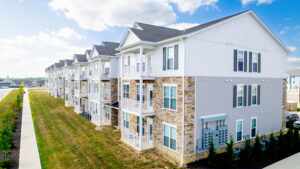

Picture two similar apartment communities in the same market.
One is managed well, but mostly stays the same. The other is managed with an eye toward continuous improvement—from updating units and common areas to strengthening day-to-day operations, retaining residents, and finding new ways to increase revenue.
This is where value-add comes in. For multifamily operators like BAM Capital, it means taking a hands-on approach to improving a property’s operations, income, and overall performance over time.
What Does Value-Add Mean in Real Estate?
Value-add in real estate focuses on improving a property’s financial performance while creating a better experience for residents.
This generally comes down to three things:
- Increasing rental income
- Reducing operating expenses
- Improving occupancy and resident retention
These improvements can increase a property’s net operating income (NOI)—the income a property generates after operating expenses—which is a key factor in determining its value. When a property generates more income and operates more efficiently, its value can increase.
Unlike market appreciation, which depends largely on outside market conditions, value-add strategies can create what is often called forced appreciation by improving a property’s income and operations.
Finding a Value Add Opportunity in Real Estate
A value-add real estate strategy doesn’t always mean buying a run-down property. Even Class A apartment communities can have opportunities to improve pricing, operations, expenses, or the resident experience.
Some signs to look for include:
- Rents that are below what the market can support
- Operating expenses that are higher than similar properties
- Outdated interiors or amenities compared to nearby communities
- Weak leasing performance or inconsistent resident retention
The opportunity isn’t always about making physical changes. It can also come down to how well the property is being run. Better leasing, stronger rent collection, lower expenses, and improved resident retention can all create value.
Operational Improvements That Drive Results
Before spending heavily on renovations, there are often opportunities to improve how a property operates day to day.
Better Tenant Screening
Stronger screening can help reduce late payments, evictions, and turnover costs. Even a small improvement can make a difference across a large property. For instance, lowering delinquency by 2% on a hypothetical 200-unit property with a $2,000 average monthly rent could yield $96,000 in gross annual revenue.
Streamlined Rent Collection
Online payments and automated accounting can make rent collection easier for both residents and onsite teams. They can also reduce administrative work and create more consistent cash flow. More consistent rent collection can also help improve NOI by increasing the amount of income a property actually collects.
Preventative Maintenance
Taking care of small issues before they become bigger problems can help keep repair costs down and prevent unnecessary disruptions. Regular inspections and preventative maintenance also help teams plan ahead instead of constantly reacting to emergencies.
Vendor Management
Reviewing contracts for services such as landscaping, trash removal, and insurance can uncover opportunities to reduce expenses without sacrificing service. Across a larger portfolio, those savings can add up quickly through shared resources and negotiated vendor agreements.
Resident Experience
Clear communication, responsive maintenance, well-maintained common areas, and a strong sense of community can improve resident retention. Retaining a resident can also be less expensive than finding, screening, and preparing a unit for someone new.
Physical Improvements That Increase Revenue
Once operations are running efficiently, physical improvements can be another way to increase a property’s appeal and support higher rents.
Unit-Level Renovations
Depending on the property, improvements might include:
- Luxury vinyl plank flooring
- Updating kitchens and bathrooms
- Modern lighting and fixtures
- Appliance upgrades
The goal is to make targeted improvements that match what renters expect in the market.
Common Area Enhancements
Residents want amenities they can actually use. Updating shared spaces can make a community more appealing and encourage people to spend time there.
Common improvements include:
- Fitness centers
- Lounges or coworking spaces
- Outdoor gathering areas
The best improvements are the ones that fit the property and the people who live there. For example, a coworking space may be especially valuable in a community with a lot of remote workers.
Curb Appeal
First impressions matter. Updated landscaping, fresh paint, improved lighting, and other exterior improvements can make a community feel more inviting and improve the overall perception of the property.
Small Add-Ons Can Add Up
Value-add doesn’t always require a major renovation. Small sources of additional income can make a meaningful difference across an entire community.
Examples include:
- Parking or garage fees
- Pet rent
- Storage rentals
- Valet trash services
- Utility reimbursements
- Technology or smart-home packages
Each charge may seem small on its own, but across an entire community, those dollars can add up quickly.
For example, a hypothetical $25 monthly valet trash fee across a 100-unit property would generate $30,000 in gross annual income. At an assumed 5% capitalization rate, that additional income could theoretically translate to an estimated $600,000 increase in property value.
Why Scale Matters
Scale can make it easier to operate properties efficiently. Larger operators can share resources, negotiate better vendor agreements, centralize certain functions, and create consistent systems across communities.
For a vertically integrated company like BAM Capital, these efficiencies can help teams manage properties consistently while keeping a close eye on expenses and the resident experience.
How Small Improvements Can Increase Property Value
One of the most important parts of value-add investing is understanding how improvements to NOI can affect a property’s value.
For instance, saving $65,000 in annual operating expenses on a hypothetical asset directly increases NOI, which translates to an estimated $1.3 million increase in property value at an assumed 5% capitalization rate—highlighting the mathematical power of forced appreciation, though actual results will vary based on market conditions.
Putting Value-Add to Work
BAM Capital takes a hands-on approach to daily operations to unlock equity value across our portfolio. As a vertically integrated firm, we’re involved in the day-to-day operations of our communities and look for ways to create value for both our investors and the residents who call them home.
Interested in learning more about BAM Capital’s approach to multifamily real estate and current investment opportunities? Email us at invest@bamcapital.com to connect with our team.
Disclaimer: This content is for informational purposes only and is not financial, tax, legal, or investment advice, nor an offer or solicitation to buy or sell securities. Investment opportunities offered by BAM Capital and its affiliates are made pursuant to Rule 506(c) of Regulation D, available exclusively to accredited investors, as defined by the Securities and Exchange Commission (SEC) and, if applicable, qualified purchasers, as defined by Section 2(a)(51) of the Investment Company Act of 1940. Verification of accredited investor status is required before participation in any investment.
Contact BAM Capital for details on current offerings. BAM Capital and its representatives are not fiduciaries or investment advisors. The information provided is general and may not reflect individual financial goals. Financial terms, projections, or forward-looking statements contained herein are hypothetical and should not be interpreted as guarantees of future performance or safety. Such statements reflect BAM Capital’s opinion and are subject to market fluctuations, economic conditions, and investment risks. Investing in private real estate securities involves significant risks, including, without limitation, illiquidity, economic downturns, and potential loss of invested funds or capital. Past performance does not predict or guarantee future results. Historical transaction figures represent past performance across multiple deals as of the date this information was published, not a single investment transaction. BAM Capital and its affiliates do not guarantee the accuracy or completeness of this information. Prospective investors are strongly encouraged to conduct independent due diligence and consult with legal, tax, and financial advisors before making any investment decisions.
© 2026 BAM Capital. All rights reserved.