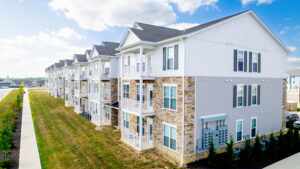

The multifamily market as of Q3 2025 is characterized by a mix of stabilization and regional divergence, driven primarily by an influx of new supply juxtaposed with high homeownership costs. Nationally, fundamentals are resilient with strong demand largely sustained by the significant premium of buying a home over renting. However, a near historic volume of new unit deliveries, particularly in Sun Belt and Mountain West metros, is temporarily suppressing rent growth and contributing to rising vacancies in those oversupplied markets. Conversely, the high barrier-to-entry coastal markets and Midwest region are showing more robust rent and occupancy growth. Overall, investment sales activity is gaining momentum, reflecting investor confidence and an adjustment to a higher-for-longer interest rate environment. Transaction volume and debt originations are on the rise, setting the stage for a stronger recovery as the new construction pipeline is projected to taper off significantly in 2026.
Bond Yields
It’s important to mention bond yields when talking about property values. Bond yields, particularly the yield on the 10-year U.S. Treasury note, can significantly impact real estate valuations through two main channels: 1) the cost of debt, and 2) the capitalization rate (Cap Rate).
When bond yields rise, they serve as a benchmark for all other long-term interest rates, including commercial and multifamily mortgage rates. This makes borrowing more expensive for investors, which directly increases the annual debt service on a property. Since a property’s value is often determined by discounting its future cash flows, higher financing costs reduce the levered cash flow and overall return on investment (ROI) for an equity investor. This forces buyers to demand a lower purchase price for the same level of net operating income, thus putting downward pressure on valuations.
The second major impact is on cap rates, which is the property’s initial unlevered yield. Said another way, the cap rate is derived by taking the property’s in-place net operating income (NOI) and dividing it by the asset’s value. The 10-year Treasury yield is considered the “risk-free” rate. Real estate cap rates offer a risk premium, which is the extra return an investor demands for taking on the higher risk and illiquidity of a real estate asset relative to a government bond. As Treasury yields increase, investors typically demand that the cap rate also increases to maintain a sufficient yield spread over risk
free investment. Since a higher cap rate implies a lower property value for a given NOI, this adjustment directly results in a decline in multifamily asset valuations. Therefore, the general rule is an inverse relationship: as bond yields rise, multifamily valuations fall, and as bond yields fall, valuations tend to increase. However, the ultimate cap rate movement is a result of this pressure being balanced against local market factors like rent growth, supply/demand, and investor appetite in order to achieve the appropriate stabilized yield on cost, which drives all investment returns.
The Cap Rate Environment
The current cap rate environment for the multifamily sector is showing signs of stabilization and modest compression across various asset classes, a significant shift after a period of expansion driven by higher interest rates in 2023. Recent data from the first half of 2025 indicates that the average going-in cap rate for core multifamily assets is approximately 4.75%, while value-add properties are seeing cap rates hover around 5.25%. This compression, though slight, reflects cautious optimism and an inflection point in the market, with some forecasts suggesting a gradual decline in cap rates throughout the year as investor demand strengthens and expectations for future interest rate cuts take hold. However, the market remains nuanced, as elevated and volatile interest rates lead to “price discovery” between buyers and sellers, and transactional activity is still below peak levels.
Cap rates vary significantly based on property class, market, and investment strategy. Market fundamentals, such as expected rent growth (projected average between 2.0% and 2.5% nationally for 2025) and the absorption of a substantial new supply pipeline, are critical factors influencing these rates. While low cap rates are typical for stable, low-risk institutional-quality apartment communities, higher cap rates are associated with Class B and C properties or high-risk, transitional markets.
National Multifamily Fundamentals
The multifamily market fundamentals for the third quarter of 2025 show a complex national picture defined by strong demand, moderating supply, and uneven rent performance. While national vacancy rates have remained relatively stable, hovering around 5.0% to 6.0% depending on the source, and a majority of the year saw robust demand (absorption in Q2 of 2025 was the strongest on record), a late-quarter demand cooling caused a slight dip in national effective asking rents, the first such decline for the quarter since 2009. This softness is largely attributed to the continued high volume of new supply, even as new construction starts have slowed considerably following a peak in 2024. As a result, many operators are increasingly utilizing rent concessions, which are offered to maintain sufficient occupancy rates.
Regionally, a clear split emerged in Q3 2025 as the market navigates the peak supply cycle. Oversupplied markets, particularly in the Sun Belt—such as Austin, Denver, and Phoenix—saw the steepest rent cuts as new inventory competed directly with slower than-expected absorption. In contrast, supply-constrained gateway and Midwest markets are outperforming with limited supply and positive market fundamentals. The overall outlook remains one of stabilization and gradual recovery, supported by a healthy labor market, continued demographic pressure that favors renting over homeownership, and an anticipated monetary policy shift with the Federal Reserve having cut rates in September 2025 and potentially in the future. As the construction pipeline continues to shrink, the market is poised for tightened vacancies and accelerated rent growth heading into 2026.
Closing Remarks
Multifamily real estate has demonstrated significant resilience over the course of time, particularly during economic downturns, due to factors like consistent demand. This resilience is highlighted by the sector’s ability to maintain performance even amidst broader market uncertainties. Multifamily is an exceptional long-term investment in wealth building while also providing diversification. Warren Buffett often said that “if you don’t find a way to make money while you sleep, you will work until you die.” Let your sleep do the talking when making a multifamily investment that compounds your interest overnight.
Disclaimer: This document is for informational purposes only and is not financial, legal, or investment advice, nor an offer or solicitation to buy or sell securities. Investment opportunities offered by Bam Capital are made pursuant to Rule 506(c) of Regulation D and are available exclusively to accredited investors, as defined by the Securities and Exchange Commission (SEC). Verification of accredited investor status is required before participation in any investment. The information contained herein reflects the opinions of the author and does not necessarily represent the views of Bam Capital. Any financial terms, projections, or forward-looking statements contained herein are hypothetical in nature and should not be interpreted as guarantees of future performance or safety. Such statements reflect opinions and are subject to market fluctuations, economic conditions, and investment risks. Investing in private real estate securities involves significant risks, including but not limited to illiquidity, economic downturns, and potential loss of invested funds. Past performance does not guarantee future results. Prospective investors are strongly encouraged to conduct independent due diligence and consult with legal, tax, and financial advisors before making any investment decisions. Bam Capital makes no representation or warranty regarding the accuracy or completeness of the information contained herein.
© 2025 Bam Capital. All rights reserved.
Author: Tony Landa, Senior Economic Advisor, The BAM Companies, November 2025