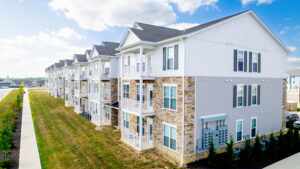

Multifamily real estate has demonstrated notable resilience in the face of economic uncertainty and recessions. This resilience stems from factors like the consistent demand for rental housing and a diversified income stream from multiple units. Additionally, multifamily properties are often valued based on their income-generating capacity and long-term fundamentals, which serve as an essential hedge against market shifts. The foundation of multifamily includes three specific investment pillars: cash flow stability, capital preservation, and appreciation potential.
The sector has withstood the test of time, and here’s why.
The Essential Need for Housing
- Food and Shelter: These are two of the most obvious necessities in life. More specifically, shelter is an important element that significantly contributes to the robust demand for rental housing.
- Higher Demand During Economic Uncertainty: Economic downturns often make it difficult for people to qualify for mortgages, which enhances demand for rental housing.
- Housing Shortage: Amidst demographic shifts and lingering pandemic impacts on the population and broader economy, the U.S. faces a pressing need to build more than 4.0 million new apartments by 2035, according to a study commissioned by the National Apartment Association (NAA) and the National Multifamily Housing Council (NMHC).
Income-Based Valuation
- In-Place Cash Flow and Future Fundamentals: Multifamily properties are valued based on the income the asset generates and the underlying apartment fundamentals of the specific submarket. For example, most real estate companies don’t overly focus on the net operating income today, but on where it will be tomorrow. It provides a stabilized yield on cost, which is the most important metric in real estate valuation. Here is a mathematical illustration.

Cash Flow Stability, Capital Preservation, and Appreciation Potential
- Cash Flow Stability: Multiple rental units within one or more buildings provide a consistent income stream, mitigating the impact of vacancies. For example, a 300-unit, 100% occupied apartment community that loses twenty residents over the summer results in an occupancy of 93.3%. While other real estate asset classes might be more sensitive to market fluctuations, multifamily typically provides consistent cash flow without the large swings in occupancy that exist with commercial properties, such as office and retail.
- Capital Preservation: Capital preservation refers to an investment strategy that prioritizes protecting the initial value of an investor’s capital by minimizing risk, rather than seeking the highest returns, to avoid significant losses. It’s often used by investors with low risk tolerance or nearing retirement who want to safeguard their funds during market fluctuations.
- Appreciation Potential: Multifamily real estate investments offer strong appreciation potential, meaning their value tends to increase over time. Factors like strong rental demand, strategic property improvements, and the long-term fundamentals of the sector drive this appreciation. For example, Multifamily Real Estate Investment Trusts (REITs) are experiencing higher renewal rates, indicating that renters are staying put in their current apartments rather than buying homes.
Current Examples of Multifamily Resilience
- Solid Fundamentals: Apartment supply has decreased by ~ 25% this year compared to deliveries in recent quarters. According to recent data from the U.S. Census, unit starts trail completions by a significant margin for the 12 months preceding May of 2025. This positive net absorption signifies increased demand and can lead to higher rental rates and lower vacancies.
- Millennial and Gen Z Demand: Both Millennials and Gen Z are driving significant demand for rental housing, with Millennials staying in rentals longer and Gen Z entering the market. This is fueled by factors such as high down payment costs for homes, the need for flexibility, and the perceived stress associated with homeownership.
- The Affordability Gap: It refers to the difference between the cost of renting or owning a home and what people can afford, particularly impacting lower- and middle-income households. This gap has widened in recent years due to rising home prices and elevated mortgage rates, making homeownership increasingly unattainable for many. Multifamily properties, however, are becoming a more attractive investment option due to this affordability gap.
Multifamily properties provide diversification and are an exceptional long-term investment in wealth building. Warren Buffett often said that “if you don’t find a way to make money while you sleep, you will work until you die.” Let your sleep do the talking when making multifamily investments that compound overnight.
Disclaimer: This document is for informational purposes only and is not financial, legal, or investment advice, nor an offer or solicitation to buy or sell securities. Investment opportunities offered by Bam Capital are made pursuant to Rule 506(c) of Regulation D and are available exclusively to accredited investors, as defined by the Securities and Exchange Commission (SEC). Verification of accredited investor status is required before participation in any investment. The information contained herein reflects the opinions of the author and does not necessarily represent the views of Bam Capital. Any financial terms, projections, or forward-looking statements contained herein are hypothetical in nature and should not be interpreted as guarantees of future performance or safety. Such statements reflect opinions and are subject to market fluctuations, economic conditions, and investment risks. Investing in private real estate securities involves significant risks, including but not limited to illiquidity, economic downturns, and potential loss of invested funds. Past performance does not guarantee future results. Prospective investors are strongly encouraged to conduct independent due diligence and consult with legal, tax, and financial advisors before making any investment decisions. Bam Capital makes no representation or warranty regarding the accuracy or completeness of the information contained herein.
© 2025 Bam Capital. All rights reserved.
Author: Tony Landa, Senior Economic Advisor, The BAM Companies, November 2025