
For accredited investors, selecting a multifamily investment strategy typically boils down to determining the level of involvement that suits you, assessing your comfort level with risk, and identifying the type of returns you aim for.
Some investors prefer a hands-on approach through direct ownership, while others opt for a passive approach via funds or syndications, allowing seasoned operators to handle the work. Not all multifamily investment strategies are created equal. Some are built for consistent income, while others are designed for bigger gains through upgrades or development. The key is knowing which mix fits your comfort level and timeline.
Types of Multifamily Investment Strategies
Category | Core | Core-Plus | Value-Add | Opportunistic / Development |
Typical Returns (%) | 6-10% | 8-12% | 12-18%s | 15-25% |
Risk Level | Low | Moderate | Moderate–High | High |
Time Horizon | 5–10 years | 5–10 years | 3–7 years | 3–10 years |
Best For | Stability + income | Income + growth | Strong growth | Max upside |
Core: Focuses on newer, well-located apartments already performing well. Returns come mainly from rent and appreciation. This approach suits investors who want predictability over aggressive growth swings.
Core-Plus: Generates regular income and aims for modest growth potential through light improvements like operational or cosmetic upgrades.
Value-Add: Targets underperforming assets that need updates or re-leasing. Returns can be strong if execution is sound. It’s a middle ground for investors comfortable with moderate risk and a hands-off structure.
Opportunistic / Development: The highest-risk, highest-potential strategy. Investors fund ground-up or heavy repositioning projects, with most rewards coming at sale or refinance.
*These are typical industry ranges based on historical data and do not represent the actual or
projected returns of any BAM Capital offering. Investment involves risk, and actual results may
differ materially.
Active vs. Passive Involvement
A significant factor in selecting a multifamily investment strategy is the level of involvement you desire in the process. The table below breaks down the distinction between active and passive participation.
Active vs. Passive Multifamily Investment Strategies | ||
Attribute | Active Ownership | Passive Participation (Funds or Single-Asset Syndications) |
Investor Role | You manage everything | Professional handle operations |
Control | Full control over decisions + expenses | Limited control |
Expertise Needed | Real estate + operations + financial knowledge | None; sponsor handles execution |
Time Commitment | Often 10–20 hours/week | None |
Best For | Hands-on, experienced investors | Income or growth-focused passive investors |
Core Factors Influencing Strategy Selection
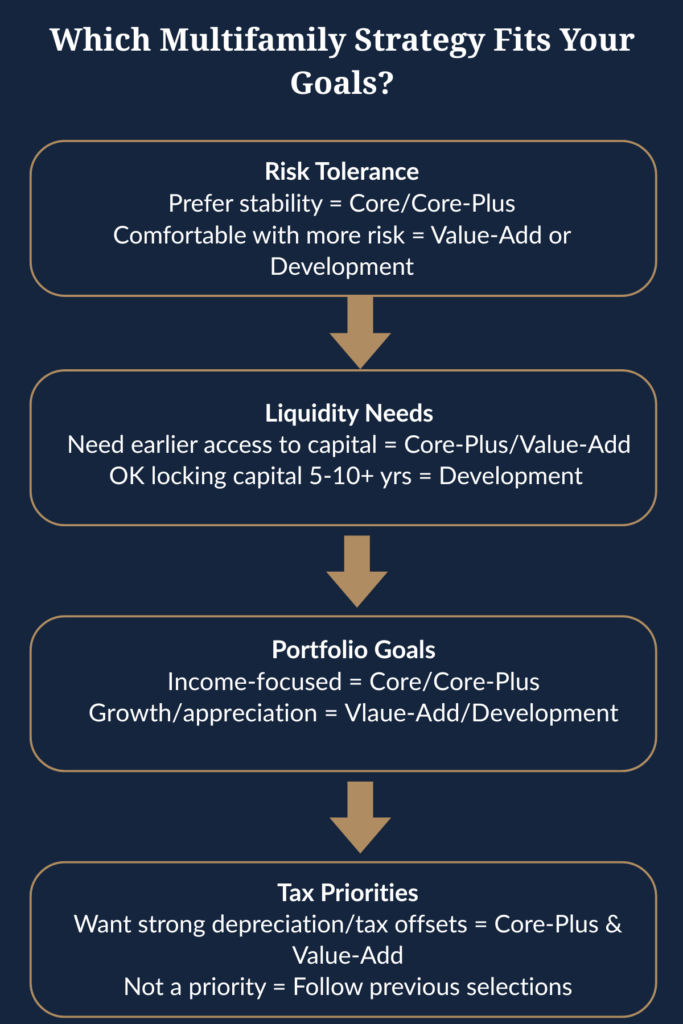
Before choosing a multifamily strategy, think about what you’re trying to achieve, how much risk and control you’re comfortable with, your liquidity needs, and your overall portfolio goals.
Risk Tolerance
Questions to ask yourself:
If you value reliable income and lower volatility, a core or core-plus strategy fits best. Those comfortable taking on more risk for higher upside might favor value-add or development opportunities, where active improvements drive higher returns over time.
Best fit strategy:
Core or Core-Plus for stability; Value-Add or Development for higher growth potential.
Liquidity Needs
Questions to ask yourself:
How long can your money sit out on the field without needing to be pulled back? Development projects can tie up capital for a long while, think five to ten years. If that feels too long, you’ll be better off with core-plus or value-add, where stabilized assets throw off income and don’t lock you in quite as tightly.
Best fit strategy:
Core-Plus or Value-Add if you want some breathing room; Development if you’re okay with a long, slow bake.
Portfolio Goals
Questions to ask yourself:
Are you building this portfolio to receive reliable income checks, or are you trying to grow your wealth over the next decade? If income is the goal, core or hybrid funds make sense; they’re designed to pay you regularly.
If you’re more growth-minded and want to squeeze more appreciation (and tax breaks) out of your dollars, value-add or development usually earns a spot in the lineup.
Best fit strategy:
Value-Add and Development if you’re aiming for appreciation and heavier depreciation benefits.
Tax Priorities
Questions to ask yourself:
Is reducing your taxable income part of the plan? Strategies that utilize depreciation and cost segregation can help mitigate the impact of Uncle Sam’s tax burden. If you want cash flow and strong tax efficiency, a mix of core-plus for income and value-add for accelerated depreciation hits a nice middle ground.
Best fit strategy:
Blend of Core-Plus for income and Value-Add for bigger tax advantages.
Experience Level
How hands-on do you really want to be? Running properties on your own can feel like juggling three chainsaws at once, doable for a pro, not ideal for most folks. Most accredited investors prefer passive funds or syndications, where the heavy lifting is handled by people who do this all day.
If you’re a seasoned operator who likes being in the driver’s seat, active ownership is an option, but it’s not for the casual investor.
Best fit strategy:
Passive funds or syndications for most investors; active ownership only if you’ve got the time, experience, and appetite for hands-on work.
Building a Multifamily Portfolio Strategy
Once you understand the different investment approaches, the next step is figuring out how they fit together.
Most accredited investors start with stabilized or core-plus assets for steady income, then add value-add or development exposure for growth and tax benefits. Some also include private credit or preferred equity for a consistent yield and less volatility.
Your mix depends on risk tolerance, time horizon, and income needs. Here’s a simple framework showing how allocations might look across three common investor profiles:
Recommended Portfolio Allocation (%) by Investor Profile | ||||
Strategy | Conservative Allocation | Balanced Allocation | Opportunistic Allocation | Typical Objective |
Core / Core-Plus Assets | 55–65% | 35–45% | 20–25% | Steady, predictable income |
Value-Add Assets | 10–20% | 25–35% | 35–45% | Higher returns through upgrades |
Development Assets | 0–5% | 5–10% | 15–20% | Upside from new projects |
Private Credit / Preferred Equity | 10–15% | 10% | 5% | Consistent yield, lower volatility |
No two portfolios look exactly the same, but spreading investments across multiple strategy types helps even out the ups and downs.
BAM Capital’s Approach to Multifamily Investment Strategies
There’s no shortage of investment options in real estate, but not all sponsors manage the details the same way. What sets BAM Capital apart is how those details are handled: in-house, with discipline, and with investors in mind.
- Vertically Integrated Operations: The majority of the process happens in-house. From acquisition and construction oversight to day-to-day property management, BAM keeps full visibility on performance. That integration aimes to keep costs low, communication clear, and performance consistent.
- Market Focus: BAM concentrates on Midwest markets; places with steady job growth, reasonable living costs, and limited new construction. Those fundamentals support stable rents and occupancy.
- Data-Driven Underwriting: Each deal is evaluated using conservative leverage, stress testing, and yield-based pricing models, which help ensure returns that withstand market cycles.
- Track Record: BAM Capital’s history of providing consistent preferred return distributions reflects a disciplined, long-term investment philosophy built to weather market cycles.
For accredited investors, this combination of vertical integration, discipline, and transparency results in a more predictable investment experience.
Long-Term Success Starts With the Right Strategy
No matter the multifamily investment strategy, returns aren’t built overnight; they’re built on discipline. At BAM Capital, we take the long view, focusing on resilient Midwest markets and managing every property in-house to deliver consistent performance through every cycle.
For accredited investors seeking a partner with both vision and restraint, that’s what defines long-term success.
Ready to see if we’re the right fit for your portfolio? Schedule a call today to learn how BAM Capital can help you build long-term wealth through our real estate syndication returns.
Disclaimer: This article is for informational purposes only and is not financial, legal, or investment advice, nor an offer or solicitation to buy or sell securities. Investment opportunities offered by Bam Capital are made pursuant to Rule 506(c) of Regulation D and are available exclusively to accredited investors, as defined by the Securities and Exchange Commission (SEC) and, if applicable, qualified purchasers. Verification of accredited investor status is required before participation in any investment.
Any financial terms, projections, or forward-looking statements contained herein are hypothetical in nature and should not be interpreted as guarantees of future performance or safety. Such statements are based on current expectations, estimates, and assumptions, which are inherently subject to uncertainties and contingencies, many of which are beyond Bam Capital’s control. Such statements reflect Bam Capital’s opinion and are subject to market fluctuations, economic conditions, and investment risks. Actual results could differ materially from those projected or implied in any forward-looking statements.
Investing in private real estate securities involves significant risks, including but not limited to illiquidity, economic downturns, and potential loss of invested funds. Past performance does not guarantee future results. Prospective investors are strongly encouraged to conduct independent due diligence and consult with legal, tax, and financial advisors before making any investment decisions.
© 2025 Bam Capital. All rights reserved.
For additional multifamily real estate insights, visit Pathways to Passive Wealth, BAM Capital’s new platform designed to make real estate investing more accessible, transparent, and achievable for aspiring and experienced investors.


