
Key Trends and Insights for Passive Real Estate Investors
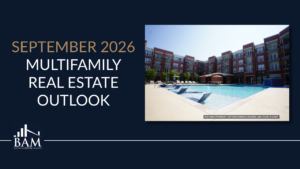
BAM Capital’s latest multifamily market outlook explores signs of a stabilizing market, providing a more predictable landscape for investors while noting that market conditions remain subject to change. The average cost to rent an apartment nationwide rose 0.3% in February, while occupancy held at 94.5%. Even with a wave of new apartments coming online, demand is keeping pace — a clear sign the market is starting to settle down.
The Big Picture: Stability Is Taking Shape
Current multifamily rent growth news highlights that as new construction slows, a more stable environment is emerging, which we believe supports the potential for steady, long-term growth. For investors, this means returns are becoming less about broad market swings and more about the quality of day-to-day property management. In a competitive leasing environment, strong execution at the property level matters more than ever.
At the same time, development is becoming more challenging. Construction costs continue to climb (+4.6%), driven by a 9% overall spike in materials. Steel prices are up 17% year over year, aluminum has jumped more than 30%, and copper is up 22%. Altogether, multifamily development costs are over 30% higher than they were five years ago.
For BAM Capital, this creates a natural shield for our existing properties. As it becomes too expensive for others to build new apartments, our current assets face less competition, making them more valuable and secure over the long run.
Indiana: Supply Pullback Meets Job Growth
We are seeing a healthy rebalancing in Indiana, where multifamily rent growth is projected to reach 1.5% in 2026 as the supply of new units tapers off significantly from the previous year.
As the gap between supply and demand narrows, properties don’t have to compete as aggressively for residents. That typically leads to fewer concessions and more consistent occupancy.
Local job growth is also playing a role. NewCold is expanding again in the Central Indiana city of Lebanon, bringing its total planned investment to $800 million and adding over 200 high-wage jobs by 2028, along with 350 construction roles. Meanwhile, INCOG BioPharma Services is investing $200 million in Fishers, a northern suburb of Indianapolis, with plans to grow to 1,000 employees by 2030.
For our investors, positive job growth like this makes renting more affordable and helps strengthen collections and long-term demand across Indianapolis.
Des Moines, Iowa: Short-Term Pressure, Long-Term Opportunity
Des Moines is working through a wave of new supply. About 1,687 units were delivered in 2025, pushing occupancy down to 92.7%, a 1.3% decline year over year.
Even with that pressure, rents still grew 3.7% to $1,165, and sales volume surpassed $500 million for the first time on record. That’s a good reminder that demand hasn’t disappeared; the market is simply absorbing new inventory.
Performance in this type of environment often comes down to operations. Staying leased and managing concessions in the short term puts properties in a strong position as the market stabilizes.
Major urban infill projects like 515 Walnut Tower and the Valley West Mall redevelopment are modernizing the Central Iowa housing landscape. For investors, this shift supports long-term multifamily rent growth by keeping the market competitive for high-earning residents.
Kansas City, Missouri: Steady Fundamentals with Strong Investment Tailwinds
Kansas City continues to show steady, reliable growth. Rents are forecast to increase 2% in 2026, while new supply is expected to ease slightly from 4,400 units in 2025 to 4,000 units this year.
That balance is helping maintain stable occupancy and consistent revenue performance. On the economic side, there’s significant capital flowing into the region. Nebius is developing a $6.6 billion hyperscale campus in Independence, bringing over 1,200 construction jobs and 130 permanent roles. Merck Animal Health is also expanding with an $895 million investment, adding another 200 jobs.
This creates both short-term and long-term demand. Construction workers support occupancy now, while permanent, higher-wage jobs help drive retention and rent growth over time.
Northwest Arkansas: Demand Leading the Way
Northwest Arkansas stands out as one of the strongest supply-demand markets. In 2026, absorption is expected to reach 1,371 units, nearly double the 696 units projected for delivery. When demand outpaces supply like this, vacancies drop, giving owners more leverage on pricing.
The region is also seeing broad investment in several different industries. Conagra Foods is expanding in Fayetteville with a $220 million project, adding over 100 jobs. Freeman Health System is acquiring Northwest Health in a $112 million deal that includes more than 1,500 employees. Infrastructure is keeping pace as well, with a $500 million expansion of the Highway 112 corridor underway.
There’s also a long-term push to add 20,000 jobs over the next 20 years through a proposed regional initiative. All of this supports longer resident tenure and more stable occupancy, which is exactly what investors look for in a growing market.
Pittsburgh, Pennsylvania: Tight Supply Meets a Growing Tech Economy
Pittsburgh is emerging as a major innovation and capital investment hub for BAM Capital, particularly in AI and robotics. The Western Pennsylvania region ranked 7th nationally for AI and autonomous vehicle venture funding and raised $2.29 billion across 124 companies in 2025. Total capital investment reached $16.1 billion, including a $500 million raise by Skild AI.
At the same time, new supply remains limited. Inventory grew just 0.3% in 2025, and in 2026, absorption is expected to exceed 1,041 units. With demand outpacing supply, existing properties face less competition while the renter base shifts toward higher-income, tech-oriented professionals.
For BAM Capital and our prospective investors, this combination supports steady occupancy, stronger renewals, and a deeper pool of qualified renters in a market with very high barriers to entry.
Why This Matters for Passive Investors
Across these key target markets, the same theme keeps showing up: supply is slowing, demand is holding, and local economies are expanding.
That’s typically when multifamily performs at its best. When new competition is limited and demand remains steady, occupancy stabilizes, income becomes more predictable, and risk is easier to manage.
In this environment, market-level growth is only half the story — execution is the other half. Choosing the right market and having the right team on the ground are what allow an asset to operate efficiently and outperform the averages.
For our passive investors, this makes an experienced, vertically integrated operator like BAM Capital especially valuable. As the broader multifamily market outlook continues to normalize, our deep local roots and active management approach are designed to be the engines behind long-term performance and value for our investors.
Disclaimer: This content is for informational purposes only and is not financial, tax, legal, or investment advice, nor an offer or solicitation to buy or sell securities. Investment opportunities offered by BAM Capital and its affiliates are made pursuant to Rule 506(c) of Regulation D, available exclusively to accredited investors, as defined by the Securities and Exchange Commission (SEC) and, if applicable, qualified purchasers, as defined by Section 2(a)(51) of the Investment Company Act of 1940. Verification of accredited investor status is required before participation in any investment.
Contact BAM Capital for details on current offerings. BAM Capital and its representatives are not fiduciaries or investment advisors. The information provided is general and may not reflect individual financial goals. Financial terms, projections, or forward-looking statements contained herein are hypothetical and should not be interpreted as guarantees of future performance or safety. Such statements reflect BAM Capital’s opinion and are subject to market fluctuations, economic conditions, and investment risks. Investing in private real estate securities involves significant risks, including, without limitation, illiquidity, economic downturns, and potential loss of invested funds or capital. Past performance does not predict or guarantee future results. Historical transaction figures represent past performance across multiple deals as of the date this information was published, not a single investment transaction. BAM Capital and its affiliates do not guarantee the accuracy or completeness of this information. Prospective investors are strongly encouraged to conduct independent due diligence and consult with legal, tax, and financial advisors before making any investment decisions.
© 2026 BAM Capital. All rights reserved.