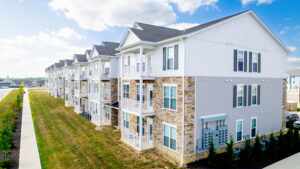

Over the past decade, stabilized multifamily assets have averaged 12–18% gross internal rate of return (IRR) and 6–9% gross annual cash-on-cash yield, depending on property type, market cycle, and sponsor performance.
Those numbers tell just part of the story. Real-world results depend on factors a spreadsheet can’t show: the sponsor’s underwriting discipline, asset selection, and management execution. When those align, investors get steady income, measured growth, and confidence in their capital.
Typical Multifamily Return Metrics
Return Metric | Typical ROI Ranges | Description |
Preferred Return | 7–10% | Paid to investors before sponsor participation |
Annual Cash-on-Cash | 6–9% | Ongoing passive income during the hold period |
IRR (Net of Fees) | 12–18% | Total annualized return, including sale proceeds |
Equity Multiple | 1.8×–2.3× | Total return over the full hold period |
Hold Period | 2–10 years | Typical range for stabilized multifamily |
Hypothetical Performance Disclosure: The above example illustrates hypothetical returns for demonstrative purposes only. These are hypothetical results, not actual performance, and do not reflect the performance of any specific BAM Capital investment. Actual results will vary, and past performance is not indicative of future results.
These ranges represent averages across thousands of institutional and sponsor-led transactions over the past decade. They vary with market timing, leverage, and management efficiency. Still, across cycles, multifamily returns have remained remarkably stable.
When you understand how those returns are built, you see why multifamily syndications have been a cornerstone of private real estate portfolios for decades.
How Multifamily Syndication Returns Are Structured
Every multifamily syndication follows a waterfall model: a structured order for how profits are shared between investors and the sponsor. In a well-designed waterfall, investors receive their preferred return and capital back first, and the sponsor only earns additional profit when the investment performs.
Investment Example

- Preferred Return: Investors earn a fixed yield, often 8%, before the sponsor gets their share.
- Capital Return: Once the preferred return is paid, the investor’s principal is repaid in full.
- Profit Split: Remaining profits are divided, commonly 70/30 or 80/20 in favor of investors.
- Carried Interest (Sponsor Promote): The sponsor’s promote is performance-based, not fee-based.
Core Components of Multifamily Syndication Returns
Multifamily returns come from several complementary sources, each contributing to total performance over time.
- Cash Flow: Quarterly distributions from net operating income (NOI) provide predictable passive income throughout the hold period.
- Appreciation: Rising rents and efficient expense management expand NOI and property value. Even modest 2–3% rent growth compounds significantly over a decade.
- Tax Benefits: Depreciation and cost segregation can often offset taxable income, thereby enhancing the after-tax yield.
- Refinance Proceeds: Strategic refinancing can return part of the investor’s capital mid-hold while maintaining ownership. This boosts cash-on-cash returns without requiring a sale.
- Profit at Sale: Upon disposition, investors capture both appreciation and cumulative cash flow, the full-cycle payoff.
Together, these streams form the backbone of multifamily’s resilience as an asset class.
Historical Performance Benchmarks
10-Year Average (2013–2023) | Multifamily (Private) | Public REITs | S&P 500 |
Annualized Return | 12–14 % | 8–10 % | 10–11 % |
Volatility | Low | Medium | High |
Income Stability | High (distributions in ~90% of quarters) | Medium (~70% of quarters with dividend growth) | Low (~60% of quarters with positive yield) |
Correlation with Stocks | Low | High | High |
Private multifamily investments have outperformed on a risk-adjusted basis. During downturns like 2008 and 2020, occupancy held at 93–96%.
That stability stems from necessity-driven demand: housing remains essential regardless of market sentiment. For investors seeking diversification from public equities, that low correlation is one of multifamily’s biggest advantages.
What Drives Strong Multifamily Returns
Performance ultimately depends on two categories of forces: those the sponsor can control and those it can’t.
Controllable Factors | External Factors |
Sponsor execution | Interest rate trends |
Expense management | Cap rate movement |
Rent growth strategy | Regional employment data |
Financing structure | National housing supply |
Controllable Factors: These are areas where a sponsor’s discipline directly drives performance:
- Sponsor execution: Strong execution keeps your property running efficiently, projects on schedule, and performance consistent.
- Expense management: Careful cost control protects your returns and helps maintain steady cash flow.
- Rent growth strategy: Thoughtful pricing and renewal management support the income you receive year after year.
- Financing structure: A balanced approach to leverage keeps your investment stable through different market conditions.
External Factors: Market forces that no sponsor can control, but the best ones plan for them early.
- Interest rate trends: Rising or falling rates change borrowing costs and property values. Good sponsors prepare for those shifts instead of betting on perfect conditions.
- Cap rate movement: When buyers are willing to pay less for each dollar of income, values drop. Conservative underwriting assumes cap rates may rise, not fall.
Regional employment conditions: Strong job markets help maintain high occupancy levels, while slower hiring can reduce the pace of rent growth.
- National housing supply: Too much new construction can soften rents, while a limited supply supports long-term stability. Skilled sponsors watch both before they buy.
Sponsors with in-house management teams, such as BAM Capital, maintain direct oversight of every controllable lever, including tenant experience, capital expenditure, and everything in between.
That operational integration keeps costs low, transparency high, and IRR performance consistent across market cycles.
Accredited Investor Considerations
A multifamily syndication gives you access to real estate typically reserved for institutions. It’s a way to scale your portfolio, stay fully passive, and put your capital to work in tangible assets that produce income every quarter.
- Capital Efficiency: A single $50K–$250K+ investment gives you exposure to properties worth tens of millions.
- Diversification: You can spread your investments across different markets and deal types—stabilized, value-add, or growth-focused.
- Tax Advantages: Depreciation and cost segregation often offset much of your passive income, improving after-tax yield. Once those benefits are realized, a 7% distribution can feel closer to 9–10%.
- Due Diligence: Focus on how sponsors perform when conditions shift. A solid track record, transparent reporting, and consistent communication matter more than projections.
Syndications are built for consistent income, steady appreciation, and the confidence that comes from knowing your capital is tied to a real asset.
Multifamily Syndication Returns Built on Discipline
At BAM Capital, investor returns come first: preferred distributions are paid before any sponsor participation, and every property is managed in-house from acquisition through exit.
Over the past decade, this disciplined model has consistently generated cash flow and achieved double-digit IRRs across market cycles in resilient markets.
For accredited investors seeking predictable income and long-term growth, multifamily syndication remains one of the most reliable paths to building and preserving wealth.
Ready to see if we’re the right fit for your portfolio? Schedule a call today to learn how BAM Capital can help you build long-term wealth through our real estate syndication returns.
Disclaimer: This article is for informational purposes only and is not financial, legal, or investment advice, nor an offer or solicitation to buy or sell securities. Investment opportunities offered by Bam Capital are made pursuant to Rule 506(c) of Regulation D and are available exclusively to accredited investors, as defined by the Securities and Exchange Commission (SEC) and, if applicable, qualified purchasers. Verification of accredited investor status is required before participation in any investment.
Any financial terms, projections, or forward-looking statements contained herein are hypothetical in nature and should not be interpreted as guarantees of future performance or safety. Such statements are based on current expectations, estimates, and assumptions, which are inherently subject to uncertainties and contingencies, many of which are beyond Bam Capital’s control. Such statements reflect Bam Capital’s opinion and are subject to market fluctuations, economic conditions, and investment risks. Actual results could differ materially from those projected or implied in any forward-looking statements.
Investing in private real estate securities involves significant risks, including but not limited to illiquidity, economic downturns, and potential loss of invested funds. Past performance does not guarantee future results. Prospective investors are strongly encouraged to conduct independent due diligence and consult with legal, tax, and financial advisors before making any investment decisions.
© 2025 Bam Capital. All rights reserved.
For additional multifamily real estate insights, visit Pathways to Passive Wealth, BAM Capital’s new platform designed to make real estate investing more accessible, transparent, and achievable for aspiring and experienced investors.