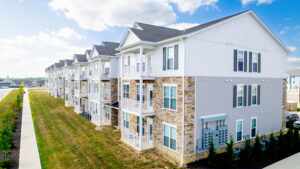

As of the final quarter of 2025, the U.S. multifamily market is being described as a “strategic turning point” because it marks the simultaneous convergence of three major cyclical shifts: the supply wave peak, the precipitous drop in construction starts, and the pivot in monetary policy. After two years of stagnation and “survival mode” for many operators, the market is transitioning from a period of oversupply and high borrowing costs to one characterized by the tightening of future inventory and improving capital markets.
Supply and Demand Dynamics
- The Supply Peak: The “supply wave” of new deliveries should reach its cyclical crest in late 2025. Markets like Austin, Phoenix, and Atlanta remain oversupplied, leading to higher vacancy rates and the heavy use of concessions. Q4 2025 is being identified as a critical “inflection point” where the multifamily market finally moves past the heightened supply of the previous two years and transitions into a period of supply scarcity.
- Absorption Overtaking Deliveries: As of Q4 2025, net absorption in the U.S. multifamily sector has successfully outpaced deliveries on a national scale. This shift marks a significant turning point from the “supply-heavy” years of 2023 and 2024. According to year-end data from major real estate economists, 2025 was a record-breaking year for demand, with net absorption roughly doubling its 2024 levels. The rebalancing of the market was driven by a triple tailwind: a dramatic surge in renter demand, the drop in construction starts, and the large pricing gap between owning and renting.
- The Construction Cliff: Due to high interest rates and stringent underwriting by lenders over the past two years, construction starts have plummeted (down roughly 40-70% from their 2021-2022 peaks). This means that while 2024-2025 saw record-high completions, the pipeline for 2026 and 2027 is incredibly thin, setting the stage for higher rental rates and strong occupancy performance based on a future supply shortage.
Rent Growth and Occupancy Performance
After a brief recovery in the first half of 2025, national rents faced a late-year correction.
- Annual Growth: As of December 2025, national advertised rent growth dropped to 0.0% year-over-year. While the sector saw modest gains during the first half of 2025, a significant slump in the fourth quarter—the weakest quarterly performance since the Global Financial Crisis—wiped out those earlier increases. The stagnation in rent growth was primarily driven by a “bifurcated” market where high supply in some regions offset growth in others. For example, a massive wave of new completions (reaching 40-year highs) adversely impacted the Sun Belt and Mountain West regions. In contrast, supply-constrained markets in the Midwest and Northeast maintained its positive momentum and overall fundamentals.
Despite the lack of rent growth, occupancy remained remarkably resilient, acting as one of the primary anchors for the “strategic turning point” narrative.
- National Occupancy Rate: Held steady at approximately 94.7%. While the Sunbelt and Mountain West markets struggle with absorption and a glut of apartment supply, Gateway cities like Boston, New York, and Indianapolis are seeing stronger occupancy due to limited new construction.
- Retention Rate Focus: Landlords shifted strategy in 2025, prioritizing occupancy over rent hikes. By offering concessions and keeping rental rate increases low on renewals, owners successfully kept units full even as a massive wave of new supply hit the market. This shift resulted in higher retention and lower turnover costs for the landlord.
- Demand Strength: Demand remained robust. Q4 2025 saw some of the highest net absorption on record, largely due to the “renters by choice” and “renters by necessity” cohorts. A “renter by choice” is an individual or household that has the financial means and creditworthiness to purchase a home but deliberately chooses to rent because of lifestyle and flexibility. The “renter by necessity” rents because they cannot afford a down payment or do not qualify for a mortgage. These cohorts are reshaping the multifamily market in 2026 and beyond.
Investment and Capital Markets
The interest rate pivot in late 2025 was also a primary catalyst for the “strategic turning point” because it shifted the market from a state of paralysis to predictability. After nearly two years of “higher-for-longer” rates that froze transaction activity, the Federal Reserve’s series of cuts—culminating in the Q4 2025 reduction to a 3.5%–3.75% range—unlocked the capital markets.
- Thawing the Transaction Market (The “Bid-Ask” Gap)
- Stalemate: Between 2023 and mid-2025, transaction volume plummeted because buyers and sellers could not agree on price. Sellers wanted 2021-era high prices, while buyers needed lower prices to make deals work with higher interest rates. By Q4 2025, this stalemate was “unlocked” by a combination of mathematical necessity, psychological fatigue, and a clearer economic forecast.
- Seller Capitulation: As of the final quarter of 2025, seller capitulation has been a decisive factor in unlocking the U.S. multifamily capital markets. After nearly two years of a “wait-and-see” approach, the gap between what buyers were willing to pay and what sellers were willing to accept finally narrowed, triggering a surge in transaction volume.
- The Maturity Wall: A massive wave of “bridge loans” and short-term debt taken out in 2021 and 2022 hit their final maturity dates in Q4 2025. Many owners who couldn’t afford to refinance at 2025 rates were forced to sell or liquidate. These maturities increased the volume of quality multifamily assets entering the market at realistic prices.
- Volume Surge: Q4 2025 marked a significant surge in multifamily transaction volume, effectively ending a two-year liquidity drought. While volume didn’t reach the record-breaking heights of 2021, it represented a 10–15% year-over-year increase from 2024.
- Cap Rate Stabilization and Compression
- Cap Rates and The Peak: Based on market data from the end of 2025, the consensus among major real estate analysts is that cap rates for multifamily assets likely peaked in early-to-mid 2025 and have since entered a period of stabilization and potential contraction. While individual assets in oversupplied markets (like the Sun Belt and Mountain West) still face pricing pressure, the national trajectory suggests a movement past the peak of the expansion cycle. Additionally, the combination of Federal Reserve interest rate cuts in the Fall of 2025 and more predictable inflation helped anchor yields.
- The Yield Spread: With the 10-year Treasury yield stabilizing near 4.0% in late 2025 and the Federal Reserve initiating a series of rate cuts, the “spread” between debt costs and property yields has begun to normalize, reducing the pressure on cap rates to climb higher.
- Strategic Entry: Capital shifted from “wait and see” to “buy now” to get ahead of the massive supply shortage. With fewer new projects breaking ground in 2025, there will be a significant shortage of new inventory in 2027 and 2028. Institutional and private investors are “buying now” to secure assets before this upcoming supply vacuum drives rents higher.
Multifamily continues to outperform riskier asset classes and remains an attractive hedge against economic uncertainty. In 2026, the multifamily sector is widely regarded as a “safe haven” for investment because it combines the stability of a basic human necessity with a unique financial structure that thrives during volatility. While asset classes like office or retail are grappling with structural shifts (remote work/e-commerce), multifamily remains anchored by a chronic housing shortage and robust rental demand, which underscores the resilience of the multifamily sector.
Disclaimer: This document is for informational purposes only and is not financial, legal, or investment advice, nor an offer or solicitation to buy or sell securities. Investment opportunities offered by BAM Capital are made pursuant to Rule 506(c) of Regulation D and are available exclusively to accredited investors, as defined by the Securities and Exchange Commission (SEC). Verification of accredited investor status is required before participation in any investment. The information contained herein reflects the opinions of the author and does not necessarily represent the views of BAM Capital. Any financial terms, projections, or forward-looking statements contained herein are hypothetical in nature and should not be interpreted as guarantees of future performance or safety. Such statements reflect opinions and are subject to market fluctuations, economic conditions, and investment risks. Investing in private real estate securities involves significant risks, including but not limited to illiquidity, economic downturns, and potential loss of invested funds. Past performance does not guarantee future results. Prospective investors are strongly encouraged to conduct independent due diligence and consult with legal, tax, and financial advisors before making any investment decisions. The information provided in this article is current as of its publication date, September 2025. BAM Capital makes no representation or warranty regarding the accuracy or completeness of the information contained herein.
© 2026 BAM Capital. All rights reserved.
Author: Tony Landa, Senior Economic Advisor, The BAM Companies, February 2026