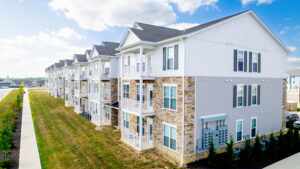

The delinquency rate for multifamily real estate varies significantly based on the type of loan and the institution holding the debt. While the broader commercial real estate market faced headwinds, multifamily performance showed signs of stabilization late in the year. The distress in multifamily loans has been more sporadic than widespread in 2025, representing a bifurcated pattern, and is the direct result of three primary factors.
- The 2025 Maturity Wall: A massive volume of loans matured in 2025. Many multifamily owners who took out low-rate, short-term bridge loans in 2021-2022 found themselves unable to refinance in 2025 since interest rates were significantly higher than they were when the existing loan first originated.
- The Record Supply Wave: 2025 saw the largest number of new apartment deliveries in decades. This oversupply, particularly in Sun Belt and Mountain West markets, forced landlords to offer heavy concessions, which eroded the net operating income (NOI) available to pay debt service.
- Surging Operating Expenses: Even as inflation cooled, specific costs like property insurance and labor skyrocketed. In states like Florida and Texas, insurance premiums have increased by 30% to 100% in a single year, eating into the profit margins of even well-occupied buildings.
Agency & Government-Sponsored Enterprises (GSEs)
GSEs and federal agencies typically report much lower delinquency rates because of stricter underwriting standards and borrower requirements.
- Fannie Mae:75%. This rate is the highest level since 2010 but still relatively low.
- Freddie Mac:48%. This is considered a multi-decade high for Freddie, slightly exceeding its previous peak during the Great Recession.
The Outlook for Agencies and GSE’s
The agencies are the “liquidity anchors” of the multifamily market. After a period of relative pullback, the 2026 outlook is one of aggressive expansion, specifically designed to address the massive wave of loan maturities and the systemic need for affordable housing.
- The Caps: The 2026 lending caps are set at $88 billion each for Fannie Mae and Freddie Mac, totaling $176 billion and representing a 20.5% increase from the 2025 caps. This increase from 2025 signals a pivot from the “cautionary” years toward a more aggressive stance to support a market recovery.
- The “Workforce” Wildcard: Loans that qualify as Workforce Housing are excluded from these caps. This means $176 billion is the floor and not a ceiling. These loans (those for middle-income renters) are often excluded from the caps meaning that the $176 billion is an actual floor and not a ceiling.
- Product Innovations: The agencies have modernized their playbooks for 2026. For example, Freddie Mac has enhanced its “Lease-Up” product, allowing developers of newly finished buildings to increase loan proceeds as they hit occupancy and NOI milestones without needing to refinance. Agencies are also using “Forward Commitments” to provide permanent rate locks for developers before construction is even finished, offering a hedge against interest rate volatility. GSEs recognize the precipitous drop in unit starts and the positive impact it will have on apartment fundamentals in the coming years.
Commercial Mortgage-Backed Securities (CMBS)
As of December of 2025, the delinquency rate for multifamily loans within the CMBS arena was approximately 6.64%. While this represents a slight improvement from the Q4 peak of nearly 7%, it remains historically high and nearly double the rate of 3.3% seen at the end of 2024. It is important to note that CMBS or securitized loans are showing much higher delinquency as opposed to other lending institutions. These loans are managed by “Special Servicers” who are legally bound by rigid contracts, making it much harder to modify a loan and more likely that a struggling loan is officially labeled “delinquent.”
The Outlook for CMBS Lenders
The 2026 outlook for CMBS lending on multifamily real estate is characterized by a “thawing” of the market. While 2025 was defined by peak supply and rising distress, 2026 is expected to see a recovery in lending volume with a strong emphasis on high-quality assets and sponsors.
- Expansion of Capacity: Total multifamily lending is expected to rise by 10–18% year-over-year. This is supported by the FHFA raising the Fannie/Freddie caps to $88 billion each, which will compete with and set the tone for CMBS pricing.
- The Potential Return of 5-Year Conduits: Borrowers are starting to pivot away from 10-year terms toward 5-year terms, betting that interest rates will be lower in the late 2020s. Credit spreads have also tightened, making fixed-rate coupons more attractive to sponsors.
- Focus on “Class A” and “Mission-Driven”: Like most lenders, the CMBS debt markets are heavily favoring stabilized Class A properties. For older “Value-Add” (Class B/C) properties, lending is much tighter unless the borrower has a significant equity position and cushion.
Commercial Banks
Commercial bank delinquency rates for multifamily real estate remained relatively stable compared to other lending sources. However, banks experienced a slight upward trend in delinquency, settling around 1.27% as of Q3 2025 (Q4 2025 not released yet). The reason the bank delinquency rate of 1.27% is so much lower than the CMBS rate of 6.64% is that banks have more flexibility in loan modifications since the loans are held on the bank’s balance sheet. For example, banks often choose to modify a loan for quality borrowers, which involves extending the loan term or allowing “interest-only” payments rather than foreclosing or flagging as delinquent.
The Outlook for Commercial Banks
The 2026 outlook for commercial bank lending in the multifamily sector is defined as “cautious re-entry.” After two years of slight retreat, banks are slowly returning to the capital stack, but they are doing so with tighter underwriting standards and a focus on identifying the high performers from the low ones.
- Lending Volume: While banks are increasing their activity, they are largely following the lead of Fannie Mae and Freddie Mac. For stabilized assets, the number of banks willing to bid on a deal has increased, signaling improved liquidity throughout the sector.
- Underwriting the New Normal: Banks in 2026 are applying a more disciplined lens to new originations. Some lenders have raised Debt Service Coverage Ratio (DSCR) benchmarks resulting in a lower Loan-to-Value (LTV). Ratio. They will rely less on “projected” rent growth and more on the Trailing 12 Operating Statement to support potential loan proceeds.
- Fresh Equity Requirements: As of early 2026, the multifamily sector is at the peak of the “multifamily maturity wall.” For borrowers with loans coming due this year, the primary challenge is the potential equity gap caused by a shift in lender requirements and interest rates. To refinance a maturing multifamily loan in 2026, some owners are finding they must inject 10% to 25% of fresh equity to bridge the gap between the old loan amount and what a new lender is willing to provide.
Life Insurance Companies (LifeCos)
In the final quarter of 2025, multifamily delinquency rates for life insurance company portfolios remained relatively low, hovering around 0.50% to 1.0%. This resilience is the result of a fundamentally different business model and risk tolerance compared to other lenders. Life insurance companies are the “pickiest” lenders in the market. These lenders don’t need to chase high-risk deals to generate returns. LifeCos need stable, predictable cash flow to pay out future insurance claims.
The Outlook for Life Insurance Company Lending
In 2026, LifeCos entered the multifamily market with aggressive allocations and a strategic pivot toward winning on price rather than leverage. After maintaining the lowest delinquency rates in the industry through 2025, they are now “leaning in” as market volatility stabilizes.
- Increased Capital Allocations: Multifamily now represents 15% to 18% of the average life insurance company general account. This represents an increase from the historical 10%–12% average, as LifeCos rotate away from other real estate asset classes. Additionally, they are allocating more capital to the “middle” of the capital stack in the form of mezzanine and preferred equity. This bridge helps sponsors who have a “funding gap” during a refinance where the new loan is smaller than the one it’s replacing.
- Loan Terms and Structural Trends: Expect life insurance companies to remain conservative on leverage while being aggressive on “spreads” (the profit margin above the Treasury rate). Most are capped out at 60% to 65% LTV based on a DSCR of 1.25x to 1.35. However, they will get slightly more aggressive for the right opportunities and quality borrowers.
- Widening the Credit Box: Like other lenders, LifeCos are revising their loan criteria to help capture this massive refinancing volume. Widening the box isn’t necessarily about being “loose” with money. It’s about life insurance companies using their capital to fill the gaps left by regional banks that are still faced with regulatory pressure.
The overall 2026 outlook for multifamily lending is characterized by renewed momentum and strategic recalibration. After several years of market volatility, the market is entering a “rebalancing phase” where capital is ample, though lenders will remain disciplined. The market has accepted that high interest rates are the new normal, which sets the stage for realistic real estate valuations. The “clog” in the lending pipeline is finally starting to clear.
Disclaimer: This document is for informational purposes only and is not financial, legal, or investment advice, nor an offer or solicitation to buy or sell securities. Investment opportunities offered by BAM Capital are made pursuant to Rule 506(c) of Regulation D and are available exclusively to accredited investors, as defined by the Securities and Exchange Commission (SEC). Verification of accredited investor status is required before participation in any investment. The information contained herein reflects the opinions of the author and does not necessarily represent the views of BAM Capital. Any financial terms, projections, or forward-looking statements contained herein are hypothetical in nature and should not be interpreted as guarantees of future performance or safety. Such statements reflect opinions and are subject to market fluctuations, economic conditions, and investment risks. Investing in private real estate securities involves significant risks, including but not limited to illiquidity, economic downturns, and potential loss of invested funds. Past performance does not guarantee future results. Prospective investors are strongly encouraged to conduct independent due diligence and consult with legal, tax, and financial advisors before making any investment decisions. The information provided in this article is current as of its publication date, September 2025. BAM Capital makes no representation or warranty regarding the accuracy or completeness of the information contained herein.
© 2026 BAM Capital. All rights reserved.
Author: Tony Landa, Senior Economic Advisor, The BAM Companies, February 2026