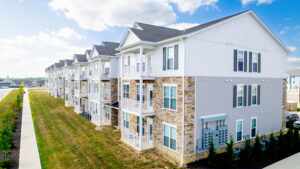

Operational value-add strategies in multifamily real estate focus on enhancing property value through improved management and operational efficiencies, rather than major renovations. This approach can include optimizing utility usage, implementing cost-saving measures, improving resident retention, and streamlining property management processes. The goal with an operational value-add strategy is to increase the property’s net operating income (NOI) and its overall value while minimizing the execution risk.
Examples of Operational Value-Add Strategies
- Improving Resident Screening and Selection: Implementing thorough background checks and resident selection processes can reduce the risk of problematic residents and minimize future vacancies. It is necessary to develop a clear, consistent, and legally compliant screening policy which can reduce bad debt and improve turnover costs. For example, reducing delinquency on a 200-unit apartment building with an average rent of $2,000 by 2% adds $96,000 in annual effective gross income. If enhanced screening reduces your annual turnover rate from 50% to 40% in a 100-unit building, an owner can save roughly $50,000/year in direct costs (10 fewer turns @ $5k/turn).
- Streamlining Rent Collection and Accounting: Utilizing property management software with features like online rent payments, automated accounting, and robust reporting tools can automate tasks, reduce errors, and provide valuable financial insights. For example, automated systems can save an onsite team 10–20 hours per week on rent-related administrative tasks. If a manager earning $30/hour saves 15 hours a week, the property saves $23,400 per year in labor costs. In a larger portfolio, this “scalability” allows one person to manage 300 units instead of 200, reducing the operating expense ratio.
- Enhancing Property Maintenance and Repairs: Implementing preventative maintenance programs and responding promptly to maintenance requests can improve resident satisfaction and reduce costly repairs or replacements. Reactive maintenance is inherently expensive. Emergency repairs (e.g., a burst pipe at midnight) often cost 3–5x more than planned work due to after-hours labor rates and expedited parts shipping. For a large portfolio, shifting from reactive to proactive maintenance typically cuts overall maintenance costs by 12–18% and can deliver an above-average return on investment.
- Optimizing On-Site Staffing and Personnel: Evaluating staffing levels and ensuring efficient workflows can reduce labor costs and improve overall operational efficiency. It is essential to determine the appropriate resident-to-staff ratio based on the property’s size, amenities, and the level of service offered. The industry benchmark is typically one office and one maintenance staff member for every 100 units, but this ratio can vary. However, optimized assets use technology to shift this ratio from 100 units to 120 or 150 units, reducing the total payroll burden without sacrificing service. If the average all-in cost of a leasing manager is $65,000/year, removing one redundant position increases the property’s value by $1.3 Million at a 5% Cap Rate ($65,000 / 5.0%).
- Improving Resident Communication and Engagement: Implementing regular communication channels and resident events can foster a sense of community, improve resident satisfaction, and reduce turnover rates. Improved resident communication and engagement convert “renters” into “stakeholders.” Quantitatively, this transition is measured through resident retention rates and referral revenue, all of which contribute to a more stable and valuable asset. The core financial principle is that it is often $4,000 to $6,000 per unit cheaper to keep an existing resident than to sign a new one.
- Negotiating Favorable Vendor Contracts: Reviewing and renegotiating vendor contracts for services such as landscaping, trash removal, and insurance can lead to substantial cost savings. Favorable agreements not only lower operating costs but can also ensure quality service. Individual properties often pay “retail” rates. Negotiating a portfolio-wide contract typically yields 10–15% savings compared to individual property agreements. If five properties each spend $20,000/year on landscaping ($100,000 total), a consolidated contract at a 12% discount saves $12,000 annually across the portfolio.
- Implementing Energy-Efficient Upgrades: Implementing energy-efficient upgrades in apartment communities involves a range of strategies aimed at reducing energy consumption, lowering utility costs, and enhancing the property’s sustainability. Key areas include optimizing building envelopes, upgrading HVAC systems, installing efficient lighting and appliances, and integrating smart technology. Quantitatively, these upgrades act as a hedge against rising utility costs and provide some of the fastest payback periods in the multifamily industry. Comprehensive energy retrofits can reduce whole-building energy use by 15–30%. For a property spending $100,000 annually on utilities, a 20% reduction adds $20,000 directly to the annual NOI.
- Economies of Scale: This refers to the cost advantages that arise from operating a larger number of units within a single property or building, resulting in lower per-unit costs compared to managing individual properties. This concept is a major draw for investors in the multifamily sector, as it can significantly enhance profitability.
The Benefits of Improved Operations
- Maximized Returns and Increased Profitability: Effective property management optimizes operations, reduces costs, and maximizes revenue, leading to a higher return on investment (ROI).
- Operating Cost Reductions: Implementing strategies such as energy-efficient upgrades, optimizing staffing, and renegotiating vendor contracts can help lower your controllable operating expenses.
- Property Valuation: Improving the operations of a multifamily property can significantly enhance its valuation. A higher valuation is fundamental if the owner decides to refinance or sell.
- Resident Satisfaction: Well-maintained properties with efficient operations, enhanced amenities, and responsive management can lead to higher resident retention and reduced turnover costs.
- Tax Benefits: Value-add strategies, like energy efficiency upgrades, may qualify for tax credits or deductions, further enhancing returns. Additionally, cost segregation is a powerful tax strategy that enables multifamily property owners to accelerate the depreciation of specific building components, resulting in substantial tax savings.
- Protection Against Market Downturns: Properties with strong operations and higher NOI will be more resilient during economic downturns, as increased efficiency can help mitigate the risk of lower rental rates and occupancy.
The focus on operational improvements in the multifamily sector is a strategic approach that drives efficiency, reduces costs, boosts resident satisfaction, and unlocks significant value for investors. Experienced multifamily operators concentrate on these operational aspects that are within their control, as they directly affect the investment’s success and resilience during market fluctuations.
The BAM Companies is an operator at its core. The organization conducts a comprehensive due diligence process during the acquisition to identify opportunities for operational improvements and create value.
For example, BAM Management will scrutinize operating expenses to determine if resources can be shared across other properties it owns, thereby reducing payroll costs. Repairs and maintenance are completed in-house by a dedicated team that handles all property upkeep and repair needs, which helps control costs. Ancillary income is another example. The company will seek to maximize ancillary income, including utility reimbursements, garages/carports, storage, valet trash, pet-friendly amenities, and smart home features. The beauty of these other income line items lies in the cap rate. Because these income streams go straight to the bottom line, a small increase in monthly income creates a massive jump in property value. For example, If you add a $25/month valet trash fee across a 100-unit building, you increase annual NOI by $30,000. At a 5% cap rate, you’ve just added $600,000 to the property’s total value.
By understanding resident needs and providing convenient, high-quality options while reducing operating costs, BAM Management can significantly boost revenue beyond the actual rent. These operational value-add strategies are a consistent theme in The BAM Companies’ success.
Disclaimer: This document is for informational purposes only and is not financial, legal, or investment advice, nor an offer or solicitation to buy or sell securities. Investment opportunities offered by Bam Capital are made pursuant to Rule 506(c) of Regulation D and are available exclusively to accredited investors, as defined by the Securities and Exchange Commission (SEC). Verification of accredited investor status is required before participation in any investment. The information contained herein reflects the opinions of the author and does not necessarily represent the views of Bam Capital. Any financial terms, projections, or forward-looking statements contained herein are hypothetical in nature and should not be interpreted as guarantees of future performance or safety. Such statements reflect opinions and are subject to market fluctuations, economic conditions, and investment risks. Investing in private real estate securities involves significant risks, including but not limited to illiquidity, economic downturns, and potential loss of invested funds. Past performance does not guarantee future results. Prospective investors are strongly encouraged to conduct independent due diligence and consult with legal, tax, and financial advisors before making any investment decisions. Bam Capital makes no representation or warranty regarding the accuracy or completeness of the information contained herein.
© 2025 Bam Capital. All rights reserved.
Author: Tony Landa, Senior Economic Advisor, The BAM Companies, November 2025